
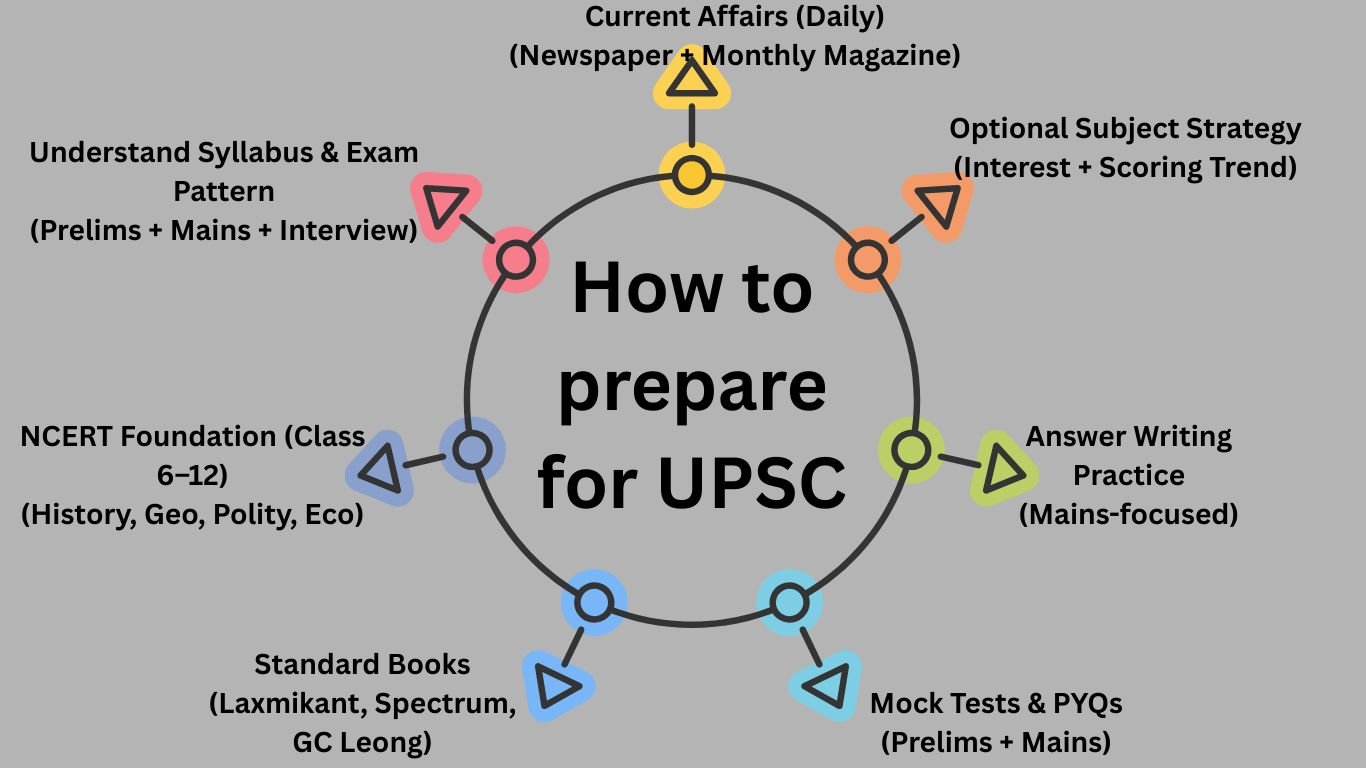
A Complete Beginner-to-Advanced Strategy for Civil Services Aspirants
Preparing for the UPSC Civil Services Examination is not just about reading books or studying for long hours. It is about clarity, consistency, and correct strategy.
Every year, more than 10 lakh candidates apply for UPSC, but only a few hundred finally succeed. The difference between success and failure is not intelligence, but planned preparation.
If you are asking:
- How should I start UPSC preparation?
- What should I study first?
- How to prepare for Prelims and Mains together?
- Can a beginner crack UPSC?
👉 This article answers all these questions in simple, clear English, step by step.
1. Introduction: Why UPSC Preparation Needs a Strategy
UPSC is not an exam you can crack by:
- Studying randomly
- Following too many sources
- Copying someone else’s timetable blindly
UPSC tests:
- Understanding, not memorization
- Consistency, not shortcuts
- Thinking ability, not coaching dependence
👉 The right preparation strategy saves:
- Time
- Energy
- Attempts
That is why learning how to prepare for UPSC is more important than asking what books to read.
2. What Is UPSC and Why Is It So Important?
What Is UPSC?
UPSC (Union Public Service Commission) is a constitutional body that conducts examinations for recruiting officers to:
- IAS (Indian Administrative Service)
- IPS (Indian Police Service)
- IFS (Indian Foreign Service)
- IRS and other Central Services
These officers:
- Run the administration
- Implement government policies
- Maintain law, order, and governance
Why UPSC Is Important for the Country
UPSC ensures:
- Merit-based recruitment
- Political neutrality
- Efficient governance
Without UPSC:
- Administration could become biased
- Political interference could increase
👉 Preparing for UPSC means preparing to serve the nation responsibly.
3. Understand the UPSC Exam Structure (Very Important)
Before studying anything, you must understand what UPSC actually demands.
UPSC Has Three Stages:
- Preliminary Examination
- Objective type (MCQs)
- General Studies Paper I
- CSAT (Qualifying)
👉 Purpose: Filtering candidates
- Mains Examination
- Descriptive answer writinghttps://iascoachingdelhi.com/how-to-write-essay-in-upsc/
- 9 papers (GS, Essay, Optional)
👉 Purpose: Testing depth, analysis, and expression
- Interview (Personality Test)
- Board interaction
- Tests personality, ethics, awareness
👉 Purpose: Selecting administrators, not bookworms
4. Step-by-Step Guide: How to Prepare for UPSC
Step 1: Understand the Syllabus Line by Line
UPSC syllabus is your Bible.
Do this first:
- Download official syllabus
- Read it multiple times
- Break it into micro-topics
Example:
- “Indian Polity” does not mean only Constitution
- It includes:
- Governance
- Parliament
- Judiciary
- Constitutional bodies
👉 Never study anything outside the syllabus unless required.
Step 2: Build Strong NCERT Foundation
NCERTs are non-negotiable, especially for beginners.
Start with:
- History (Class 6–12)
- Geography (Class 6–12)
- Polity (Class 9–12)
- Economy (Class 9–12)
- Science (Class 6–10)
Why NCERTs?
- Simple language
- Conceptual clarity
- UPSC-oriented facts
👉 Many Prelims questions come directly from NCERT concepts.
Step 3: Standard Reference Books (Limited Sources)
After NCERTs, move to standard books only.
Examples:
- Polity – Laxmikanth
- History – Spectrum, Old NCERTs
- Geography – GC Leong
- Economy – Basic economy book + current affairs
👉 One subject = one book
Multiple books = confusion.
5. Preparing for Prelims and Mains Together
A common beginner mistake is preparing Prelims and Mains separately.
This is wrong.
How to Integrate Both:
- Read topics with analytical depth
- Make short notes
- Practice MCQs and answer writing together
Example:
- Topic: Fundamental Rights
- Prelims: Articles, facts
- Mains: Issues, judgments, limitations
👉 Integrated preparation saves time and improves quality.
6. Importance of Current Affairs in UPSC Preparation
UPSC is not about static knowledge alone.
How to Study Current Affairs:
- Read one standard newspaper daily
- Focus on:
- Polity
- Economy
- Environment
- International relations
Avoid:
- Political news
- Sensational stories
👉 Link current affairs with static syllabus.
7. Answer Writing Practice (Game Changer)
Many aspirants fail in Mains because:
- They know answers
- But cannot write properly
Start Answer Writing Early:
- Begin with 1–2 answers daily
- Follow structure:
- Introduction
- Body
- Conclusion
Benefits:
- Improves speed
- Improves clarity
- Improves confidence
8. Mock Tests and Revision Strategy
Importance of Mock Tests:
- Simulates exam pressure
- Identifies weak areas
- Improves time management
Revision Rule:
- Revise at least 3–4 times
- Short notes are crucial
- Last 2 months = only revision + tests
👉 UPSC is won in revision, not in reading new material.
9. Mental Health and Consistency
UPSC preparation is a long journey.
To survive:
- Avoid comparison
- Maintain routine
- Take breaks
- Stay physically active
👉 A healthy mind prepares better than a stressed one.
10. UPSC Exam Relevance (Prelims & Mains)
Prelims:
- Concept clarity
- Facts + application
- Elimination techniques
Mains:
- Analytical answers
- Examples
- Constitutional references
👉 Strategy-based preparation benefits all three stages.
11. Common Mistakes Aspirants Must Avoid
- Starting without syllabus clarity
- Changing books repeatedly
- Ignoring answer writing
- Over-dependence on coaching
- Studying without revision
12. Conclusion: UPSC Is Tough, But Achievable
UPSC is not impossible.
It is difficult by design, not by destiny.
Key takeaways:
- Understand the exam
- Build strong basics
- Practice consistently
- Revise multiple times
- Stay patient and disciplined
👉 UPSC rewards clarity, not chaos.
If you prepare with the right strategy, even an average student can become an IAS officer.