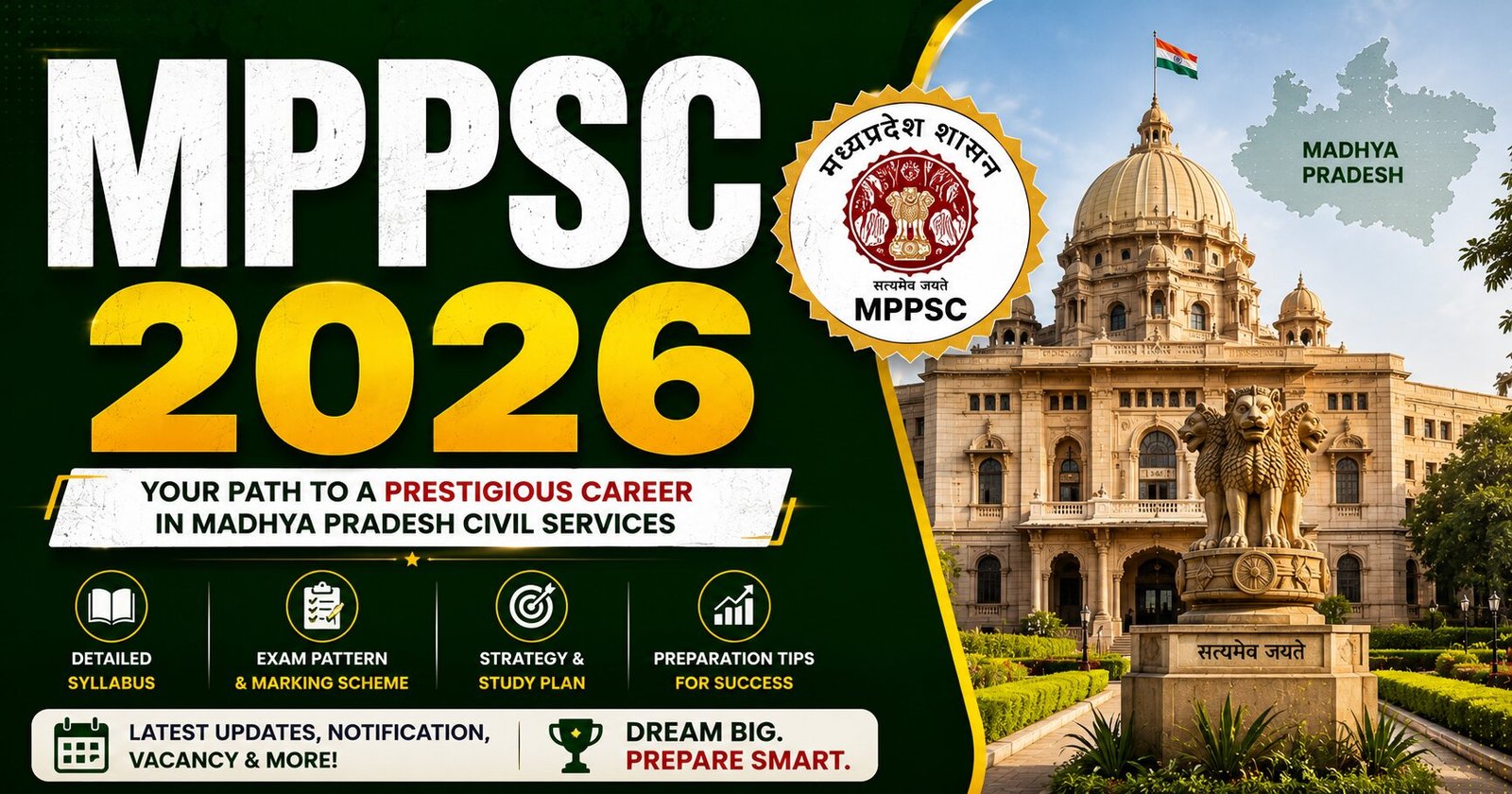
Introduction
Every year, thousands of aspirants across Madhya Pradesh prepare for one of the state’s most prestigious competitive examinations—the MPPSC examination. Conducted by the Madhya Pradesh Public Service Commission, this recruitment process opens doors to various administrative and government positions, making it a preferred career choice for graduates seeking stability, authority, and public service opportunities.
With increasing competition and evolving exam patterns, understanding every aspect of the examination is crucial before starting preparation. From eligibility requirements and age criteria to syllabus coverage and selection procedures, candidates need a clear roadmap to succeed. This comprehensive guide covers everything you need to know about MPPSC 2026, helping aspirants build a strong foundation for their preparation journey.
What is MPPSC?
The Madhya Pradesh Public Service Commission conducts state civil services examinations to recruit candidates for various administrative departments within the state government.
The examination serves as the gateway to prestigious positions such as:
- Deputy Collector
- Deputy Superintendent of Police (DSP)
- Commercial Tax Officer
- Block Development Officer
- Chief Municipal Officer
- District Registrar
- Cooperative Inspector
- Various State Administrative Services
The recruitment process is designed to identify candidates with strong analytical abilities, administrative aptitude, leadership qualities, and decision-making skills.
For many graduates, clearing the State Civil Services Examination is a stepping stone toward a respected and impactful career in public administration.
MPPSC 2026 Notification Overview
The official notification is expected to provide complete information regarding vacancies, eligibility conditions, application dates, examination schedules, and selection procedures.
Candidates should carefully review the notification before submitting their applications to ensure they meet all eligibility requirements.
Important Information Covered in the Notification
- Application process
- Vacancy details
- Eligibility conditions
- Age requirements
- Reservation policies
- Exam pattern
- Syllabus details
- Selection stages
- Interview guidelines
A thorough understanding of the notification helps candidates avoid mistakes during the application process.
Why is MPPSC Popular Among Aspirants?
Government jobs continue to attract candidates due to their stability and career growth opportunities. State civil services offer a unique combination of responsibility, authority, and social impact.
Some key reasons aspirants choose this career path include:
- Job security
- Attractive salary structure
- Pension and retirement benefits
- Administrative authority
- Career progression opportunities
- Social prestige
- Work-life balance
Unlike many private-sector careers, state administrative services provide long-term stability along with opportunities to contribute directly to public welfare and governance.
MPPSC Eligibility Criteria 2026
Understanding eligibility requirements is the first step before applying.
Educational Qualification
Candidates must possess a bachelor’s degree from a recognized university.
Accepted qualifications include:
- BA
- BSc
- BCom
- BBA
- BCA
- Engineering degrees
- Professional qualifications recognized by universities
Final-year students may also be eligible subject to conditions specified in the official notification.
Nationality Requirements
Applicants must be Indian citizens.
Certain positions may require candidates to fulfill additional state-specific requirements.
Physical Standards
For posts such as Deputy Superintendent of Police and similar services, specific physical standards may apply.
Candidates should carefully verify post-wise requirements before applying.
MPPSC Age Limit 2026
Age eligibility remains one of the most important aspects of the application process.
Generally, candidates applying for state services must fall within the prescribed age bracket specified in the notification.
Age Relaxation
Various categories may receive relaxation benefits according to government rules.
Common categories eligible for relaxation include:
- Scheduled Castes
- Scheduled Tribes
- Other Backward Classes
- Government employees
- Women candidates
- Persons with Disabilities
Applicants should refer to official guidelines for category-specific relaxation provisions.
Selection Process
The recruitment procedure typically consists of three major stages.
Stage 1: Preliminary Examination
This is a screening examination designed to shortlist candidates for the next stage.
The marks obtained in prelims generally do not count toward the final merit list.
Stage 2: Main Examination
Candidates who qualify for the preliminary stage appear for the mains examination.
This stage evaluates:
- Subject knowledge
- Analytical thinking
- Writing ability
- Administrative understanding
- General awareness
Stage 3: Interview
Candidates who clear the mains examination are invited for a personality assessment.
The interview panel evaluates:
- Communication skills
- Leadership qualities
- Decision-making ability
- Administrative aptitude
- Current affairs awareness
The final merit list is prepared based on mains and interview performance.
MPPSC Exam Pattern 2026
A clear understanding of the exam pattern helps candidates create an effective preparation strategy.
Preliminary Examination
The preliminary stage generally consists of two papers:
| Paper | Subject |
| Paper I | General Studies |
| Paper II | Aptitude Test |
The preliminary examination serves as a qualifying stage.
Main Examination
The mains examination is more comprehensive and descriptive in nature.
It typically includes papers covering:
- General Studies
- Constitution and Governance
- Science and Technology
- Economics
- History and Culture
- Essay Writing
- Hindi Language
This stage demands conceptual clarity and strong answer-writing skills.
MPPSC Syllabus 2026
One of the biggest challenges for aspirants is managing the extensive syllabus.
Instead of studying randomly, candidates should divide the syllabus into manageable sections.
History
Topics often include:
- Ancient India
- Medieval India
- Modern Indian History
- Freedom Movement
- Madhya Pradesh History
Geography
Important areas include:
- Physical Geography
- Indian Geography
- World Geography
- Environment
- Natural Resources
Polity and Governance
Candidates should focus on:
- Indian Constitution
- Parliament
- Judiciary
- Fundamental Rights
- Panchayati Raj
- Governance Mechanisms
Economy
Key topics include:
- Indian Economy
- Economic Development
- Budget
- Banking
- Agriculture
- Government Schemes
Science and Technology
Subjects typically include:
- Physics basics
- Chemistry basics
- Biology
- Information Technology
- Space Technology
- Emerging Technologies
Current Affairs
Regular newspaper reading remains essential.
Candidates should focus on:
- National events
- International developments
- Government schemes
- Economic updates
- Science and technology news
Best Strategy for MPPSC Preparation
Success requires consistency rather than last-minute effort.
Build Strong Fundamentals
Start with basic NCERT books to develop conceptual clarity.
Strong fundamentals make advanced topics easier to understand.
Create a Study Plan
A structured timetable helps maintain discipline.
Allocate separate time slots for:
- Static subjects
- Current affairs
- Revision
- Mock tests
Practice Answer Writing
The mains examination rewards clarity and presentation.
Daily answer-writing practice improves:
- Speed
- Structure
- Analytical ability
- Content quality
Solve Previous Year Papers
Past papers help identify:
- Frequently asked topics
- Question patterns
- Difficulty levels
Regular Revision
Revision is often more important than studying new material continuously.
Many successful candidates revise the same topics multiple times before the examination.
Common Mistakes Aspirants Should Avoid
Many candidates work hard but fail due to avoidable mistakes.
Studying Without a Plan
Random preparation leads to confusion and poor retention.
Ignoring Current Affairs
Current events influence both prelims and mains examinations.
Excessive Resource Collection
Collecting too many books often reduces productivity.
Lack of Revision
Without revision, information fades quickly.
Neglecting Answer Writing
Knowledge alone is not sufficient; presentation matters significantly in descriptive examinations.
Avoiding these mistakes can improve overall performance considerably.
Recommended Resources
Candidates should focus on quality resources rather than quantity.
Useful Study Sources
- NCERT textbooks
- Standard reference books
- Government reports
- Current affairs magazines
- Economic Survey
- Budget highlights
Selecting limited but reliable resources helps maintain consistency.
Time Management Tips
Managing time effectively can significantly improve preparation quality.
Daily Study Approach
A balanced routine may include:
- Concept learning
- Current affairs reading
- Practice questions
- Revision sessions
Breaking study sessions into smaller goals improves concentration and productivity.
Career Opportunities After Selection
Clearing the examination opens the door to various administrative services.
Selected candidates may work in areas such as:
- Revenue administration
- Law enforcement
- Rural development
- Municipal administration
- Taxation departments
- Cooperative management
These roles provide opportunities to influence governance and public welfare directly.
Why Quality Guidance Matters
Preparing for competitive examinations can sometimes feel overwhelming due to the vast syllabus and intense competition.
Professional mentoring can help aspirants:
- Understand exam trends
- Build effective strategies
- Improve answer writing
- Manage preparation efficiently
Many candidates seek structured guidance through specialized civil services coaching platforms and mentorship programs to streamline their preparation journey.
Conclusion
The upcoming MPPSC 2026 examination offers an excellent chance for those who dream of having a satisfying career in the field of state administration. Knowing the eligibility conditions, subject areas, age restrictions, and examination pattern will be extremely helpful while preparing for the test.
To pass the examination of the State Civil Service, one should display self-discipline, effective planning, and hard work. The primary emphasis should be placed not on the competitors but on working on basic knowledge, developing writing skills, and revising material on a regular basis.
FAQs
Q.1 What is MPPSC?
MPPSC is the Madhya Pradesh Public Service Commission examination conducted to recruit candidates for various state administrative and government services.
Q.2 What is the educational qualification required for MPPSC 2026?
Candidates must possess a bachelor’s degree from a recognized university to apply for most posts.
Q.3 How many stages are there in the selection process?
The recruitment process generally consists of Preliminary Examination, Main Examination, and Interview.
Q.4 Is current affairs important for MPPSC preparation?
Yes, current affairs play an important role in both preliminary and main examinations and should be studied regularly.
Q.5 How much time is required to prepare for MPPSC?
Preparation time varies by individual, but most successful candidates typically dedicate several months of focused and consistent study before the examination.