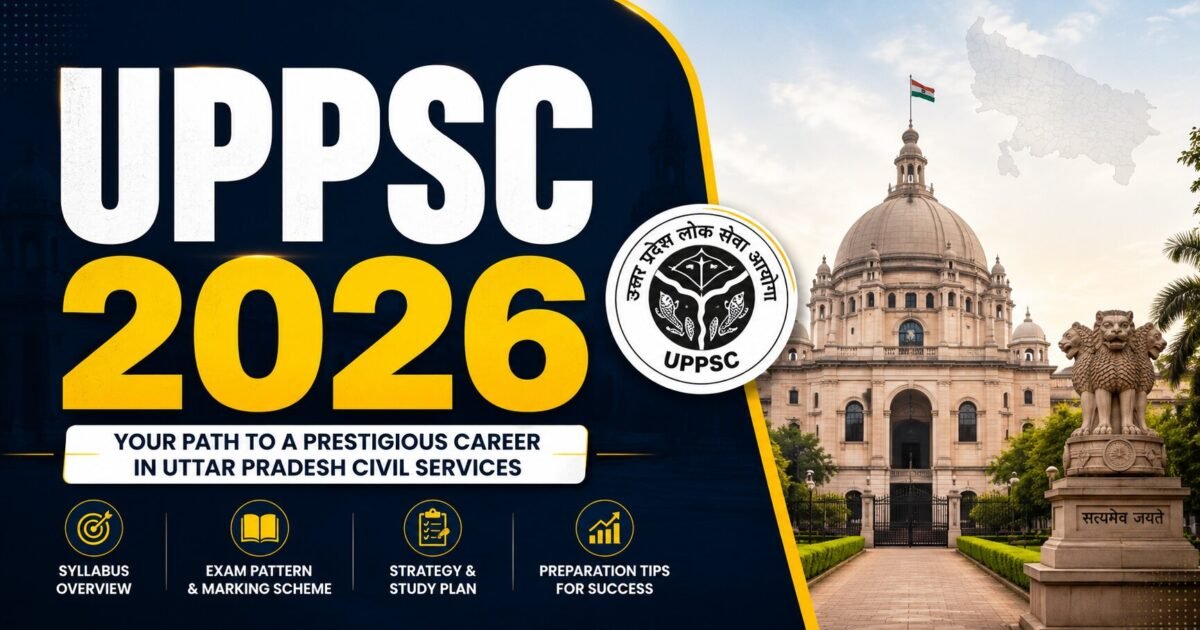
Introduction
For thousands of aspirants aiming to secure a prestigious government position in Uttar Pradesh, the UPPSC examination remains one of the most sought-after competitive exams in India. Conducted by the Uttar Pradesh Public Service Commission, this recruitment process opens the door to various administrative and civil service positions within the state government.
Every year, candidates begin their preparation months in advance to improve their chances of selection. Understanding the notification details, eligibility criteria, age requirements, syllabus, exam pattern, and preparation strategy is essential for success. This comprehensive guide covers everything aspirants need to know about the upcoming recruitment cycle while maintaining a practical and easy-to-understand approach.
What is UPPSC?
The Uttar Pradesh Public Service Commission is the constitutional body responsible for recruiting candidates for various state government departments and administrative services.
The commission conducts several examinations throughout the year, but the most prominent is the Provincial Civil Services (PCS) Examination. Through this process, candidates are selected for key administrative roles that contribute to governance and public administration across Uttar Pradesh.
The examination is highly competitive because it offers:
- Job security
- Attractive salary packages
- Administrative authority
- Career growth opportunities
- Social prestige
As a result, lakhs of candidates apply every year for a limited number of vacancies.
UPPSC 2026 Notification Overview
The official notification is expected to provide complete information regarding:
- Number of vacancies
- Important dates
- Application process
- Eligibility conditions
- Exam pattern
- Syllabus
- Reservation criteria
- Selection process
Candidates should carefully read the official notification before applying.
Expected Highlights
| Particulars | Details |
| Conducting Body | Uttar Pradesh Public Service Commission |
| Examination Level | State Civil Services |
| Mode of Examination | Offline |
| Selection Process | Prelims, Mains, Interview |
| Job Location | Uttar Pradesh |
| Official Language | Hindi & English |
The notification serves as the foundation for a candidate’s preparation strategy and application process.
Why is UPPSC a Popular Career Choice?
State civil services provide a rewarding and respected career path.
Many candidates prefer this examination because it offers:
- Administrative responsibilities
- Opportunities to serve society
- Stable government employment
- Promotions and career advancement
- Financial security
Selected officers often work in crucial departments involving revenue, development, public welfare, law and order, and governance.
The combination of authority and public service makes it an attractive career option for graduates.
UPPSC Eligibility Criteria
Before applying, candidates must ensure they meet the prescribed eligibility conditions.
Educational Qualification
Applicants must possess a bachelor’s degree from a recognized university.
The degree can belong to any stream, including:
- Arts
- Science
- Commerce
- Engineering
- Management
Final-year students may also be eligible depending on notification guidelines.
Nationality
Candidates must be Indian citizens.
Certain posts may have additional conditions specified by the commission.
Number of Attempts
Unlike UPSC Civil Services Examination, there is generally no fixed restriction on attempts.
Candidates can continue applying until they cross the upper age limit.
This provides flexibility for aspirants preparing over multiple years.
Age Limit for UPPSC 2026
Age eligibility is one of the most important factors candidates must verify.
Expected Age Criteria
| Category | Age Limit |
| General Category | 21 to 40 Years |
| OBC Category | Age Relaxation Applicable |
| SC/ST Category | Age Relaxation Applicable |
| PwD Category | Additional Relaxation Applicable |
The exact age calculation date will be mentioned in the official notification.
Candidates should review age-related provisions carefully before submitting applications.
Selection Process
The recruitment process consists of three stages.
Stage 1: Preliminary Examination
The preliminary stage acts as a screening test.
It consists of objective-type questions covering various subjects.
Marks obtained in prelims are generally not counted in the final merit list.
However, qualifying this stage is mandatory to proceed further.
Stage 2: Main Examination
The mains examination is descriptive in nature.
This stage evaluates:
- Analytical ability
- Subject knowledge
- Writing skills
- Administrative understanding
Performance in mains significantly impacts final selection.
Stage 3: Personality Test
Candidates clearing the written stages appear for an interview.
The board assesses:
- Communication skills
- Decision-making ability
- Leadership qualities
- Administrative aptitude
- General awareness
The interview plays a crucial role in determining the final merit ranking.
Understanding the Exam Pattern
A clear understanding of the examination structure helps candidates prepare strategically.
Preliminary Examination
The preliminary stage generally includes:
Paper I
Subjects include:
- History
- Geography
- Polity
- Economy
- Environment
- Science
- Current Affairs
Paper II (CSAT)
Includes:
- Reasoning
- Comprehension
- Decision Making
- Basic Mathematics
Paper II is qualifying in nature.
Main Examination Structure
The mains examination typically includes:
- General Hindi
- Essay
- General Studies Papers
- Optional Subject Papers (as applicable under revised patterns)
Candidates must develop strong answer-writing skills for this stage.
Detailed Syllabus Overview
Aspirants often make the mistake of studying without understanding the syllabus.
A structured approach begins with syllabus analysis.
History
Topics generally include:
- Ancient India
- Medieval India
- Modern India
- Freedom Movement
- National Movement
History forms an important part of both prelims and mains preparation.
Geography
Candidates should focus on:
- Physical Geography
- Indian Geography
- Uttar Pradesh Geography
- Environmental Issues
- Natural Resources
Map-based understanding can significantly improve retention.
Indian Polity
Key topics include:
- Constitution
- Fundamental Rights
- Parliament
- Judiciary
- Governance
- Panchayati Raj
Polity remains one of the highest-scoring subjects.
Economy
Important areas include:
- Economic Development
- Budget
- Inflation
- Banking
- Government Schemes
- Agriculture
Candidates should connect static concepts with current developments.
Science and Technology
Questions generally focus on:
- Basic Science
- Biotechnology
- Space Technology
- Computer Awareness
- Emerging Technologies
Conceptual clarity is more important than memorization.
Current Affairs
Current affairs often determine overall performance.
Focus on:
- Government Schemes
- International Relations
- Awards
- Sports
- Economic Developments
- Uttar Pradesh-specific news
Regular newspaper reading is essential.
Best Preparation Strategy
Success depends more on consistency than on studying for long hours.
A well-planned strategy helps aspirants stay focused.
Step 1: Understand the Syllabus
Start by thoroughly reviewing the syllabus.
Every topic should be linked to relevant study resources.
Step 2: Build Strong Fundamentals
NCERT books remain an excellent starting point.
They help establish conceptual clarity before moving to advanced materials.
Step 3: Create a Realistic Timetable
A balanced study plan should include:
- Subject study
- Revision
- Current affairs
- Mock tests
Consistency is more effective than short bursts of intensive study.
Step 4: Practice Previous Year Papers
Previous papers help candidates understand:
- Question trends
- Difficulty level
- Important topics
- Time management
This practice builds confidence before the actual examination.
Step 5: Focus on Answer Writing
Many candidates clear prelims but struggle in mains.
Daily answer-writing practice improves:
- Presentation
- Structure
- Speed
- Analytical thinking
This is one of the most important skills for mains success.
Common Mistakes to Avoid
Many aspirants repeat similar errors during preparation.
Avoid These Mistakes
- Ignoring the syllabus
- Reading too many books
- Skipping revision
- Neglecting current affairs
- Avoiding mock tests
- Poor time management
A focused strategy usually delivers better results than excessive resource collection.
Importance of Current Affairs
Current affairs influence both prelims and mains.
Candidates should follow:
- National news
- State government initiatives
- International developments
- Economic updates
- Government policies
Maintaining concise notes can simplify revision.
Time Management Tips
Effective time management can dramatically improve preparation quality.
Practical Suggestions
- Set daily targets
- Prioritize weak subjects
- Allocate revision slots
- Limit distractions
- Track progress weekly
Even small improvements in productivity accumulate over time.
Role of Coaching and Guidance
Self-study remains important, but structured guidance can accelerate preparation.
Many aspirants choose professional mentoring for:
- Study planning
- Answer writing
- Mock tests
- Current affairs analysis
- Interview guidance
The right support system can reduce confusion and improve consistency.
Career Opportunities After Selection
Successful candidates may be appointed to various administrative positions.
Potential roles include:
- Deputy Collector
- Block Development Officer
- District Administrative Officer
- Assistant Commissioner
- Treasury Officer
These positions offer opportunities to directly contribute to governance and public welfare.
Conclusion
Getting prepared for the UPPSC 2026 calls for a lot of hard work, good planning, and dedication. Knowing the eligibility conditions, age criteria, syllabus, examination format, and recruitment process would provide you with a firm base to prepare well for the same. The aspirants who take the examinations seriously and have a long-term perspective do well compared to those who study intensely just before the examination.
This task might prove difficult, but at the same time the rewards will not disappoint you if you have prepared well for the same. It is necessary to build yourself up gradually through adequate revision, good current affairs, and preparation consistently in order to make a mark in the Uttar Pradesh state services.
FAQs
Q.1 What is the minimum qualification required for UPPSC?
Candidates must possess a bachelor’s degree from a recognized university to apply for most posts.
Q.2 What is the age limit for UPPSC 2026?
The expected age range is 21 to 40 years for the general category, with relaxation available for reserved categories as per government rules.
Q.3 How many stages are there in the selection process?
The recruitment process generally consists of Preliminary Examination, Main Examination, and Interview.
Q.4 Is current affairs important for UPPSC preparation?
Yes, current affairs play a major role in both the preliminary and main examinations and should be studied regularly.
Q.5 How much time is needed to prepare for UPPSC?
Most successful candidates dedicate 8–12 months of focused preparation, depending on their academic background and familiarity with the syllabus.