
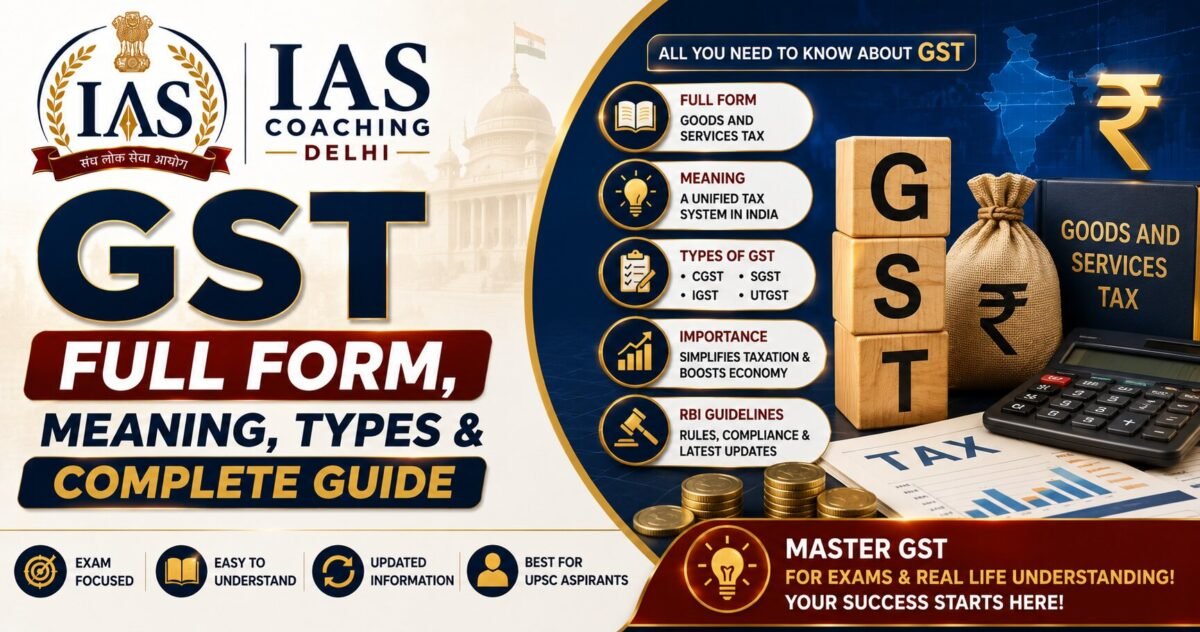
The GST acronym can be seen by taxpayers, businessmen, and entrepreneurs in India almost on a daily basis. No matter whether you are registering your business or preparing invoices, having an insight into the meaning and effect of the GST Full Form is important. From the time of its implementation in 2017, the Goods and Services Tax has become one of the biggest changes in the Indian indirect tax regime due to its replacement of several taxes.
In case you are considering starting up or expanding a business in the future or need to learn about the impact of GST on consumers and businesses, then this article will be quite useful. We will be using no fancy technical language to explain each concept.
What is the GST Full Form?
The GST Full Form is Goods and Services Tax. It is a destination-based indirect tax that is charged on the supply of goods and services across India.
Before GST was introduced, businesses had to deal with several different taxes, including VAT, Service Tax, Excise Duty, Entry Tax, and Luxury Tax. Managing multiple tax systems increased compliance costs and created unnecessary complexity. The introduction of GST simplified this process by bringing most indirect taxes under one framework.
Today, GST applies to almost every stage of the supply chain. Businesses collect tax from customers and deposit it with the government while claiming eligible Input Tax Credit (ITC). This system reduces the cascading effect of taxes and improves transparency.
Why Was GST Introduced in India?
Before GST, India’s indirect taxation system was complicated. Different states followed different tax structures, making interstate trade difficult for businesses. Companies often paid tax on tax, which increased the final price of products.
The government introduced GST to create “One Nation, One Tax.” The objective was to simplify taxation, improve compliance, and encourage economic growth.
Some major objectives include:
- Creating a unified tax system across India
- Eliminating multiple indirect taxes
- Reducing the cascading tax effect
- Improving tax transparency
- Encouraging ease of doing business
- Supporting digital tax compliance
The implementation of GST has significantly changed the way businesses manage taxation, invoicing, and return filing.
Understanding How GST Works
One of the biggest advantages of GST is its systematic structure. Instead of paying different taxes separately, businesses now follow a standardized tax mechanism.
Here’s a simple example.
Suppose a manufacturer sells a product to a wholesaler. GST is charged on the sale. Later, when the wholesaler sells it to the retailer, GST is again charged. However, the wholesaler can claim credit for the tax already paid while purchasing the product. This process continues until the product reaches the final consumer.
This mechanism is called Input Tax Credit (ITC) and is one of the biggest reasons why GST is considered more efficient than the previous tax system.
Types of GST in India
Many people know the GST Full Form, but they often get confused about its different types.
India follows four major GST categories depending on the nature of the transaction.
CGST (Central Goods and Services Tax)
CGST is collected by the Central Government whenever goods or services are sold within the same state.
For example, if a business in Delhi sells products to another business in Delhi, CGST will apply along with SGST.
SGST (State Goods and Services Tax)
SGST is collected by the respective State Government on intra-state transactions.
Both CGST and SGST are charged together when the supplier and buyer are located in the same state.
IGST (Integrated Goods and Services Tax)
IGST applies when goods or services move from one state to another.
For example, if a company in Maharashtra sells products to a customer in Rajasthan, Integrated GST is charged instead of CGST and SGST separately.
This system simplifies interstate trade and avoids multiple taxation.
UTGST (Union Territory Goods and Services Tax)
UTGST is applicable in Union Territories that do not have their own legislature.
It works similarly to SGST but is specifically designed for Union Territories.
Key Features of GST
The Goods and Services Tax introduced several improvements over the earlier taxation system.
Some of its most important features include:
- One unified indirect tax structure
- Digital registration process
- Online return filing
- Transparent tax collection
- Input Tax Credit facility
- Simplified compliance
- Better tracking through GSTIN
- Reduced tax cascading
- Uniform taxation across India
These features have helped businesses streamline their tax management while improving transparency for both taxpayers and authorities.
Benefits of GST for Businesses
GST has changed the way businesses operate in India. While compliance remains important, the overall taxation process has become more organized.
Some major benefits include:
Simplified Tax Structure
Instead of handling multiple indirect taxes, businesses now follow one integrated taxation framework.
Better Input Tax Credit
Eligible businesses can claim credit for taxes already paid on purchases, helping reduce the overall tax burden.
Easier Interstate Business
Businesses can sell products across India with fewer tax-related complications compared to the earlier system.
Improved Transparency
Online registration, digital invoicing, and electronic return filing reduce paperwork and improve accountability.
Organized Business Operations
GST encourages businesses to maintain proper accounting records, making financial management easier.
GST Registration – Who Needs It?
One of the most frequently asked questions after understanding the GST Full Form is whether GST registration is mandatory.
GST registration depends on several factors, including business turnover, type of business, and the nature of supplies. Businesses engaged in interstate trade, e-commerce operations, or those crossing the prescribed turnover limit are generally required to obtain GST registration.
Having GST registration also offers several advantages:
- Legal recognition as a registered supplier
- Ability to collect GST from customers
- Eligibility to claim Input Tax Credit
- Improved business credibility
- Easier expansion across different states
Before applying, businesses should always verify the latest eligibility criteria and compliance requirements issued by the GST authorities.
GSTIN – What Does It Mean?
After successful registration, every taxpayer receives a GST Identification Number (GSTIN). This unique number helps identify registered businesses under the GST system.
GSTIN is used for:
- Filing GST returns
- Generating invoices
- Claiming Input Tax Credit
- Business verification
- Compliance tracking
Maintaining accurate GST records is essential for smooth business operations and avoiding compliance-related issues.
GST Return Filing Process
Once a business completes GST registration, filing returns becomes one of its most important responsibilities. GST returns contain details of sales, purchases, tax collected, and tax paid during a specific period. Filing returns on time not only keeps your business compliant but also helps avoid penalties and interruptions in claiming Input Tax Credit.
Today, the GST portal has made return filing more convenient through online submission. Depending on the type of business and registration category, taxpayers may need to file different types of GST returns. Keeping invoices, purchase records, and tax details updated throughout the year makes the filing process much easier.
For businesses with growing operations, maintaining proper accounting software and regularly reconciling invoices can significantly reduce filing errors and improve compliance.
GST Tax Slabs in India
One of the most important aspects of GST is its tax rate structure. Different goods and services are taxed under different slabs depending on their category and usage.
The commonly applicable GST tax slabs include:
| GST Rate | Common Applicability |
| 0% | Essential goods and selected services |
| 5% | Daily-use products and basic necessities |
| 12% | Processed goods and selected services |
| 18% | Most goods and business services |
| 28% | Luxury products and selected premium items |
Apart from these slabs, certain products may attract additional cess as per government regulations.
Businesses should always verify the latest GST rates before pricing products or issuing invoices, as tax rates may be revised from time to time.
Understanding Input Tax Credit (ITC)
One of the biggest advantages of the GST system is the Input Tax Credit (ITC) mechanism. It helps businesses reduce their overall tax liability by allowing them to claim credit for the GST paid on eligible business purchases.
For example, if a manufacturer pays GST while purchasing raw materials and later collects GST while selling the finished product, the tax already paid can be adjusted against the final GST liability. This prevents the problem of “tax on tax,” which existed under the previous indirect tax system.
To claim ITC successfully, businesses should:
- Maintain valid tax invoices.
- Purchase goods or services from registered suppliers.
- File GST returns within the prescribed timeline.
- Match invoices accurately with supplier records.
Proper documentation and timely compliance are essential for maximizing Input Tax Credit benefits.
Common GST Mistakes Businesses Should Avoid
Although GST has simplified taxation, many businesses still face compliance issues due to avoidable mistakes. Understanding these common errors can save both time and money.
Some of the most frequent mistakes include:
- Filing GST returns after the due date.
- Entering incorrect GSTIN details.
- Claiming ineligible Input Tax Credit.
- Failing to reconcile purchase and sales records.
- Using incorrect GST tax rates.
- Delaying invoice generation.
- Ignoring compliance notices from tax authorities.
Regular accounting reviews and proper record management help businesses avoid these issues and maintain smooth GST compliance.
GST vs Previous Indirect Tax System
The introduction of GST replaced multiple indirect taxes with a unified framework. This change has made taxation more transparent and business-friendly.
| Feature | Before GST | After GST |
| Number of Taxes | Multiple indirect taxes | Single integrated system |
| Tax Structure | Complex | Simplified |
| Input Tax Credit | Limited | Wider availability |
| Interstate Trade | More complicated | Easier and streamlined |
| Compliance | Manual and fragmented | Mostly digital |
| Transparency | Lower | Higher |
The shift to GST has significantly improved the ease of doing business, especially for companies operating across multiple states.
Advantages of GST
The Goods and Services Tax offers several long-term benefits for businesses, consumers, and the economy.
Simplified Tax Compliance
GST has reduced the complexity of managing multiple indirect taxes under different authorities.
Better Transparency
Digital registration, online return filing, and invoice matching have improved accountability.
Reduced Cascading Effect
Input Tax Credit minimizes double taxation and lowers the overall tax burden.
Improved Business Efficiency
Uniform taxation across states has simplified logistics and interstate trade.
Stronger Digital Ecosystem
The GST portal enables businesses to complete registrations, return filing, and compliance activities online.
Are There Any Challenges Under GST?
Like every major reform, GST also comes with certain challenges, especially for new businesses.
Some common concerns include:
- Frequent compliance requirements.
- Regular return filing obligations.
- Need for accurate accounting.
- Continuous updates to GST rules.
- Technology adaptation for small businesses.
Despite these challenges, proper planning and timely compliance help businesses manage GST efficiently.
Latest GST Updates for Businesses
GST regulations continue to evolve to improve compliance and simplify taxation. Businesses should stay updated with notifications issued by the GST Council and tax authorities.
Some areas that frequently receive updates include:
- Return filing procedures
- E-invoicing requirements
- Input Tax Credit rules
- GST registration guidelines
- Compliance timelines
Instead of relying on outdated information, businesses should periodically review official notifications and consult qualified tax professionals whenever necessary.
Why Understanding GST Matters
Whether you are starting a new business, expanding into new markets, or managing an existing company, understanding GST is essential for smooth operations.
Knowledge of GST helps businesses:
- Avoid penalties.
- Maintain proper compliance.
- Improve financial planning.
- Build credibility with customers and suppliers.
- Manage taxation more efficiently.
Learning the basics of GST also helps entrepreneurs make informed financial decisions and reduce unnecessary compliance risks.
Conclusion
Knowing the full form of GST is just the tip of the iceberg. The Goods and Services Tax have revolutionized the indirect taxation system of India through the introduction of a systematic and more technology-based system for both businesses and consumers. Every process of GST, including registrations, returns, Input Tax Credits and tax compliance processes, all play a major role in the operations of your business.
No matter whether you are an entrepreneur, freelancer, startup founder, or a student, knowing about GST makes you understand better what to do in financial matters. This will ensure that you will be able to comply with the regulations set forth in GST.
Frequently Asked Questions
Q.1 What is the GST Full Form?
The GST Full Form is Goods and Services Tax, a destination-based indirect tax applicable to the supply of goods and services in India.
Q.2 What are the four types of GST?
The four major types are CGST, SGST, IGST, and UTGST, depending on the nature and location of the transaction.
Q.3 Who should register for GST?
Businesses meeting the prescribed turnover limit or involved in specific taxable activities, such as interstate supply or e-commerce, generally need GST registration as per applicable rules.
Q.4 What is Input Tax Credit (ITC)?
Input Tax Credit allows eligible businesses to claim credit for the GST paid on business purchases, reducing their final tax liability.
Q.5 Why is GST important for businesses?
GST simplifies taxation, improves transparency, enables Input Tax Credit, streamlines interstate trade, and helps businesses maintain better tax compliance.