
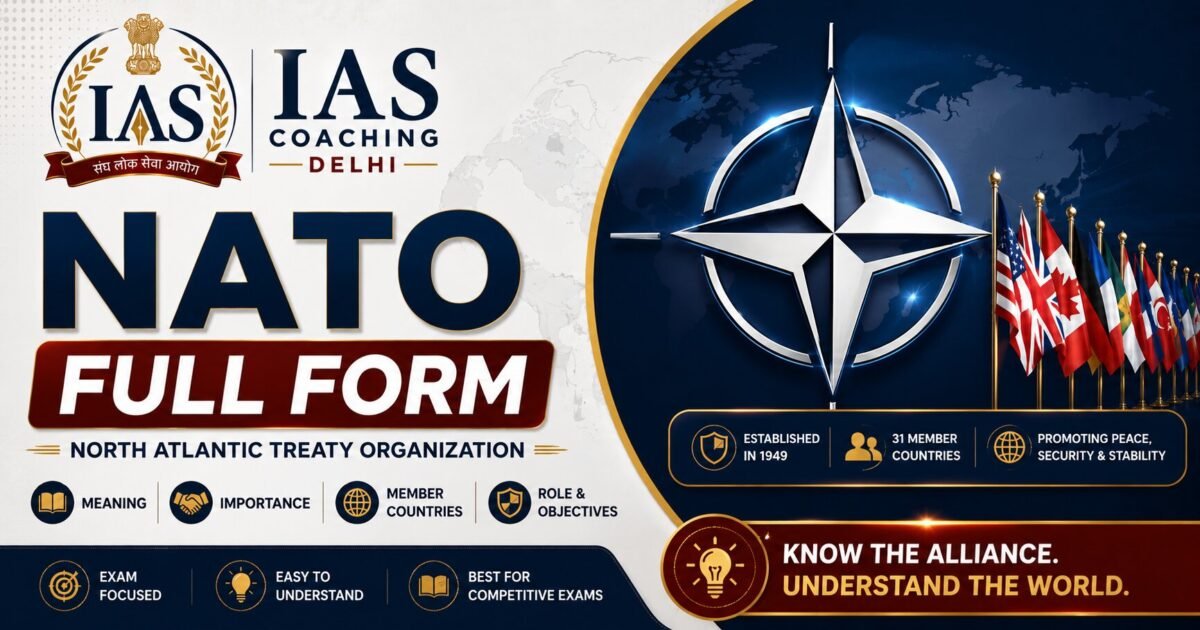
If you are an aspirant of the UPSC Civil Services Exam or other government exams, you must know about the different international organizations. One such organization which features heavily in all the exams on International Relations and Current Affairs is the NATO Full Form. There are always questions that ask about NATO in exams such as UPSC, CDS, NDA, SSC, State PCS, and other government exams.
However, simply knowing the NATO Full Form is not enough. Aspirants need to have some knowledge about its history, goals, member nations, organizational structure, and its importance in world affairs. The following guide talks about everything aspirants need to know about the NATO full form and beyond.
What is the NATO Full Form?
The NATO Full Form is North Atlantic Treaty Organization. It is an intergovernmental military alliance established to promote collective security among its member countries.
NATO was officially formed on 4 April 1949 after the signing of the North Atlantic Treaty in Washington, D.C., United States. The alliance was initially created to provide mutual defence against potential threats during the Cold War. Over the decades, NATO has expanded both in terms of membership and responsibilities, making it one of the most influential international organizations in global politics.
Today, NATO works to maintain peace, enhance military cooperation, and strengthen collective defence among its member nations.
Why is NATO Important?
The importance of NATO extends far beyond military cooperation. It plays a significant role in maintaining regional stability, responding to international crises, and promoting security partnerships across the world.
For students preparing for competitive examinations, understanding the NATO Full Form also means understanding how global alliances influence diplomacy, defence policies, and international relations.
Some of the key reasons why NATO remains important include:
- Promoting collective defence among member countries
- Enhancing military cooperation
- Supporting peacekeeping missions
- Responding to emerging security threats
- Encouraging political consultation between allies
- Strengthening international stability
Its policies often influence global geopolitical developments, making NATO a recurring topic in current affairs.
History of NATO
The origin of NATO can be traced back to the years following the Second World War. Europe had experienced widespread destruction, and many countries faced growing security concerns due to increasing tensions between the Western powers and the Soviet Union.
To ensure collective protection, twelve countries signed the North Atlantic Treaty in 1949. This agreement marked the beginning of NATO as a defence alliance based on the principle that an attack against one member would be treated as an attack against all.
Initially, NATO consisted of only twelve founding members. Over time, several countries joined the alliance, expanding its influence across Europe and North America. The organization has continuously adapted to changing global security challenges, including terrorism, cyber threats, and regional conflicts.
Objectives of NATO
Understanding NATO’s objectives is important from both an academic and examination perspective. The alliance was established with clearly defined goals that continue to shape its policies today.
The major objectives include:
- Maintaining collective security among member nations
- Preventing armed conflicts through cooperation
- Promoting peace and political stability
- Enhancing military readiness
- Strengthening defence capabilities
- Supporting international crisis management
- Encouraging partnerships with non-member countries
Rather than focusing only on military operations, NATO also works toward diplomatic cooperation and strategic planning among allied nations.
NATO Headquarters
The headquarters of NATO is located in Brussels, Belgium.
The headquarters serves as the administrative and political center of the alliance. Representatives from all member countries regularly meet here to discuss international security, defence cooperation, policy decisions, and emerging global challenges.
Important meetings held at NATO Headquarters include:
- Defence Ministers’ Meetings
- Foreign Ministers’ Meetings
- NATO Summits
- Military Committee Meetings
- Strategic Planning Sessions
The headquarters plays a crucial role in coordinating activities among all member states.
NATO Member Countries
One of the most frequently asked examination topics is the list of NATO member countries. The organization has expanded significantly since its establishment in 1949.
Currently, NATO consists of 32 member countries.
Some major NATO members include:
- United States
- United Kingdom
- Canada
- France
- Germany
- Italy
- Spain
- Poland
- Netherlands
- Belgium
- Norway
- Türkiye
- Greece
- Portugal
- Finland
- Sweden
The alliance continues to evolve as geopolitical situations change. Aspirants should always refer to the latest membership list while preparing for current affairs.
Founding Members of NATO
The original founding members signed the North Atlantic Treaty in 1949.
These twelve countries were:
| Founding Members |
| United States |
| Canada |
| United Kingdom |
| France |
| Belgium |
| Netherlands |
| Luxembourg |
| Norway |
| Denmark |
| Iceland |
| Portugal |
| Italy |
These nations established the framework that later became one of the strongest defence alliances in the world.
NATO Organizational Structure
The functioning of NATO involves several important bodies responsible for policy-making, defence planning, and military coordination.
Key institutions include:
- North Atlantic Council (NAC)
- Secretary General
- Military Committee
- Allied Command Operations
- Allied Command Transformation
Each institution has a specific role in ensuring that NATO’s objectives are implemented effectively.
The North Atlantic Council remains the highest decision-making body, where every member country has an equal voice regardless of its size or military strength.
How Does NATO Work?
Unlike many international organizations, NATO operates on the principle of collective decision-making. Major policy decisions are generally taken through consensus rather than voting.
The alliance also follows the principle of collective defence, which means member countries agree to protect one another if any member faces armed aggression.
Apart from defence cooperation, NATO also conducts:
- Joint military exercises
- Intelligence sharing
- Cybersecurity cooperation
- Disaster response coordination
- Defence planning
- Military training programs
These collaborative efforts strengthen coordination among member nations and improve their ability to respond to security challenges.
NATO and International Security
In today’s interconnected world, security challenges extend beyond traditional warfare. NATO has gradually expanded its focus to include cyber threats, terrorism, hybrid warfare, and emerging technologies.
The alliance regularly works with partner nations and international organizations to address these evolving risks. It also participates in humanitarian assistance, disaster relief, and crisis management operations whenever required.
For UPSC aspirants, understanding NATO’s role in modern international relations helps build a stronger conceptual foundation for International Relations and Current Affairs.
NATO vs United Nations (UN)
Many UPSC aspirants confuse NATO with the United Nations because both work at the international level. However, their objectives, membership, and responsibilities are completely different.
The table below highlights the key differences:
| Feature | NATO | United Nations (UN) |
| Full Form | North Atlantic Treaty Organization | United Nations |
| Established | 1949 | 1945 |
| Headquarters | Brussels, Belgium | New York, USA |
| Nature | Military Alliance | International Organization |
| Primary Objective | Collective Defence and Security | International Peace and Cooperation |
| Membership | 32 Countries | 190+ Countries |
| Decision Making | Consensus among Members | General Assembly & Security Council |
For competitive exams, candidates should clearly understand this distinction as direct comparison-based questions are common in UPSC Prelims.
NATO and India
One of the frequently discussed topics in International Relations is the relationship between India and NATO.
India is not a member of NATO. The country’s foreign policy is based on strategic autonomy, allowing it to maintain balanced diplomatic relations with multiple global powers.
Although India is outside the alliance, both sides engage through diplomatic discussions on issues such as:
- Maritime security
- Counter-terrorism
- Cybersecurity
- Regional stability
- Global peace initiatives
India also cooperates with several NATO member countries through bilateral defence partnerships and strategic dialogues.
For UPSC aspirants, understanding India’s independent foreign policy is just as important as knowing the NATO Full Form.
NATO and Russia
The relationship between NATO and Russia has remained one of the most important subjects in global politics.
During the Cold War, NATO was established primarily as a defensive alliance against the Soviet Union. After the Soviet Union dissolved in 1991, there was hope for improved relations. However, geopolitical developments over the years have created several areas of disagreement.
Some major issues include:
- NATO’s eastward expansion
- European security concerns
- Military deployments
- Regional conflicts
- Strategic defence policies
These developments have made NATO a major topic in current affairs and international diplomacy.
NATO’s Role in Modern Global Security
Today’s security challenges are very different from those faced in 1949. Modern threats include cyberattacks, terrorism, hybrid warfare, misinformation campaigns, and technological risks.
To respond effectively, NATO has expanded its focus beyond conventional military defence.
Its modern responsibilities include:
- Cyber defence cooperation
- Intelligence sharing
- Counter-terrorism initiatives
- Crisis management
- Maritime security
- Protection of critical infrastructure
- Disaster response coordination
This evolution demonstrates how international organizations adapt to changing global security environments.
Recent Developments Related to NATO
International organizations continue to evolve based on global political developments. In recent years, NATO has attracted attention because of:
- Expansion of membership
- Increased focus on European security
- Investment in advanced defence technologies
- Cybersecurity cooperation
- Strengthening collective defence capabilities
These developments are regularly discussed in international news and frequently become part of UPSC Current Affairs.
Instead of memorizing headlines, aspirants should understand the reasons behind these developments and their impact on international relations.
Advantages of NATO
The alliance offers several strategic benefits to its member countries.
Major Advantages
- Collective defence framework
- Strong military cooperation
- Intelligence sharing
- Crisis response capabilities
- Joint military exercises
- Improved defence planning
- Political consultation among allies
These advantages have helped NATO remain one of the world’s most influential defence alliances.
Criticisms of NATO
Like any international organization, NATO has also faced criticism over the years.
Some commonly discussed concerns include:
- Expansion leading to geopolitical tensions
- High defence spending requirements
- Differences among member countries
- Involvement in international conflicts
- Strategic disagreements between allies
Understanding both strengths and criticisms helps aspirants develop balanced analytical answers in the UPSC Mains examination.
Why is NATO Important for UPSC Preparation?
International organizations form an important part of the UPSC syllabus under International Relations and Current Affairs.
Questions related to NATO may appear in:
- UPSC Prelims
- UPSC Mains
- CDS Examination
- CAPF Examination
- NDA Examination
- State PCS
- SSC CGL
- Banking Awareness Sections
Instead of remembering only the NATO Full Form, candidates should focus on understanding its objectives, structure, member countries, headquarters, and relevance in global politics.
A concept-based approach always performs better than rote learning.
Key Facts to Remember
For quick revision, here are some important facts.
| Topic | Information |
| Full Form | North Atlantic Treaty Organization |
| Established | 4 April 1949 |
| Headquarters | Brussels, Belgium |
| Nature | Military Alliance |
| Current Members | 32 |
| Founding Members | 12 Countries |
| Principle | Collective Defence |
| Highest Decision-Making Body | North Atlantic Council |
These facts are useful for last-minute revision before competitive examinations.
Preparation Tips for Competitive Exams
Studying international organizations becomes easier when you follow a structured approach.
Smart Preparation Tips
- Learn the objectives instead of only definitions.
- Revise headquarters and founding years regularly.
- Compare international organizations using tables.
- Follow reliable current affairs sources.
- Practice previous years’ UPSC questions.
- Make short revision notes.
- Connect current events with static concepts.
This strategy improves both factual knowledge and analytical understanding.
Conclusion
Knowing the NATO Full Form is just a starting point. Candidates preparing for competitive exams such as UPSC need to know about its formation, aims, membership, organization, and significance in international security as well.
As international politics evolves constantly, NATO continues to be an essential area in International Relations. Conceptual understanding is much better than rote learning in excelling in objective as well as descriptive tests.
Revision and practice can help students master international organizations-related subjects.
Frequently Asked Questions (FAQs)
Q.1 What is the NATO Full Form?
The NATO Full Form is North Atlantic Treaty Organization, a military alliance established in 1949 to promote collective defence among member countries.
Q.2 How many countries are members of NATO?
As of 2026, NATO has 32 member countries, mainly from Europe and North America.
Q.3 Is India a member of NATO?
No. India is not a NATO member and follows an independent foreign policy based on strategic autonomy.
Q.4 Where is NATO headquartered?
The headquarters of NATO is located in Brussels, Belgium.
Q.5 Why is NATO important for UPSC preparation?
NATO is an important topic under International Relations, Current Affairs, and International Organizations, making it highly relevant for UPSC and other competitive examinations.