
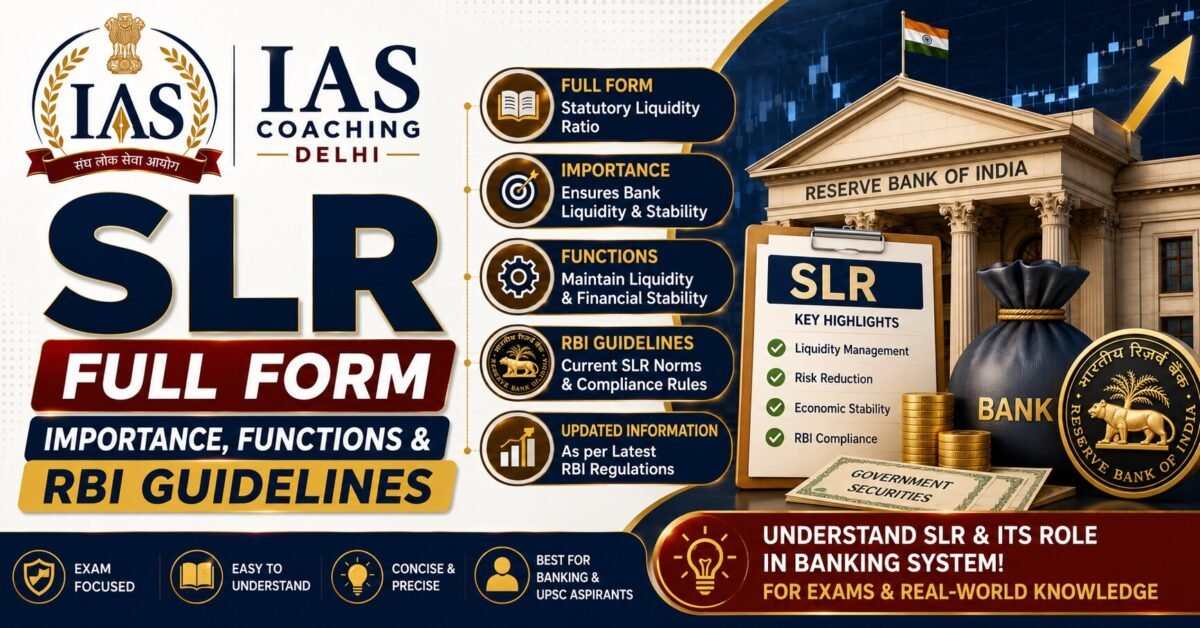
In case you are gearing up for UPSC, SSC, Banking, RBI Grade B, or any other type of Government examination, having knowledge about the SLR Full Form becomes absolutely necessary. It is one of the most commonly asked topics in Economy and Banking Awareness since it has a direct relevance to India’s economy and monetary policy. Other than this, it also helps you comprehend the mechanism behind maintaining stability in banks while safeguarding your money.
Most candidates tend to memorize the definition but find it difficult to comprehend the relevance of SLR in India and how does the Reserve Bank of India (RBI) make use of it. Having an understanding of this topic becomes easy in solving objective questions and writing answers in any kind of competitive examination. Here, we help you comprehend the topic in an exam oriented way.
What is the SLR Full Form?
The SLR Full Form is Statutory Liquidity Ratio. It refers to the minimum percentage of deposits that every commercial bank in India must maintain in the form of liquid assets before lending money to customers.
These liquid assets generally include:
- Cash
- Gold
- Government-approved securities
Unlike cash reserves kept with the Reserve Bank of India, these assets remain under the control of the respective bank. However, banks cannot freely use these funds for lending because they are maintained to comply with RBI regulations.
For students preparing for government exams, remembering this basic definition is only the first step. Understanding its objective and practical application is equally important.
Why is the Statutory Liquidity Ratio Important?
The Statutory Liquidity Ratio plays a significant role in maintaining financial discipline within the banking system. It ensures that banks always have sufficient liquid assets to meet unexpected financial obligations while reducing excessive lending.
When banks maintain adequate liquidity, the financial system becomes more stable. During uncertain economic conditions, these reserves help banks handle sudden withdrawal requests without creating panic among customers.
Another important objective is controlling credit growth. If banks lend almost all deposited money, it could increase inflation and create financial instability. By prescribing a minimum liquidity requirement, the RBI regulates how much money banks can circulate into the economy.
For competitive examination aspirants, remembering these practical reasons is more useful than simply learning the definition.
RBI Guidelines for SLR
The Reserve Bank of India regulates the Statutory Liquidity Ratio as part of its monetary policy framework. Every scheduled commercial bank is required to maintain the prescribed ratio according to RBI guidelines.
The percentage is reviewed periodically depending on the country’s economic conditions, inflation levels, liquidity requirements, and overall monetary policy objectives. Since RBI may revise these guidelines from time to time, aspirants should always refer to the latest official notifications while preparing for examinations.
Some important points include:
- Applicable to scheduled commercial banks.
- Maintained in liquid assets.
- Helps regulate banking liquidity.
- Supports monetary policy implementation.
- Promotes financial stability.
Instead of memorizing changing percentages, candidates should understand why RBI modifies SLR and what economic impact those changes create.
Components Included in SLR
Many students confuse SLR with cash reserves. In reality, banks maintain the ratio using different types of liquid assets.
The primary components include:
Cash
Banks keep a portion of their funds in cash to meet immediate liquidity requirements and daily operational needs.
Gold
Gold has traditionally been considered a reliable liquid asset. It forms a part of the assets that banks may hold for maintaining statutory liquidity requirements.
Government Securities
Government-approved securities constitute a major portion of SLR holdings. These investments are considered relatively safe and provide stability to the banking system.
Together, these assets help banks comply with RBI regulations while maintaining sufficient liquidity.
Objectives Behind Maintaining SLR
The Reserve Bank of India introduced the Statutory Liquidity Ratio to achieve multiple economic objectives. Instead of focusing only on banking regulation, it also influences broader monetary management.
Some major objectives include:
- Ensuring liquidity in the banking system.
- Protecting depositors’ interests.
- Controlling inflation through credit regulation.
- Encouraging investment in government securities.
- Strengthening financial stability.
- Supporting effective monetary policy.
For UPSC and Banking examinations, questions often focus on these objectives rather than numerical values. Understanding the purpose behind SLR helps answer conceptual questions more confidently.
How Does SLR Affect Banks?
Every lending decision made by a commercial bank is influenced by regulatory requirements, including the Statutory Liquidity Ratio.
When the prescribed ratio is higher, banks have fewer funds available for lending because a larger share of deposits must remain invested in liquid assets. This can reduce credit availability in the market.
On the other hand, when RBI lowers the ratio, banks may have additional funds available for loans. Increased lending supports business expansion, consumer spending, and economic growth.
This relationship between SLR and lending frequently appears in UPSC Economy, Banking Awareness, RBI Grade B, and SSC examinations.
Importance of SLR for Competitive Exams
The SLR Full Form is one of the fundamental topics covered under Indian Economy and Banking Awareness. Questions based on this concept regularly appear in examinations such as:
- UPSC Civil Services Examination
- RBI Grade B
- IBPS PO
- SBI PO
- SBI Clerk
- IBPS Clerk
- NABARD
- SSC CGL
- State PSC Examinations
Instead of asking only the full form, examiners increasingly test conceptual understanding, differences between SLR and CRR, RBI functions, monetary policy, and the impact of liquidity regulations on the economy.
Students preparing for these examinations should therefore focus on understanding the practical application of the concept rather than memorizing definitions alone.
How is SLR Calculated?
Understanding the calculation of the Statutory Liquidity Ratio (SLR) is important for both conceptual clarity and competitive exams. The ratio is calculated as the percentage of a bank’s Net Demand and Time Liabilities (NDTL) that must be maintained in the form of approved liquid assets.
SLR Formula:
SLR = (Liquid Assets ÷ Net Demand and Time Liabilities) × 100
Here:
- Liquid Assets include cash, gold, and approved government securities.
- Net Demand and Time Liabilities (NDTL) represent the total deposits that a bank receives from customers, including savings accounts, current accounts, and fixed deposits, after making certain regulatory adjustments.
Although numerical questions are less common in UPSC, understanding this formula is helpful for Banking, RBI Grade B, and other finance-related examinations.
SLR vs CRR – Understanding the Difference
Many aspirants confuse SLR with the Cash Reserve Ratio (CRR). While both are important monetary policy tools used by the Reserve Bank of India, their purpose and maintenance differ.
| Basis | Statutory Liquidity Ratio (SLR) | Cash Reserve Ratio (CRR) |
| Full Form | Statutory Liquidity Ratio | Cash Reserve Ratio |
| Maintained With | The bank itself | Reserve Bank of India |
| Assets Maintained | Cash, gold, and approved securities | Cash only |
| Purpose | Maintain liquidity and regulate lending | Control money supply |
| Interest Earned | Banks may earn returns on securities | No interest is paid on CRR balance |
Remembering these differences is useful for objective questions, descriptive answers, and interviews.
Advantages of Maintaining SLR
The Statutory Liquidity Ratio offers several benefits for both the banking sector and the overall economy. It creates a balance between lending activities and financial stability, ensuring that banks do not take excessive risks.
1. Promotes Financial Stability
SLR ensures that banks always maintain a minimum reserve of liquid assets. This improves confidence in the banking system and reduces the risk of financial distress.
2. Protects Depositors
Depositors trust banks with their savings. By maintaining statutory reserves, banks remain better prepared to meet withdrawal demands even during uncertain economic conditions.
3. Controls Excessive Credit Growth
If banks lend all their deposits without restrictions, excessive money circulation can increase inflation. SLR acts as a regulatory tool to manage credit expansion.
4. Encourages Investment in Government Securities
Since government securities form a major component of SLR assets, banks naturally invest more in them. This supports government borrowing and contributes to economic development.
5. Supports RBI’s Monetary Policy
SLR helps the Reserve Bank of India regulate liquidity in the financial system. Along with CRR, Repo Rate, and Reverse Repo Rate, it plays an important role in monetary policy implementation.
Limitations of SLR
Although SLR is beneficial, it also has certain limitations.
A higher statutory liquidity requirement means banks have less money available for lending. This may slow down business expansion and reduce credit availability, especially during periods when industries require financial support.
Similarly, if lending capacity decreases significantly, economic growth may also slow down in the short term.
Therefore, RBI carefully reviews the liquidity ratio based on prevailing economic conditions before making policy changes.
How Does SLR Impact the Indian Economy?
The Statutory Liquidity Ratio directly influences liquidity, inflation, investment, and credit availability in India.
When RBI increases SLR:
- Banks maintain more liquid assets.
- Lending capacity decreases.
- Credit supply reduces.
- Inflationary pressure may decline.
When RBI reduces SLR:
- Banks receive additional lending capacity.
- Businesses can access more loans.
- Investment increases.
- Economic activity may accelerate.
This balance allows the Reserve Bank of India to maintain financial stability while supporting sustainable economic growth.
Common Mistakes Students Make While Studying SLR
Many competitive exam aspirants lose marks because they memorize facts without understanding concepts.
Some common mistakes include:
- Confusing SLR with CRR.
- Memorizing outdated percentages.
- Ignoring RBI’s role in monetary policy.
- Focusing only on definitions instead of practical applications.
- Forgetting the components included in statutory liquidity.
A conceptual understanding helps students answer both objective and descriptive questions more effectively.
Preparation Tips for UPSC and Banking Aspirants
Economy and Banking Awareness require regular revision and conceptual clarity. Instead of learning isolated topics, aspirants should connect them with broader monetary policy concepts.
Here are a few preparation tips:
- Understand the relationship between SLR, CRR, Repo Rate, and Reverse Repo Rate.
- Read RBI monetary policy updates regularly.
- Practice previous years’ questions.
- Revise banking terminology weekly.
- Prepare short notes for quick revision.
- Focus on conceptual understanding instead of rote memorization.
Building strong fundamentals will improve your performance in both prelims and mains examinations.
Conclusion
The knowledge about the SLR full form is very crucial for all those candidates who want to appear in UPSC, Banking, SSC, and other government examinations. It is important to know the purpose, RBI guidelines, how the SLR is calculated, and its effect on Indian banks. This approach will not only help in competitive exams but will also make candidates learn about the Indian financial system.
All those candidates who are preparing for the UPSC Civil Services, RBI Grade B, IBPS, SBI, or other such competitive examinations must know the concept of statutory liquidity ratio. This is because it is important for the preparation of Economy. Practice regularly, know about the RBI policy, and revise often.
FAQs
Q.1 What is the SLR Full Form?
The SLR Full Form is Statutory Liquidity Ratio, the minimum percentage of deposits that banks must maintain in liquid assets such as cash, gold, and approved government securities.
Q.2 Who decides the Statutory Liquidity Ratio in India?
The Reserve Bank of India (RBI) determines and revises the Statutory Liquidity Ratio as part of its monetary policy framework.
Q.3 What is the difference between SLR and CRR?
SLR is maintained by banks in liquid assets, whereas CRR is maintained as cash with the Reserve Bank of India.
Q.4 Why is SLR important for competitive exams?
The concept is frequently asked in UPSC, Banking, SSC, RBI Grade B, NABARD, and other government examinations under Economy and Banking Awareness.
Q.5 Which assets are included in SLR?
The Statutory Liquidity Ratio is maintained through cash, gold, and approved government securities.