
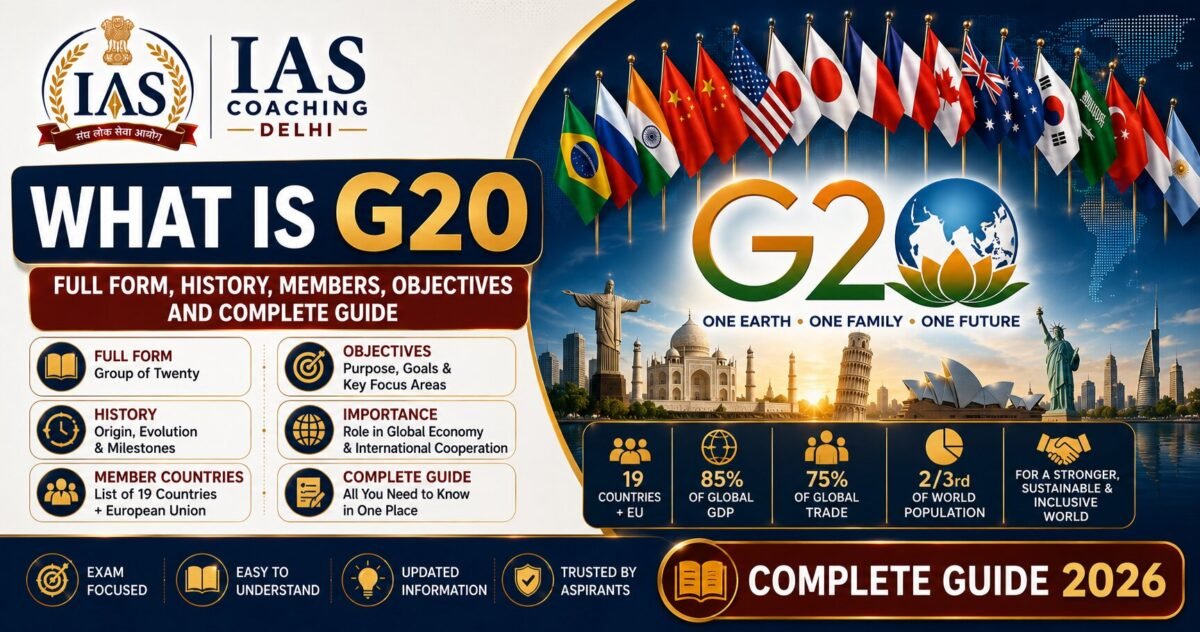
For those who are preparing for UPSC Civil Services Exam or other competitive exams, knowledge about the International Organization becomes crucial. One of the most asked topics in current affairs is the G20 Full Form and the significance of the G20 in today’s economy. The topic of G20 comes in exams like Prelims, Mains, and Interviews due to its increasing significance in the field of international policies.
In this article, we will discuss all the information which one needs to know about the G20 Full Form. From history to the member countries and objectives, from the structure to the significance in competitive exams, everything is explained here.
What is the G20 Full Form?
The G20 Full Form is Group of Twenty. It is an international forum that brings together the world’s major developed and developing economies to discuss global economic cooperation and address pressing international issues.
The G20 was established to strengthen economic coordination after financial crises and to encourage sustainable global growth. Over the years, its agenda has expanded beyond finance to include climate change, digital transformation, health, food security, energy, and sustainable development.
Today, the Group of Twenty represents around 85% of global GDP, nearly 75% of international trade, and approximately two-thirds of the world’s population, making it one of the most influential international forums.
For UPSC aspirants, understanding the G20 Full Form is not only important for General Studies but also for current affairs and international relations.
History of G20
The origin of the G20 dates back to the Asian Financial Crisis of 1997–98, which highlighted the need for stronger global economic cooperation. Existing international platforms were not sufficient to address the growing interconnectedness of the world’s economies.
As a result, the G20 was officially established in 1999 as a meeting of Finance Ministers and Central Bank Governors from major economies. Its primary objective was to improve financial stability and strengthen international economic dialogue.
A major turning point came during the Global Financial Crisis of 2008, when G20 meetings were elevated to the Leaders’ Summit level. Since then, heads of state and government have met annually to discuss key global challenges and coordinate international responses.
Today, the G20 has evolved into a broader platform that addresses not only economic issues but also sustainable development, public health, innovation, digital economy, disaster resilience, and geopolitical cooperation.
Why Was G20 Formed?
Many students memorize the G20 Full Form but often overlook why it was created. Understanding its purpose helps answer analytical questions in competitive examinations.
The G20 was formed to:
- Promote international financial stability.
- Improve economic cooperation among major economies.
- Prevent future financial crises.
- Encourage sustainable and inclusive growth.
- Strengthen global governance.
- Support international trade and investment.
- Address emerging global challenges.
Unlike many international organizations, the G20 functions as a platform for dialogue rather than a treaty-based institution. Its decisions are generally reached through consensus, allowing member nations to collaborate on shared priorities.
G20 Member Countries
One of the most important topics for competitive exams is remembering the member nations.
The G20 consists of 19 countries and two regional organizations.
G20 Countries
- Argentina
- Australia
- Brazil
- Canada
- China
- France
- Germany
- India
- Indonesia
- Italy
- Japan
- Mexico
- Republic of Korea (South Korea)
- Russia
- Saudi Arabia
- South Africa
- Türkiye
- United Kingdom
- United States
Regional Members
- European Union (EU)
- African Union (AU)
The inclusion of the African Union has strengthened the representation of developing economies and expanded the forum’s global reach.
For UPSC preparation, candidates should regularly revise the list of G20 members because questions may appear in Prelims or Current Affairs sections.
Objectives of the G20
The G20 works towards creating a stable, sustainable, and inclusive global economy. Although economic cooperation remains its core objective, the scope of discussions has expanded significantly.
Major Objectives
Promote Global Economic Stability
The forum encourages cooperation among leading economies to maintain financial stability and reduce the impact of global economic disruptions.
Strengthen International Trade
The G20 supports fair, transparent, and rules-based international trade while promoting investment opportunities among member countries.
Encourage Sustainable Development
Member nations discuss policies related to environmental protection, clean energy, climate resilience, and sustainable economic growth.
Improve Global Financial Systems
The forum works towards making international financial institutions stronger, more transparent, and better prepared for future economic challenges.
Address Global Challenges
The agenda now includes topics such as:
- Climate action
- Food security
- Public health
- Digital economy
- Artificial Intelligence
- Energy transition
- Women’s empowerment
- Employment generation
These objectives make the G20 one of the most comprehensive international forums in today’s interconnected world.
How Does the G20 Work?
Unlike organizations such as the United Nations, the G20 does not have a permanent headquarters or a permanent secretariat.
Instead, the presidency rotates annually among member countries. The country holding the presidency organizes meetings, prepares the agenda, and hosts the annual G20 Leaders’ Summit.
Throughout the year, several meetings take place involving:
- Heads of State
- Finance Ministers
- Foreign Ministers
- Central Bank Governors
- Sherpas
- Working Groups
- Engagement Groups
These discussions help build consensus before major decisions are announced during the Leaders’ Summit.
This flexible structure allows the G20 to respond quickly to emerging global issues while encouraging collaboration among member nations.
Importance of G20 for India
India plays a significant role in the G20 due to its growing economy, large population, and increasing influence in global affairs.
India has consistently highlighted issues that are relevant to both developed and developing nations, including:
- Inclusive economic growth
- Digital public infrastructure
- Climate finance
- Renewable energy
- Food security
- Healthcare cooperation
- Sustainable development
India’s active participation has strengthened its position as an important voice in international policymaking.
For UPSC aspirants, understanding India’s priorities within the G20 framework is especially valuable for General Studies Paper II, Essay, and Interview preparation.
Why is G20 Important for UPSC Aspirants?
Questions related to the G20 Full Form, member countries, objectives, and international significance frequently appear in competitive examinations.
A strong understanding of this topic helps in:
- UPSC Prelims
- UPSC Mains
- State PSC examinations
- SSC examinations
- Banking exams
- Defence entrance examinations
- Current Affairs preparation
Instead of memorizing facts alone, aspirants should understand how the G20 influences global governance, economic cooperation, and India’s foreign policy.
For students preparing seriously for competitive exams, structured guidance, updated current affairs, and conceptual learning can make a significant difference. Platforms like IAS Coaching Delhi regularly publish educational resources that help aspirants strengthen topics related to international relations, economy, governance, and current affairs.
G20 Presidency and How It Works
One of the unique features of the G20 is its rotating presidency. Unlike many international organizations, the forum does not have a permanent headquarters or a fixed secretariat. Instead, one member country assumes the presidency each year and takes responsibility for organizing meetings, setting priorities, and hosting the annual summit.
The presidency works closely with the previous and next host countries, known as the Troika, to maintain continuity in the G20 agenda. This system ensures that long-term global priorities remain consistent while allowing each host nation to introduce issues that reflect current international challenges.
Throughout the year, hundreds of meetings are organized involving ministers, policymakers, experts, business leaders, researchers, youth representatives, and civil society organizations. These discussions eventually shape the agenda presented during the G20 Leaders’ Summit.
Major G20 Summits and Their Significance
Since becoming a leaders’ forum in 2008, the G20 has played a crucial role in addressing several global challenges. Each summit focuses on issues that require international cooperation and collective decision-making.
Some notable milestones include:
- 2008 Washington Summit – Focused on responding to the global financial crisis.
- 2009 London Summit – Introduced measures to stabilize financial markets.
- 2015 Antalya Summit – Addressed global economic recovery and terrorism.
- 2020 Riyadh Summit – Concentrated on pandemic response and economic resilience.
- 2023 New Delhi Summit – Marked the inclusion of the African Union as a permanent member and emphasized digital public infrastructure, sustainable development, and inclusive growth.
Every summit reflects the changing priorities of the global economy while encouraging collaboration among member countries.
India’s Growing Role in the G20
India has emerged as one of the most influential voices within the G20 due to its expanding economy, technological progress, and strategic global partnerships.
India has consistently promoted the idea of inclusive and sustainable development, ensuring that the concerns of developing nations receive equal attention. Initiatives related to digital governance, financial inclusion, renewable energy, healthcare, and climate action have strengthened India’s global leadership.
During its presidency, India focused on the theme “One Earth, One Family, One Future,” highlighting cooperation, sustainability, and shared responsibility. The country also emphasized digital innovation, women-led development, disaster resilience, and green growth.
For competitive exam aspirants, India’s role in the G20 is an important topic for General Studies, International Relations, Essay writing, and interviews.
G20 vs G7 vs BRICS
Students often confuse the G20 with other international groups. Understanding the differences helps answer conceptual questions in examinations.
| Feature | G20 | G7 | BRICS |
| Main Focus | Global economic cooperation | Developed economies | Emerging economies |
| Members | 19 countries + EU + AU | 7 developed nations | Brazil, Russia, India, China, South Africa and expanded members |
| Nature | International forum | Informal political and economic group | Economic cooperation group |
| Representation | Developed and developing economies | Advanced economies | Emerging markets |
| Global Coverage | Around 85% of global GDP | Smaller economic bloc | Focus on Global South |
Each organization has different objectives, although some member countries participate in more than one international forum.
Key Achievements of the G20
Over the years, the G20 has contributed significantly to international cooperation. While it does not pass legally binding laws, its policy discussions often influence global economic decisions.
Some major achievements include:
- Strengthening global financial stability after the 2008 crisis.
- Supporting coordinated responses during the COVID-19 pandemic.
- Promoting sustainable development initiatives.
- Encouraging climate-related cooperation.
- Advancing discussions on digital transformation.
- Supporting reforms in international financial institutions.
- Expanding representation through the inclusion of the African Union.
These achievements demonstrate the forum’s growing importance in addressing both economic and non-economic challenges.
Challenges Facing the G20
Despite its influence, the G20 also faces several challenges.
Different member countries often have varying political priorities, economic interests, and foreign policy objectives. Achieving consensus on complex international issues can therefore be difficult.
Some ongoing challenges include:
- Geopolitical conflicts
- Climate change commitments
- Global inflation
- Energy security
- Supply chain disruptions
- Food security
- Debt management in developing countries
Addressing these issues requires continuous dialogue, cooperation, and mutual understanding among member nations.
Why Understanding G20 Matters for Competitive Exams
International organizations remain an important part of the UPSC syllabus. Questions related to the G20 Full Form, member countries, objectives, recent summits, and India’s role frequently appear in current affairs and international relations sections.
Instead of memorizing facts, aspirants should understand the broader context behind global economic cooperation. This conceptual understanding is useful for:
- UPSC Civil Services Examination
- State PSC Exams
- SSC CGL
- CDS & CAPF
- Banking Examinations
- University entrance tests
Developing analytical skills alongside factual knowledge can significantly improve performance in both objective and descriptive examinations.
For aspirants looking to strengthen their preparation, IAS Coaching in Delhi provides educational resources, current affairs updates, and exam-oriented study materials designed to simplify complex topics and support effective learning.
Conclusion
The concept of the G20 Full Form goes beyond just finding out the expansion of the abbreviation. It is a very informative topic about the functioning of the major economies of the world and how they come together to resolve their problems and contribute to economic stability and sustainable development.
From its inception in 1999 till now, it has established itself as one of the most powerful global platforms. For UPSC and other competitive exam aspirants, knowing about this forum and its contributions will help enhance your conceptual as well as current affair knowledge.
Frequently Asked Questions
Q.1 What is the G20 Full Form?
The G20 Full Form is Group of Twenty, an international forum comprising major developed and developing economies that work together on global economic and policy issues.
Q.2 How many members are there in the G20?
The G20 includes 19 countries, the European Union (EU), and the African Union (AU), making it one of the most representative global forums.
Q.3 Why is the G20 important for UPSC preparation?
The G20 is a significant topic in UPSC because it covers international relations, global governance, economic cooperation, and current affairs, all of which are important parts of the syllabus.
Q.4 Does the G20 have a permanent headquarters?
No. The G20 does not have a permanent headquarters or secretariat. Its presidency rotates annually among member countries.
Q.5 What is India’s role in the G20?
India actively contributes to discussions on sustainable development, digital innovation, climate action, financial inclusion, and global economic cooperation, making it an important participant in the G20 framework.