
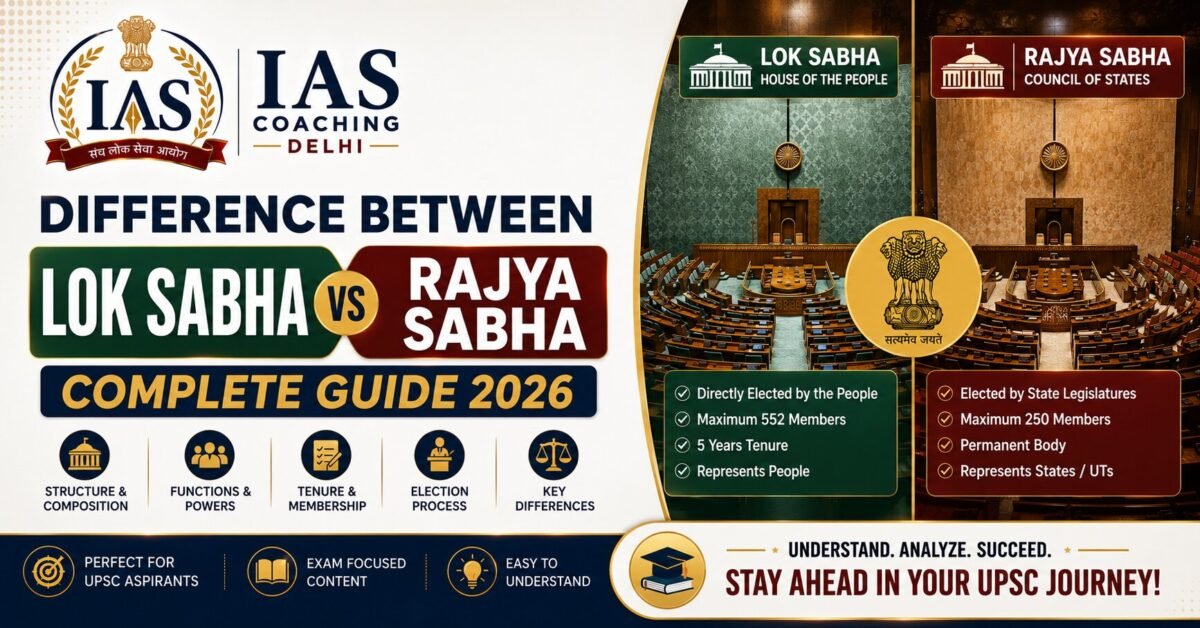
If you are preparing for the UPSC Civil Services Exam, State PCS, SSC, Bank exams or other competitive exams, it is important that you understand the Difference Between Lok Sabha and Rajya Sabha. The questions on the Indian Parliament are often asked in both the Prelims and Mains and this becomes one of the important topics in Indian Polity.
While many candidates learn about the differences between Lok Sabha and Rajya Sabha without comprehending the significance of these differences from a constitutional point of view, it is always beneficial to adopt a conceptual approach to improve your performance in objective as well as descriptive papers.
Why Understanding the Difference Between Lok Sabha and Rajya Sabha Matters
The Parliament of India is the supreme legislative body of the country. It consists of the President, the Lok Sabha (House of the People), and the Rajya Sabha (Council of States). Although both Houses work together to make laws, their powers, composition, election process, tenure, and constitutional roles are different.
For UPSC aspirants, this topic is much more than a factual comparison. Questions often test conceptual clarity by asking about legislative powers, Money Bills, constitutional amendments, or emergency provisions. Instead of learning isolated facts, understanding how both Houses complement each other creates a stronger foundation in Indian Polity.
Students preparing through a structured approach often perform better because they connect constitutional concepts with current affairs. At IAS Coaching Delhi, experienced mentors encourage aspirants to focus on conceptual learning, regular revision, and answer-writing practice rather than rote memorization.
Understanding the Structure of the Indian Parliament
Before comparing both Houses, it is important to understand how Parliament functions as a whole.
The Indian Parliament is bicameral, meaning it has two legislative Houses:
- Lok Sabha (House of the People)
- Rajya Sabha (Council of States)
This bicameral system was adopted to ensure balanced law-making, wider representation, and effective parliamentary functioning. While the Lok Sabha represents the people directly, the Rajya Sabha represents the states and union territories.
Together, both Houses discuss bills, debate national issues, approve policies, examine government decisions, and contribute to the democratic functioning of the country. Their combined role strengthens India’s parliamentary democracy and ensures that laws are carefully examined before implementation.
What is Lok Sabha?
The Lok Sabha, also known as the House of the People, is the lower house of the Indian Parliament. Members are directly elected by the citizens of India through general elections held every five years.
Since representatives are chosen by the people, the Lok Sabha reflects the democratic will of the electorate. The political party or alliance securing a majority in this House forms the Central Government, and the Prime Minister is generally a member of the Lok Sabha.
The responsibilities of the Lok Sabha include passing laws, approving the national budget, debating public issues, and holding the Council of Ministers accountable. Because it is directly elected, it enjoys several exclusive powers under the Constitution, especially in financial matters.
For aspirants preparing for competitive examinations, remembering that the Lok Sabha has greater control over Money Bills is one of the most frequently tested concepts.
What is Rajya Sabha?
The Rajya Sabha, known as the Council of States, is the upper house of Parliament. Unlike the Lok Sabha, members are not directly elected by the general public. Instead, they are elected by elected members of State Legislative Assemblies using the system of proportional representation.
The Rajya Sabha was created to represent the interests of states in the legislative process. It provides stability to Parliament because it is a permanent House and is never dissolved.
One-third of its members retire every two years, while new members are elected to fill those vacancies. This continuity ensures uninterrupted parliamentary functioning even when the Lok Sabha is dissolved.
The Rajya Sabha also plays an important role in reviewing legislation, discussing national policies, and protecting federal principles within India’s constitutional framework.
Difference Between Lok Sabha and Rajya Sabha at a Glance
Understanding the comparison becomes much easier through a structured table.
| Feature | Lok Sabha | Rajya Sabha |
| Also Known As | House of the People | Council of States |
| Nature | Lower House | Upper House |
| Election | Direct Election | Indirect Election |
| Represents | Citizens | States & Union Territories |
| Maximum Strength | 552 Members | 250 Members |
| Current Constitutional Strength | As notified by law | As notified by law |
| Tenure | Five Years | Permanent House |
| Dissolution | Can be dissolved | Never dissolved |
| Money Bill Powers | Stronger | Limited |
| Government Formation | Yes | No |
Instead of memorizing every point separately, understanding why these differences exist helps retain the information for a longer period.
Composition of Lok Sabha and Rajya Sabha
The composition of both Houses reflects their constitutional objectives.
The Lok Sabha primarily represents the citizens of India. Members are elected from parliamentary constituencies across the country through universal adult franchise. This ensures that every eligible voter has the opportunity to choose their representative.
The Rajya Sabha, on the other hand, represents the states. Members are elected by elected Members of Legislative Assemblies (MLAs). This indirect election strengthens India’s federal structure by giving states a voice in national legislation.
Another important distinction is that the Rajya Sabha can also include members nominated by the President for their exceptional contribution to fields such as literature, science, art, and social service. These nominated members enrich parliamentary debates with their expertise and experience.
Election Process Explained
The method of election is one of the biggest differences between the two Houses.
Lok Sabha Election
Members are elected directly by Indian citizens through general elections conducted by the Election Commission of India.
Every eligible voter participates in the electoral process, making the Lok Sabha the true representative of the people’s mandate.
Rajya Sabha Election
Members are elected indirectly by elected members of State Legislative Assemblies.
The election follows the system of Proportional Representation through the Single Transferable Vote, ensuring representation for different political parties according to their legislative strength.
This distinction frequently appears in UPSC Prelims, SSC, CDS, CAPF, and State PCS examinations.
Tenure of Both Houses
Another important concept is the tenure of each House.
The Lok Sabha has a normal term of five years unless dissolved earlier by the President on the advice of the Prime Minister. During a National Emergency, its tenure may be extended according to constitutional provisions.
The Rajya Sabha follows a completely different model. It is a permanent House and is never dissolved.
Instead, one-third of its members retire after every two years, while newly elected members replace them. Each member normally serves a six-year term.
This system ensures continuity in the legislative process even when general elections are taking place.
Powers of Lok Sabha and Rajya Sabha
Although both Houses participate in law-making, their constitutional powers are not identical.
The Lok Sabha enjoys greater authority in financial matters. Money Bills can only be introduced in the Lok Sabha, and the Rajya Sabha has limited powers regarding such bills. This reflects the principle that elected representatives of the people should control public finances.
For ordinary bills, however, both Houses generally have equal legislative powers. A bill usually requires approval from both Houses before becoming law.
Both Houses also participate in constitutional amendment procedures, discussions on national issues, parliamentary committees, and policy debates.
Understanding these distinctions is extremely important because UPSC often frames conceptual questions rather than factual ones.
Money Bill: One of the Most Important Differences
Questions related to Money Bills appear regularly in competitive examinations.
A Money Bill can only be introduced in the Lok Sabha after obtaining the President’s recommendation.
Once passed by the Lok Sabha, it is sent to the Rajya Sabha for recommendations. However, the Rajya Sabha cannot reject or amend the Money Bill. It must return the bill within fourteen days, and the Lok Sabha may accept or reject its suggestions.
This constitutional arrangement clearly establishes the financial supremacy of the Lok Sabha.
For aspirants, this remains one of the highest-priority topics in Indian Polity and should always be revised carefully.
Joint Sitting of Parliament
One of the most interesting aspects of the Indian parliamentary system is the Joint Sitting of Parliament. It is held when the Lok Sabha and Rajya Sabha fail to agree on an Ordinary Bill. Instead of allowing the legislative process to remain stalled, the Constitution provides a mechanism to resolve the deadlock.
The President of India can summon a Joint Sitting under Article 108 of the Constitution. During this session, members of both Houses meet together and vote on the bill. Since the Lok Sabha has a larger number of members, its opinion generally carries greater weight in the final decision.
However, it is important to remember that Joint Sitting is not applicable for Money Bills or Constitutional Amendment Bills. This distinction is frequently asked in UPSC Preliminary examinations and other competitive exams.
Exclusive Powers of Lok Sabha
Although both Houses work together in law-making, the Lok Sabha enjoys certain exclusive constitutional powers that make it extremely important in India’s democratic system.
Some major powers include:
- Introduction of Money Bills
- Control over the Union Budget
- Passing Demands for Grants
- Deciding financial legislation
- Removing the Council of Ministers through a No-Confidence Motion
The Council of Ministers is collectively responsible only to the Lok Sabha. If the government loses the confidence of the Lok Sabha, it must resign. This is one of the biggest constitutional differences between the two Houses.
Because the Lok Sabha is directly elected by citizens, it plays a dominant role in matters involving public finance and government accountability.
Exclusive Powers of Rajya Sabha
While many students believe the Rajya Sabha is weaker than the Lok Sabha, that is not entirely correct. The upper house also enjoys several exclusive constitutional powers.
Under Article 249, the Rajya Sabha can authorize Parliament to make laws on subjects listed in the State List if it considers them necessary in the national interest.
Another important power comes under Article 312, where the Rajya Sabha can create new All India Services through a special resolution passed by a two-thirds majority of members present and voting.
These provisions highlight the Rajya Sabha’s important role in protecting India’s federal structure and balancing the powers of Parliament.
Role in Constitutional Amendment
Constitutional Amendment Bills are different from Ordinary Bills and Money Bills.
When the Constitution needs to be amended, both Houses enjoy equal powers. A Constitutional Amendment Bill must be passed separately by the Lok Sabha and the Rajya Sabha with the required special majority.
Unlike Ordinary Bills, there is no provision for a Joint Sitting if disagreement arises between the two Houses.
This makes Constitutional Amendments one of the best examples where both Houses have equal constitutional authority.
For UPSC aspirants, understanding this distinction is extremely important because it appears frequently in conceptual questions.
Difference Between Lok Sabha and Rajya Sabha in Emergency Provisions
During National Emergency, Parliament’s functioning becomes even more significant.
Both Houses participate in approving Emergency Proclamations issued by the President. If the Lok Sabha is dissolved during an Emergency, the Rajya Sabha continues functioning because it is a permanent House.
This continuity ensures that Parliament remains operational even during extraordinary situations.
The Rajya Sabha’s permanent nature provides institutional stability and ensures uninterrupted constitutional functioning.
Which House is More Powerful?
This is one of the most debated questions among UPSC aspirants.
The answer is neither House is absolutely more powerful. Instead, their powers vary depending on the subject under consideration.
The Lok Sabha has greater authority in:
- Financial matters
- Formation of Government
- No-Confidence Motion
- Money Bills
The Rajya Sabha has special powers relating to:
- State List legislation under Article 249
- Creation of All India Services
- Permanent legislative continuity
For Ordinary Bills and Constitutional Amendments, both Houses generally share equal legislative responsibilities.
Instead of comparing them as competitors, it is more accurate to view them as complementary institutions that strengthen India’s parliamentary democracy.
Common Mistakes Students Make
Many aspirants lose marks because they confuse similar constitutional provisions.
Some common mistakes include:
- Assuming Rajya Sabha can reject a Money Bill.
- Believing both Houses are dissolved after General Elections.
- Confusing the election methods of members.
- Forgetting that the Rajya Sabha is a permanent House.
- Assuming Joint Sitting applies to every type of bill.
Avoiding these conceptual mistakes can significantly improve your score in Indian Polity.
Smart Preparation Strategy for UPSC Aspirants
Indian Polity is one of the highest-scoring subjects in the UPSC Civil Services Examination. Instead of memorizing facts, aspirants should build conceptual understanding.
An effective strategy includes:
- Read the Constitution alongside standard reference books.
- Revise comparison tables regularly.
- Practice previous year questions.
- Solve topic-wise mock tests.
- Prepare short revision notes.
- Follow important constitutional developments.
At IAS Coaching Delhi, mentors encourage aspirants to understand constitutional principles rather than relying on rote learning. Regular answer-writing practice, concept-based discussions, and revision sessions help students strengthen their preparation for both Prelims and Mains.
Why This Topic is Important for UPSC 2026
The Difference Between Lok Sabha and Rajya Sabha is among the most frequently tested topics in Indian Polity. It is relevant not only for UPSC but also for SSC CGL, CDS, CAPF, NDA, State PCS, Banking, and other government examinations.
Questions may be asked directly through factual comparisons or indirectly through constitutional scenarios involving Money Bills, Constitutional Amendments, Emergency provisions, or parliamentary procedures.
A strong conceptual understanding of this topic also helps aspirants write better Mains answers by connecting constitutional provisions with current affairs and governance issues.
How to Revise This Topic Effectively
Revision plays a crucial role in retaining constitutional concepts. Instead of reading lengthy chapters repeatedly, focus on structured revision.
A practical revision plan includes:
- Preparing one-page comparison notes.
- Revising constitutional articles related to Parliament.
- Practicing MCQs weekly.
- Solving previous years’ UPSC questions.
- Discussing concepts with mentors or study groups.
Repeated revision helps convert theoretical knowledge into exam-ready concepts.
Conclusion
Importance of Understanding the Difference between Lok Sabha and Rajya Sabha cannot be overemphasized for any serious UPSC aspirant. Both Houses have their own Constitutional duties, powers, and functions that help them to work properly.
Do not try to remember facts individually but understand the Constitution behind each provision. This can be done by adopting a concept-based approach towards preparation, proper revision, and practice. If you are preparing for UPSC 2026, then Parliament, Fundamental Rights, and Constitutional Bodies need to be among your top priorities.
FAQs
Q.1 What is the main difference between Lok Sabha and Rajya Sabha?
The primary Difference Between Lok Sabha and Rajya Sabha is that the Lok Sabha is directly elected by the people, while the Rajya Sabha is elected indirectly by State Legislative Assemblies.
Q.2 Which House has more power over Money Bills?
The Lok Sabha has greater authority over Money Bills. The Rajya Sabha can only recommend changes and cannot reject or amend a Money Bill.
Q.3 Can the Rajya Sabha be dissolved?
No. The Rajya Sabha is a permanent House. One-third of its members retire every two years, ensuring continuity in Parliament.
Q.4 Why is this topic important for UPSC?
Questions related to Parliament, legislative procedures, and constitutional provisions are regularly asked in UPSC Prelims and Mains, making this topic highly important.
Q.5 How can I prepare this topic effectively?
Focus on conceptual understanding, revise comparison tables, solve previous year questions, and practice mock tests regularly. A structured learning approach and expert guidance can significantly improve your preparation.