
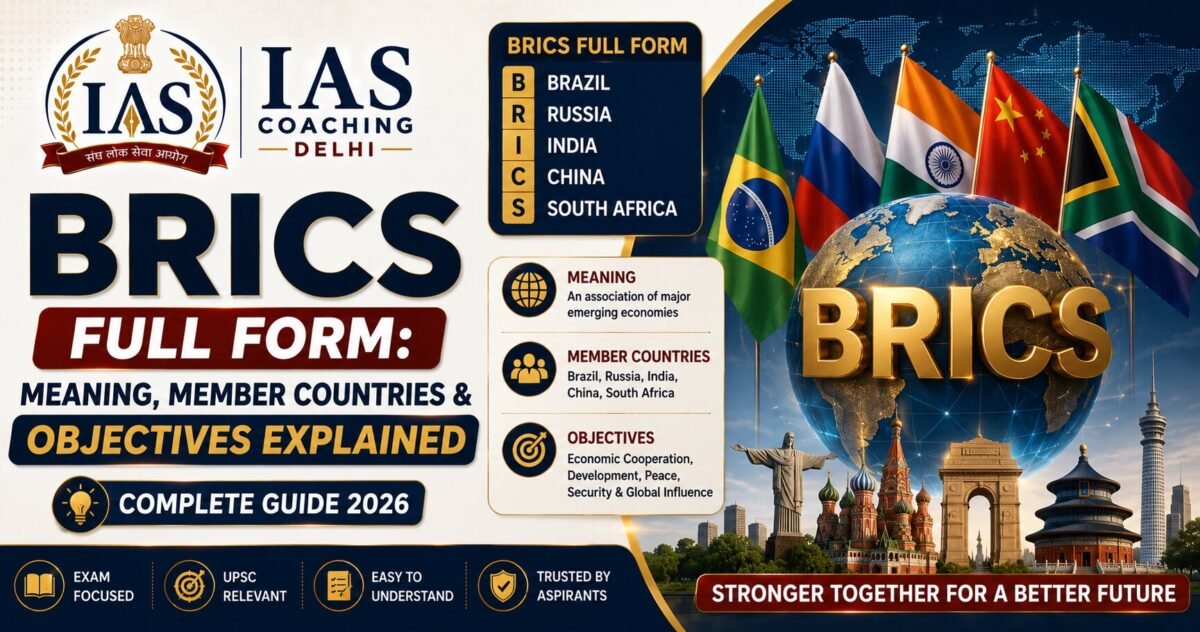
Nowadays, BRICS is one of the hottest issues in international relations, economics, and current affairs. If you are preparing for the UPSC Civil Services Examination, State PCS, SSC, Banking, and other competitive exams, then having an idea about BRICS Full Form will be useful for you. Questions based on BRICS often come in the section of current affairs and international relations, which makes it an important topic for serious aspirants.
Rather than learning the facts, it is crucial to learn the influence of BRICS on the politics and economy of the world. Here, you will find all information regarding the BRICS Full Form, the countries that are part of BRICS, its objective, importance, latest expansion, and more.
What is BRICS?
BRICS is an international grouping of emerging economies that work together to strengthen economic cooperation, promote sustainable development, and create a more balanced global financial system. Over the years, the organization has evolved from an economic partnership into a strategic platform where member countries discuss issues related to trade, technology, climate change, global security, healthcare, and international governance.
Unlike military alliances, BRICS focuses primarily on economic growth, development, and collaboration. The member nations collectively represent a significant share of the world’s population, global GDP, natural resources, and international trade. Because of its growing influence, BRICS is now considered one of the most important international organizations in today’s geopolitical landscape.
For UPSC aspirants, understanding BRICS is not just about remembering names. It is about understanding why the organization matters, how it impacts global affairs, and why it regularly appears in examination questions.
BRICS Full Form
The BRICS Full Form is:
- B – Brazil
- R – Russia
- I – India
- C – China
- S – South Africa
Originally, the organization was known as BRIC, consisting of Brazil, Russia, India, and China. In 2010, South Africa joined the group, and the acronym officially became BRICS.
In recent years, BRICS has expanded further by inviting additional countries, making the grouping even more influential in global politics and economics. This expansion reflects the growing importance of developing economies in shaping international decisions.
For competitive examinations, candidates should remember both the original members and the newly admitted countries, as questions are increasingly based on recent developments.
History of BRICS
The concept behind BRICS originated from an economic report published by Goldman Sachs economist Jim O’Neill in 2001. He predicted that Brazil, Russia, India, and China would become major drivers of global economic growth during the 21st century.
Initially, BRIC was simply an economic concept rather than a formal organization. However, recognizing their shared interests and growing influence, the four countries held their first official summit in Yekaterinburg, Russia, in 2009.
A year later, South Africa joined the group, transforming BRIC into BRICS. Since then, annual BRICS Summits have become important platforms where leaders discuss economic cooperation, global challenges, sustainable development, and international reforms.
Over time, BRICS has established several institutions and initiatives aimed at strengthening collaboration among member countries while promoting a more inclusive global economic system.
BRICS Member Countries (Updated 2026)
The membership of BRICS has expanded significantly in recent years. Originally consisting of five countries, the organization has welcomed new members to strengthen cooperation among emerging economies.
Founding Members
| Country | Year Joined |
| Brazil | 2009 |
| Russia | 2009 |
| India | 2009 |
| China | 2009 |
| South Africa | 2010 |
New Members (Expansion)
Following recent BRICS expansion initiatives, additional countries have been invited or admitted, increasing the group’s global influence. Candidates preparing for competitive exams should always verify the latest membership updates because this area is frequently covered in current affairs.
The expansion reflects BRICS’ broader objective of increasing representation for developing and emerging economies in global institutions.
Objectives of BRICS
The primary goal of BRICS is to promote cooperation among emerging economies while encouraging balanced and sustainable global development.
Some of its major objectives include:
- Strengthening economic cooperation among member nations.
- Promoting international trade and investment.
- Supporting sustainable development.
- Reforming global financial institutions.
- Enhancing technological collaboration.
- Improving cooperation in healthcare and education.
- Addressing climate change and environmental challenges.
- Encouraging peace, diplomacy, and multilateral cooperation.
These objectives demonstrate that BRICS is much more than an economic alliance. It has become a platform where member countries coordinate on issues affecting both regional and global development.
Why BRICS Matters in the Global Economy
One of the biggest reasons BRICS receives worldwide attention is its economic influence. Together, member countries account for a significant share of the global population, manufacturing capacity, agricultural production, and natural resources.
The organization plays an increasingly important role in:
- Global trade
- Foreign investment
- Energy security
- Infrastructure development
- Digital innovation
- Financial cooperation
As developing economies continue to grow, BRICS is expected to contribute even more to shaping international economic policies.
For UPSC aspirants, understanding these economic dimensions helps in answering analytical questions in both the Preliminary and Mains examinations.
Key Institutions Created by BRICS
To strengthen cooperation beyond annual summits, BRICS has established several important institutions.
New Development Bank (NDB)
The New Development Bank was established to finance infrastructure and sustainable development projects among member countries and other developing nations.
Its primary objectives include:
- Infrastructure financing
- Renewable energy projects
- Urban development
- Sustainable growth
- Economic cooperation
The NDB provides an alternative source of development financing alongside traditional international financial institutions.
Contingent Reserve Arrangement (CRA)
The Contingent Reserve Arrangement was created to provide financial support to member countries facing short-term balance of payments difficulties.
Its objectives include:
- Financial stability
- Currency support
- Economic resilience
- Crisis management
This mechanism strengthens economic cooperation and reduces financial risks among participating countries.
Why BRICS is Important for UPSC Aspirants
International organizations are one of the most important areas of the UPSC syllabus. Questions related to BRICS frequently appear in Current Affairs, International Relations, Economic Development, and Essay papers.
Understanding BRICS helps aspirants in:
- UPSC Prelims
- UPSC Mains (GS Paper II)
- State PCS examinations
- SSC examinations
- Banking awareness
- Defence examinations
Instead of memorizing facts, candidates should focus on understanding how BRICS influences international diplomacy, global trade, financial reforms, and India’s foreign policy.
A strong conceptual understanding improves answer-writing quality and helps in analytical questions during the Mains examination.
BRICS vs G7: Understanding the Difference
Many UPSC aspirants confuse BRICS with the G7, but these two international groups have different objectives, members, and areas of focus. Understanding their differences is important for both the Preliminary and Mains examinations.
| Feature | BRICS | G7 |
| Nature | Group of emerging economies | Group of advanced economies |
| Primary Focus | Economic cooperation, development, global reforms | Global economic policy, security, climate, governance |
| Members | Brazil, Russia, India, China, South Africa and expanded members | Canada, France, Germany, Italy, Japan, United Kingdom, United States |
| Global Representation | Emerging and developing nations | Developed nations |
| Headquarters | No permanent headquarters | No permanent headquarters |
| Major Institution | New Development Bank (NDB) | No separate development bank |
While the G7 represents established industrial economies, BRICS gives emerging nations a stronger voice in international affairs. This distinction is frequently tested in competitive examinations.
India’s Role in BRICS
India plays a significant role in BRICS by promoting economic cooperation, sustainable development, digital innovation, and global peace. As one of the founding members, India actively participates in discussions related to trade, climate change, healthcare, technology, and international governance.
India also supports reforms in global financial institutions to ensure greater representation for developing countries. Through BRICS, India strengthens its diplomatic relations with major economies while protecting its national interests.
For UPSC aspirants, India’s role should be understood from the perspective of foreign policy, international relations, and global diplomacy rather than simply memorizing summit outcomes.
Major Areas of Cooperation
BRICS is not limited to economic discussions. Over the years, cooperation has expanded into multiple sectors that directly influence global development.
Economic Cooperation
Economic collaboration remains the foundation of BRICS. Member countries work together to encourage investment, strengthen trade partnerships, and improve financial stability.
Key areas include:
- Cross-border investment
- Infrastructure financing
- Trade facilitation
- Financial cooperation
Technology and Innovation
Digital transformation has become an important priority.
BRICS countries collaborate on:
- Artificial Intelligence
- Digital economy
- Cybersecurity
- Innovation partnerships
- Smart infrastructure
Technology cooperation helps member nations prepare for future economic challenges.
Healthcare Collaboration
Following global health challenges, BRICS has increased cooperation in public health.
Important initiatives include:
- Medical research
- Disease surveillance
- Healthcare innovation
- Pharmaceutical cooperation
- Emergency response planning
Healthcare has become an increasingly relevant topic for international cooperation.
Climate Change and Sustainable Development
Environmental sustainability is another important area of collaboration.
Member countries work together on:
- Renewable energy
- Green technology
- Climate adaptation
- Sustainable infrastructure
- Environmental protection
These topics frequently appear in UPSC GS Paper III and Essay papers.
Recent BRICS Expansion
One of the biggest developments in recent years has been the expansion of BRICS membership. The organization has invited additional countries to strengthen representation among emerging economies and increase cooperation across different regions.
The expansion reflects the growing importance of developing nations in shaping the future of global governance.
For examination purposes, aspirants should regularly follow official announcements regarding new member countries, as this remains a highly dynamic area of current affairs.
Challenges Before BRICS
Despite its growing influence, BRICS also faces several challenges that affect its effectiveness.
Different Economic Priorities
Each member country has its own economic structure and national priorities. Balancing these differences requires continuous dialogue and cooperation.
Geopolitical Differences
Political disagreements and regional issues occasionally create challenges for collective decision-making.
Trade Imbalances
Differences in trade volumes and economic development can influence policy discussions among member countries.
Institutional Coordination
As the organization expands, coordination among a larger number of members becomes increasingly important.
Understanding these challenges helps aspirants write balanced answers in UPSC Mains.
Future of BRICS
The future of BRICS appears promising as emerging economies continue to play a larger role in global development. Expansion, stronger financial cooperation, digital innovation, and infrastructure investment are expected to remain key priorities.
Experts believe BRICS will continue influencing discussions related to:
- Global trade
- Sustainable development
- Climate policy
- International finance
- Technology partnerships
- Multilateral cooperation
Rather than replacing existing international institutions, BRICS aims to contribute to a more inclusive global order where developing nations have greater participation in decision-making.
How to Prepare BRICS for UPSC
Instead of memorizing isolated facts, aspirants should develop a conceptual understanding of the topic.
A practical preparation strategy includes:
- Study the history of BRICS.
- Learn the objectives and institutions.
- Understand India’s role.
- Follow recent summit outcomes.
- Read current affairs regularly.
- Practice answer writing on international relations topics.
- Compare BRICS with G7, G20, SCO, and QUAD.
This approach improves both factual recall and analytical writing.
Common UPSC Questions on BRICS
Some frequently asked themes include:
- What is the BRICS Full Form?
- Explain the objectives of BRICS.
- Discuss India’s role in BRICS.
- Compare BRICS and G7.
- Explain the significance of the New Development Bank.
- Why is BRICS important in international relations?
- Discuss the impact of BRICS expansion.
- Evaluate the future prospects of BRICS.
Preparing these topics strengthens both Prelims and Mains preparation.
Why Understanding BRICS Matters for Civil Services Preparation
International organizations are no longer limited to factual questions. UPSC increasingly focuses on analytical thinking and application-based learning.
A clear understanding of BRICS helps aspirants connect multiple subjects, including:
- International Relations
- Economy
- Current Affairs
- Environment
- Governance
- Essay Writing
Candidates preparing with a structured study plan and updated resources often find it easier to understand such interconnected topics.
Platforms dedicated to UPSC preparation, such as IAS Coaching Delhi, regularly publish current affairs, exam-oriented blogs, and preparation resources that help aspirants build conceptual clarity and stay updated with important international developments.
Conclusion
The understanding of BRICS Full Form is not just about knowing the acronym. It offers a lot of information on the subject of international collaboration and world economic development, as well as India’s increasing presence in global affairs. Given that BRICS is becoming more and more significant in shaping global policies, it has become a very important subject for examinations like UPSC and others.
For those who want to succeed in their examinations, the key is to understand BRICS in terms of both facts and analysis. Learn about its past and objectives, as well as about the nations associated with it, its institutions and recent events related to BRICS, and India’s part in it.
FAQs
Q.1 What is the BRICS Full Form?
The BRICS Full Form is Brazil, Russia, India, China, and South Africa. It represents a group of emerging economies working together on economic and strategic cooperation.
Q.2 Why is BRICS important for UPSC?
BRICS is an important topic in UPSC because it covers international relations, current affairs, global economy, and India’s foreign policy, making it relevant for both Prelims and Mains.
Q.3 What are the main objectives of BRICS?
The organization focuses on economic cooperation, sustainable development, global financial reforms, trade, investment, technology, and multilateral collaboration.
Q.4 What is the New Development Bank?
The New Development Bank (NDB) is a financial institution established by BRICS to support infrastructure and sustainable development projects in member and developing countries.
Q.5 How should I prepare BRICS for competitive exams?
Study its history, objectives, institutions, member countries, India’s role, recent summit updates, and compare it with organizations like G7, G20, and SCO. Regular current affairs revision is equally important.