
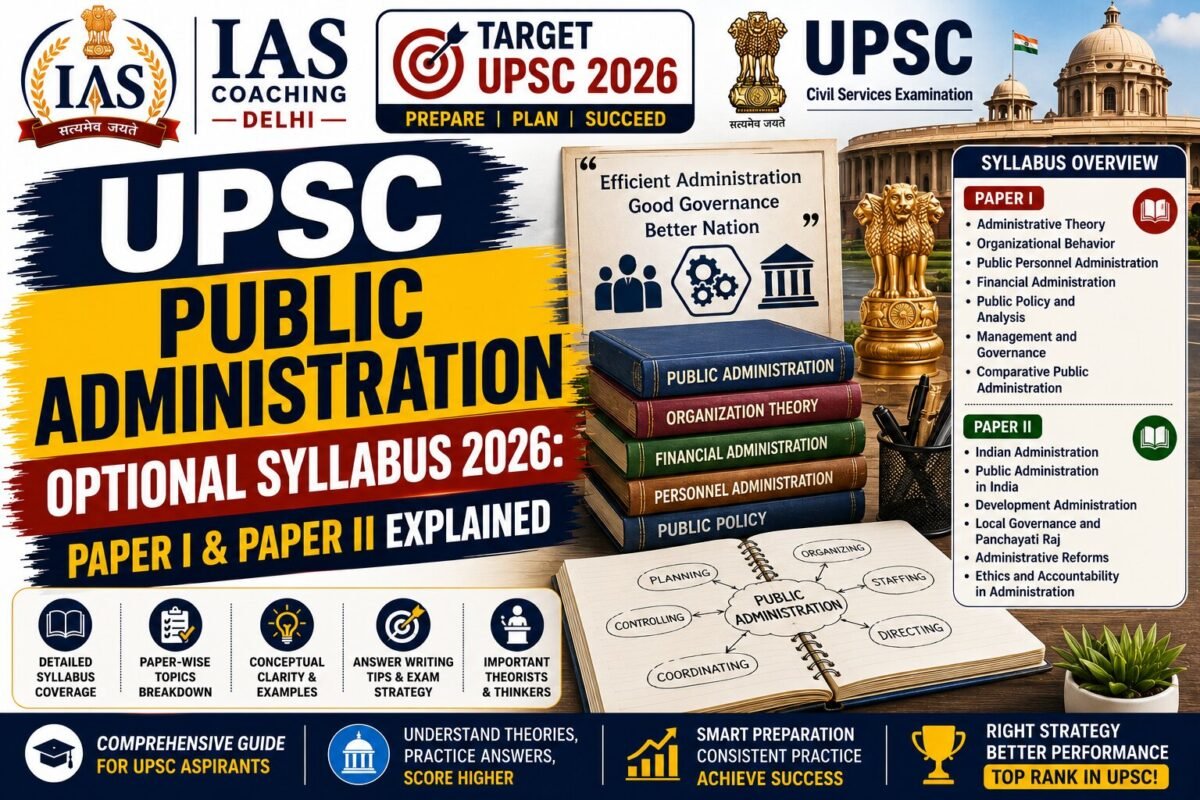
Preparation of Civil Services Examination involves some key decisions, and selection of the right optional paper is one of them. In case you are seeking a good optional paper that will provide a balanced syllabus, has high similarity with GS, and is relevant for governance and administration, then the UPSC Public Administration Optional Syllabus can be considered.
The UPSC aspirants have selected Public Administration as their optional subject since it develops an analytical outlook towards government machinery, public policies, ethics in administration, and management. Other than being helpful for clearing the examinations, Public Administration as a subject has helped to develop a practical outlook which can be useful for the job of a civil servant in future.
In case you are choosing Public Administration as your optional for the 2026 examination, having knowledge about the Public Administration Syllabus and other aspects related to it will help you make a wise decision.
Why Choose Public Administration as Your UPSC Optional?
Choosing an optional subject should never depend only on trends or previous results. Instead, it should match your interests, academic background, and preparation strategy. The UPSC Public Administration Optional Syllabus offers several advantages that make it a preferred option for many aspirants.
Unlike highly technical subjects, Public Administration focuses on governance, accountability, public policy, and administrative systems. These concepts are useful not only in the optional papers but also in General Studies, Essay, Ethics, and even the Personality Test.
Some key reasons candidates prefer this optional include:
- Well-defined and manageable syllabus
- Strong overlap with GS Paper II and Ethics
- Useful for Essay preparation
- Contemporary relevance with governance issues
- Availability of quality study material
- Suitable for students from diverse educational backgrounds
Instead of memorizing isolated facts, this subject encourages conceptual understanding and analytical thinking, which are essential for scoring well in the UPSC examination.
Understanding the UPSC Public Administration Optional Syllabus
Before starting preparation, every aspirant should understand the structure of the syllabus. The UPSC Public Administration Optional Syllabus consists of two papers carrying 250 marks each.
| Paper | Focus Area | Marks |
| Paper I | Administrative Theory & Concepts | 250 |
| Paper II | Indian Administration | 250 |
Paper I introduces theoretical concepts, administrative thinkers, organizational behavior, public policy, accountability, and financial administration.
Paper II applies those concepts to the Indian administrative system. It focuses on constitutional governance, Union and State administration, district administration, local governance, public sector organizations, and administrative reforms.
A clear understanding of both papers helps candidates build a balanced preparation strategy rather than studying topics in isolation.
Paper I: Build Strong Administrative Fundamentals
Paper I forms the conceptual foundation of the subject. It explains how public organizations function, how policies are implemented, and how administrative systems evolve over time.
Many aspirants initially find the theories difficult, but once the concepts become clear, answer writing becomes much easier.
Administrative Theory
Administrative Theory introduces the evolution of Public Administration as an academic discipline. Candidates study different approaches to administration and understand how governance models have changed over time.
Important areas include:
- Meaning and scope of Public Administration
- Evolution of the discipline
- Public and private administration
- New Public Administration
- New Public Management
- Governance models
Instead of learning definitions by heart, aspirants should understand how these theories relate to present-day governance.
Administrative Thinkers
One of the highest-scoring sections in the Public Administration Syllabus is Administrative Thinkers.
Candidates study the ideas of influential scholars whose theories continue to influence modern administration.
Commonly covered thinkers include:
- Woodrow Wilson
- Max Weber
- Chester Barnard
- Herbert Simon
- Dwight Waldo
- Mary Parker Follett
Rather than memorizing quotations, successful aspirants connect these thinkers with contemporary administrative issues, making their answers more analytical and relevant.
Organizational Behaviour
Public organizations function because of people, leadership, communication, and motivation. This section focuses on the human side of administration.
Major topics generally include:
- Leadership
- Motivation
- Decision-making
- Communication
- Organizational culture
- Team management
- Conflict resolution
Many case studies in Ethics and Governance also reflect these concepts, making this portion valuable beyond the optional paper.
Accountability and Administrative Ethics
Modern governance demands transparency, accountability, and ethical decision-making. This section has gained increasing importance in recent UPSC examinations.
Candidates should understand topics such as:
- Accountability mechanisms
- Administrative responsibility
- Citizen participation
- Transparency
- Ethics in public administration
- Integrity in governance
Instead of writing theoretical answers alone, aspirants should support their responses with contemporary examples, government initiatives, and commission recommendations.
Public Policy and Development Administration
Public policy connects administration with real-world governance. This portion explains how policies are designed, implemented, monitored, and evaluated.
Important themes include:
- Policy formulation
- Policy implementation
- Policy evaluation
- Development dynamics
- Role of civil servants
- Citizen-centric governance
Candidates should regularly follow government initiatives, policy reforms, and administrative developments because they strengthen answers significantly.
Paper II: Understanding Indian Administration
While Paper I develops conceptual clarity, Paper II applies those principles to India’s administrative framework.
This paper is highly dynamic because many questions relate to current governance challenges.
Preparation should combine the syllabus with newspapers, government reports, and recent administrative reforms.
Constitutional Framework
Every civil servant must understand India’s constitutional structure.
This section covers:
- Constitutional philosophy
- Union Government
- State Government
- Centre-State Relations
- Emergency provisions
- Federalism
Connecting constitutional provisions with recent governance developments helps candidates write balanced and mature answers.
Union and State Administration
The functioning of administrative institutions forms an important part of the syllabus.
Candidates study:
- Cabinet Secretariat
- Prime Minister’s Office
- Ministries
- Civil Services
- State Secretariat
- Chief Secretary
Rather than studying these institutions separately, aspirants should understand how they coordinate in policy implementation.
District Administration
District administration remains the backbone of governance in India.
Topics generally include:
- District Collector
- District Magistrate
- Law and order
- Revenue administration
- Development administration
- Citizen services
This section becomes more interesting when linked with current government initiatives related to digital governance and public service delivery.
Local Governance and Panchayati Raj
Grassroots democracy plays a major role in India’s administrative structure.
Candidates should develop conceptual clarity on:
- Panchayati Raj Institutions
- Urban Local Bodies
- Municipal Administration
- Decentralization
- Citizen participation
- Local governance reforms
Current affairs related to smart cities, digital governance, and urban development often provide valuable examples for this section.
Administrative Reforms
Administrative reforms remain one of the most dynamic areas of the UPSC Public Administration Optional Syllabus.
Preparation should focus on understanding why reforms are introduced and how they improve governance.
Important areas include:
- Civil service reforms
- Good governance
- E-governance
- Citizen charters
- RTI implementation
- Performance management
Using recent examples from Digital India, Mission Karmayogi, and public service reforms can strengthen answer quality without overloading answers with unnecessary facts.
Build Your Preparation Around the Syllabus, Not Around Notes
One common mistake many aspirants make is collecting too many books before understanding the syllabus. Successful candidates usually begin by studying the UPSC Public Administration Optional Syllabus line by line and then selecting resources that directly address each topic.
A focused preparation strategy saves time, improves revision, and helps maintain consistency throughout the preparation journey. Instead of chasing multiple sources, build your study plan around the syllabus, previous year questions, and regular answer-writing practice. This approach keeps your preparation organized and increases your confidence as the examination approaches.
Best Books and Resources for Public Administration Preparation
Choosing the right study material is just as important as choosing the optional subject itself. Instead of collecting dozens of books, focus on a few reliable resources that align with the Public Administration Syllabus and revise them multiple times. Quality revision always delivers better results than reading too many sources once.
A balanced preparation plan should include standard books, previous year question papers, government reports, current affairs, and regular answer-writing practice. These resources help you develop conceptual clarity while improving your analytical approach.
Some commonly preferred resources include:
- Standard books for Public Administration
- Previous Year UPSC Question Papers
- ARC (Administrative Reforms Commission) Reports
- India Year Book (selected topics)
- Economic Survey (relevant governance sections)
- PIB and government policy updates
- Yojana and Kurukshetra magazines
- Regular newspaper editorials
Remember, books alone cannot guarantee success. Your ability to connect theory with current governance issues makes your answers stand out.
Answer Writing Strategy That Improves Scores
One of the biggest differences between average and high-scoring candidates is answer presentation. Since Public Administration is an analytical subject, simply reproducing definitions or theories is rarely enough. UPSC expects candidates to apply concepts to real administrative challenges.
A good answer should begin with a short introduction, followed by logical arguments supported by examples, committee recommendations, or contemporary developments. End with a balanced conclusion that reflects administrative practicality.
To improve answer quality:
- Practice writing answers regularly.
- Use headings and subheadings for clarity.
- Include diagrams or flowcharts wherever relevant.
- Quote administrative thinkers naturally.
- Connect theoretical concepts with current affairs.
- Maintain a balanced and objective approach.
Consistent answer-writing practice also improves time management, which is crucial during the Mains examination.
Common Mistakes to Avoid During Preparation
Many aspirants spend months studying but still struggle to score well because of avoidable mistakes. Understanding these challenges early can save valuable preparation time.
Some common mistakes include:
- Studying without following the official syllabus.
- Ignoring previous year questions.
- Depending on too many study sources.
- Avoiding answer-writing practice.
- Neglecting current affairs integration.
- Memorizing theories without understanding concepts.
- Poor revision planning.
Instead of trying to complete everything at once, focus on steady progress. Small daily improvements often produce better results than irregular intensive study sessions.
How to Build a Smart Preparation Plan
A successful preparation strategy should be realistic and consistent. Rather than studying randomly, divide the syllabus into manageable sections and create weekly goals.
A practical preparation plan may include:
- Daily concept study
- Current affairs revision
- Answer writing practice
- Weekly mock tests
- Monthly revision schedule
Regular revision helps retain concepts for a longer period and reduces stress closer to the examination.
Who Should Choose Public Administration as an Optional?
Every optional subject has its own strengths, and Public Administration is no exception. However, it is not necessary that it suits every aspirant.
You may consider this optional if you:
- Have an interest in governance and public policy.
- Enjoy analytical subjects.
- Want overlap with General Studies.
- Prefer a concise and structured syllabus.
- Like connecting theory with current events.
Choosing an optional should always be based on your interest and preparation style rather than popularity alone.
Why Aspirants Trust Expert Guidance
While self-study remains the foundation of UPSC preparation, structured mentorship can simplify the journey. Many aspirants prefer joining coaching programs to gain clarity on difficult topics, improve answer-writing skills, and maintain consistency throughout their preparation.
Platforms like IAS Coaching Delhi support aspirants with well-structured study plans, experienced faculty guidance, updated learning resources, and regular test practice. The focus is not just on completing the syllabus but on helping students understand concepts, improve analytical thinking, and build exam-oriented strategies.
With a student-centric approach and guidance tailored to the changing UPSC pattern, aspirants can prepare with greater confidence and direction.
Is Public Administration a Good Optional for UPSC 2026?
The answer depends on your individual strengths and preparation goals. Public Administration continues to be a relevant optional because of its connection with governance, administration, ethics, and public policy.
Candidates who develop conceptual clarity, practice answer writing consistently, and integrate current affairs effectively often perform well in this subject. Rather than looking for the “highest-scoring optional,” choose the one you can study with interest and consistency.
Conclusion
The UPSC Public Administration Optional Syllabus 2026 is a good blend of theory, governance, and practical administration, and hence is a better option for many Civil Services aspirants. The similarities between the General Studies and Public Administration subjects, along with the relevance to contemporary issues and an organized syllabus, enable preparation if done using the correct strategy.
Preparation for this optional subject involves not mugging up but understanding the concepts, writing answers, and preparing with a planned methodology. With the help of proper coaching and dependable materials, one can prepare effectively for both Paper I and Paper II. However, before taking up the preparation, one must first assess one’s interest and then decide on the mode of preparation accordingly.
Frequently Asked Questions
Q.1 Is Public Administration a good optional for UPSC 2026?
Yes, it is considered a good optional for aspirants interested in governance, administration, and public policy. It also offers useful overlap with General Studies and the Essay paper.
Q.2 What does the UPSC Public Administration Optional Syllabus include?
The syllabus consists of Paper I, covering administrative theories and concepts, and Paper II, focusing on Indian Administration, governance, public policy, and administrative reforms.
Q.3 How much time is required to complete the Public Administration Syllabus?
Most aspirants complete the syllabus in 3–5 months, depending on their preparation level, revision schedule, and answer-writing practice.
Q.4 Which books are recommended for Public Administration optional?
Standard reference books, ARC Reports, previous year UPSC papers, government publications, and current affairs resources are commonly used for preparation.
Q.5 Should I join coaching for Public Administration optional?
Coaching is optional, but structured guidance, regular test practice, and expert mentorship can help many aspirants strengthen their preparation and improve answer-writing skills.