
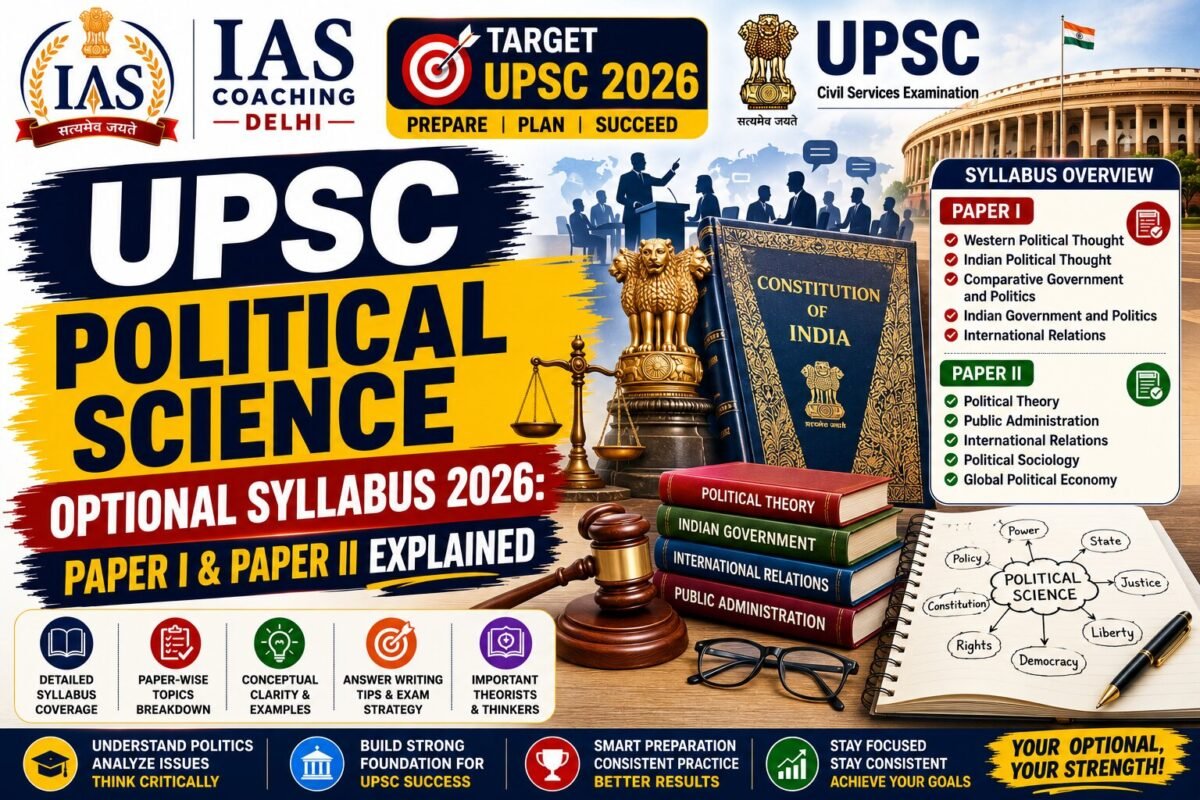
The selection of an appropriate optional can play a major role in UPSC preparation. If you want an optional that will involve conceptual learning, contemporary issues, and relevance to General Studies, the UPSC Political Science Optional Syllabus should not be overlooked by you. It is considered to be one of the most sought-after optional subjects amongst Civil Service candidates owing to its well-structured syllabus and scoring capability.
Before joining any coaching institute or buying any study material, it is very important for you to know everything about the complete Political Science Syllabus. Understanding the syllabus of Paper I and Paper II will help you formulate a proper preparation strategy, which will enable you to prepare efficiently according to the present UPSC guidelines.
Why Choose Political Science as Your UPSC Optional?
Every UPSC aspirant has different strengths, but Political Science remains one of the most practical optional subjects because it overlaps with several sections of the Civil Services Examination.
Some major advantages include:
- Significant overlap with General Studies Papers II and IV.
- Helpful for Essay preparation.
- Relevant for current affairs and international relations.
- Widely available study material and guidance.
- Suitable for candidates from both humanities and non-humanities backgrounds.
Apart from improving your optional preparation, the subject also strengthens your understanding of governance, public administration, constitutional values, and international developments.
Understanding the UPSC Political Science Optional Syllabus
The UPSC Political Science Optional Syllabus is divided into two papers, each carrying 250 marks, making a total of 500 marks.
| Paper | Focus Area | Marks |
| Paper I | Political Theory & Indian Politics | 250 |
| Paper II | Comparative Politics & International Relations | 250 |
Instead of memorizing isolated topics, UPSC expects candidates to develop analytical thinking and connect political concepts with contemporary issues. This makes conceptual clarity far more important than rote learning.
Paper I: Political Theory and Indian Politics
Paper I focuses on political philosophy, Indian political thought, constitutional development, governance, and democratic institutions.
Political Theory and Concepts
The first section introduces aspirants to the foundation of political science. Questions are often analytical and require conceptual clarity.
Major topics include:
- Political Theory
- Justice
- Equality
- Rights
- Liberty
- Democracy
- Citizenship
- Political Ideologies
- Feminism
- Multiculturalism
Instead of learning definitions alone, candidates should understand how these concepts apply in modern governance and constitutional democracy.
Indian Political Thought
This section introduces influential political thinkers who shaped India’s political philosophy.
Important thinkers include:
- Mahatma Gandhi
- B.R. Ambedkar
- Jawaharlal Nehru
- M.N. Roy
- Sri Aurobindo
UPSC frequently asks questions that require comparing their ideas with present-day political challenges.
Indian Constitution and Government
This is one of the most scoring sections of the Political Science Syllabus because it overlaps with General Studies Paper II.
Key topics include:
- Constituent Assembly
- Philosophy of the Constitution
- Fundamental Rights
- Directive Principles
- Union Government
- Parliament
- Judiciary
- Federalism
- Election Commission
- Constitutional Bodies
Candidates should combine constitutional provisions with recent judicial developments and governance issues.
Paper II: Comparative Politics and International Relations
Paper II shifts the focus from domestic politics to global politics and India’s foreign policy.
This section requires regular newspaper reading and current affairs integration.
The syllabus is divided into two broad areas:
- Comparative Political Analysis
- International Relations
A strong understanding of global developments makes this paper easier to approach.
Comparative Politics
This section explains how different political systems function across the world.
Important topics include:
- Comparative Politics
- Political Development
- Political Modernization
- State Theory
- Dependency Theory
- Globalization
- Political Economy
Candidates should focus on understanding concepts instead of memorizing definitions.
International Relations
International Relations is one of the most dynamic portions of the UPSC Political Science Optional Syllabus because many questions are linked to current affairs.
Major topics include:
- India’s Foreign Policy
- India–USA Relations
- India–China Relations
- India–Russia Relations
- India and South Asia
- United Nations
- International Organizations
- Global Security
- Regional Cooperation
- Contemporary World Politics
Regular newspaper reading significantly improves answer quality in this section.
Smart Preparation Strategy for Political Science Optional
Success in Political Science depends more on smart preparation than collecting dozens of books.
An effective preparation strategy should include:
- Completing the syllabus topic-wise.
- Reading standard reference books.
- Preparing concise revision notes.
- Practising answer writing every week.
- Revising current affairs regularly.
- Solving previous years’ UPSC questions.
Following a structured approach helps improve consistency and reduces preparation stress.
Best Books for Political Science Optional
Selecting the right resources is just as important as covering the syllabus.
Some commonly recommended books include:
| Topic | Recommended Resource |
| Political Theory | O.P. Gauba |
| Indian Government | M. Laxmikanth |
| Western Political Thought | Subrata Mukherjee & Sushila Ramaswamy |
| Comparative Politics | Andrew Heywood |
| International Relations | V.N. Khanna |
| Current Affairs | Newspapers & Government Reports |
Instead of reading multiple books for the same topic, focus on one reliable source and revise it multiple times.
Common Mistakes to Avoid During Preparation
Many aspirants spend months studying without following the syllabus properly.
Avoid these common mistakes:
- Ignoring answer-writing practice.
- Depending on too many books.
- Neglecting current affairs.
- Skipping previous years’ questions.
- Preparing without revision.
- Memorizing instead of understanding concepts.
A disciplined study plan can help you avoid these issues and improve overall performance.
Build a Better Strategy with Expert Guidance
While self-study plays the biggest role in UPSC preparation, expert guidance can make your preparation more structured and efficient. A well-planned mentorship program helps aspirants understand the UPSC Political Science Optional Syllabus, prioritize high-weightage topics, improve answer-writing skills, and stay consistent throughout the preparation journey.
At IAS Coaching Delhi, aspirants receive access to experienced faculty, updated study resources, regular test discussions, and personalized guidance designed to match the latest UPSC pattern. A structured preparation strategy not only saves valuable time but also helps candidates focus on topics that matter most in the examination.
High-Weightage Topics You Should Never Skip
Not every topic in the UPSC Political Science Optional Syllabus carries equal importance. Some areas are repeatedly tested and deserve extra attention during preparation. Instead of studying everything with the same intensity, focus on topics that consistently appear in previous years’ papers.
Paper I Priority Topics
Give extra time to:
- Political Theory and Thinkers
- Justice, Equality and Liberty
- Indian Constitution
- Parliament and Executive
- Judiciary and Judicial Review
- Federalism
- Electoral Reforms
- Party System in India
Paper II Priority Topics
Focus on:
- Comparative Politics
- India’s Foreign Policy
- India–China Relations
- India–USA Relations
- International Organisations
- United Nations
- Globalisation
- Contemporary International Politics
Preparing these topics thoroughly improves your overall scoring potential while covering a significant portion of the syllabus.
90-Day Preparation Plan for Political Science Optional
A structured study plan can help aspirants complete the syllabus without feeling overwhelmed. Dividing the preparation into phases makes revision and practice much easier.
Phase 1 (Days 1–30): Build Strong Fundamentals
During the first month:
- Complete Political Theory.
- Cover Indian Political Thought.
- Study the Indian Constitution.
- Prepare short notes after every topic.
The goal is to understand concepts rather than memorize them.
Phase 2 (Days 31–60): Complete Paper II
The second phase should focus on:
- Comparative Politics
- International Relations
- India’s Foreign Policy
- Global Issues
- International Organisations
Along with the syllabus, start linking current affairs with static topics.
Phase 3 (Days 61–90): Revision and Answer Writing
The final month should focus on improving presentation.
Your schedule should include:
- Daily answer writing
- Weekly mock tests
- Previous year question practice
- Current affairs revision
- Multiple revisions of short notes
Regular practice during this phase can significantly improve confidence before the examination.
Answer Writing Strategy That Improves Scores
Completing the syllabus alone is not enough. UPSC evaluates how effectively you present your knowledge.
A high-quality answer should:
- Begin with a brief introduction.
- Explain concepts clearly.
- Use relevant examples.
- Include constitutional references where applicable.
- Mention recent developments.
- End with a balanced conclusion.
You can also improve presentation by using:
- Flowcharts
- Diagrams
- Simple tables
- Thinker quotations
- Supreme Court judgments
- Government reports
Good presentation makes answers more readable and leaves a positive impression on the evaluator.
Previous Year Question Trend
Analyzing previous UPSC papers helps aspirants understand the changing nature of the examination.
Recent trends show that UPSC increasingly asks:
- Analytical questions
- Opinion-based questions
- Contemporary political issues
- International developments
- Constitution-related topics linked with current affairs
Instead of preparing isolated notes, develop the habit of connecting static concepts with recent events. This approach makes your preparation more relevant and examination-oriented.
Should You Choose Political Science Optional in 2026?
If you enjoy understanding politics, governance, international relations, and constitutional issues, Political Science can be an excellent optional subject.
It is especially suitable for candidates who want:
- Strong overlap with General Studies.
- Better Essay preparation.
- Better understanding of governance.
- Current affairs integration.
- Logical and analytical learning.
However, every optional has its own challenges. Your final decision should depend on your interest in the subject, availability of study resources, and long-term preparation strategy rather than popularity alone.
How to Maximize Your Optional Score
Scoring well requires more than simply finishing the syllabus.
Focus on these practices:
- Revise multiple times instead of collecting more books.
- Write answers regularly.
- Improve introduction and conclusion writing.
- Practice value addition through reports and committee recommendations.
- Follow current affairs consistently.
- Evaluate mock test performance objectively.
Small improvements made consistently often lead to better marks in the final examination.
Conclusion
For UPSC Political Science Optional Syllabus 2026 preparation, there is a need for a balanced approach that combines conceptual clarity, frequent revision, answer writing, and good planning. Rather than spending time going through a number of sources, what one should do is gain a proper understanding of the syllabus and political theories.
And, most importantly, apply them to the recent events happening around the country and internationally. If Political Science is your optional choice for the exam, then a well-thought plan to start preparation will help you save much-needed time. With proper mentoring and materials, the candidate can prepare accordingly.
Frequently Asked Questions
Q.1 Is the UPSC Political Science Optional Syllabus suitable for beginners?
Yes. Aspirants from both humanities and non-humanities backgrounds can prepare effectively with a structured study plan and the right guidance.
Q.2 Does Political Science Optional overlap with General Studies?
Yes. It has considerable overlap with GS Paper II, parts of GS Paper IV, Essay, and current affairs, making preparation more efficient.
Q.3 How much time is required to complete the Political Science Syllabus?
Most aspirants complete the syllabus in about 3–4 months with regular study, revision, and answer-writing practice.
Q.4 Which books are best for Political Science Optional?
Standard resources such as O.P. Gauba, Andrew Heywood, M. Laxmikanth, and V.N. Khanna are commonly recommended, along with current affairs and previous years’ papers.
Q.5 Where can I get expert guidance for Political Science Optional preparation?
Institutes like IAS Coaching Delhi provide structured classroom programs, experienced faculty, test series, and mentorship to help aspirants prepare strategically for the UPSC Civil Services Examination.