
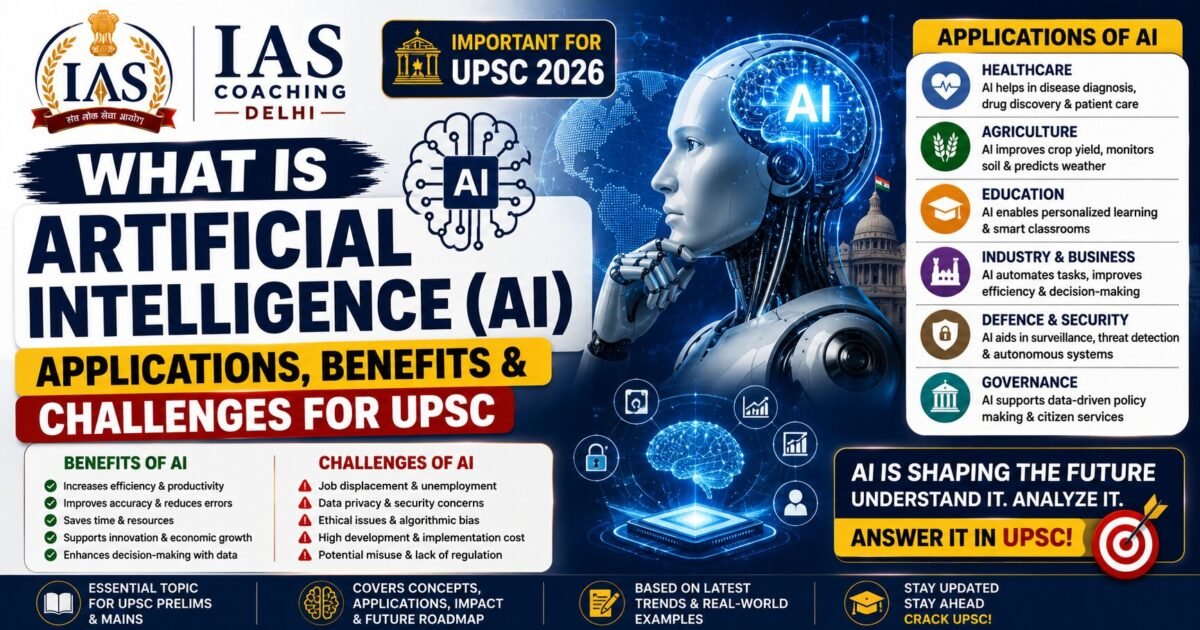
Artificial Intelligence (AI) in life has not been science fiction anymore; rather, it has come as reality in the form of governance and life. Voice search, recommendations, healthcare, agriculture, banks, security of nations, and many other things have been transformed using AI. For aspirants who are aiming to clear the UPSC exams, it is very important to know What is Artificial Intelligence since it is being discussed frequently in the UPSC Civil Service Examinations in GS paper 3, essays, and interviews.
As AI is being seen as the central part of Digital India, AI strategy for India, and responsible technology movement of India, its applications, issues, and scope for the future are getting more significance now. It will help in answering analytical questions as well as connecting technology with governance, economy, education, etc.
Why Artificial Intelligence is Important for UPSC Aspirants
Technology has become one of the most dynamic sections of the UPSC syllabus. Artificial Intelligence is often linked with governance reforms, digital transformation, cybersecurity, healthcare innovation, climate change, and economic development. Instead of memorizing definitions, aspirants should understand how AI influences policymaking and public welfare.
Questions on AI can appear in:
- General Studies Paper III
- Essay Paper
- Science & Technology section
- Ethics (GS Paper IV)
- UPSC Personality Test
A strong understanding of AI enables candidates to write balanced answers by discussing both opportunities and challenges while supporting their arguments with current developments.
What is Artificial Intelligence?
Artificial Intelligence (AI) is a term used for the capacity of machines or computer programs to perform operations that require human intelligence. Such operations include learning from data, problem-solving, speech recognition, language understanding, decision-making, and pattern recognition.
The major difference between conventional software and AI programs is that the latter are able to learn from experience and become better at performing various operations.
At the moment, artificial intelligence is applied for developing many technological products that people use in everyday life, like voice assistants, navigation systems, recommendations on websites, fraud detection, and automation services.
In order to prepare for UPSC, it is necessary to get acquainted not only with AI but also with its effects on governance, society, economics, and public administration.
Key Components of Artificial Intelligence
Artificial Intelligence is a broad field that combines multiple technologies. Understanding these concepts helps aspirants build a strong conceptual foundation.
Machine Learning (ML)
Machine Learning enables computers to learn from data without being explicitly programmed for every task. It identifies patterns and improves predictions based on previous experiences.
Examples include:
- Email spam filters
- Recommendation systems
- Fraud detection
- Predictive analytics
Deep Learning
Deep Learning is an advanced branch of Machine Learning that uses artificial neural networks inspired by the human brain.
It is commonly used in:
- Image recognition
- Speech recognition
- Medical diagnosis
- Autonomous vehicles
Natural Language Processing (NLP)
Natural Language Processing helps computers understand, interpret, and generate human language.
Examples include:
- AI chatbots
- Language translation
- Voice assistants
- Automated customer support
Computer Vision
Computer Vision enables machines to interpret visual information from images and videos.
Applications include:
- Facial recognition
- Medical imaging
- Traffic monitoring
- Security surveillance
Applications of Artificial Intelligence in India
One reason AI is important for UPSC is its growing role in national development. The Government of India is actively promoting AI across multiple sectors to improve governance and public service delivery.
AI in Healthcare
Artificial Intelligence is improving healthcare by assisting doctors in diagnosis, treatment planning, disease prediction, and medical research.
Some important applications include:
- Early disease detection
- AI-assisted medical imaging
- Telemedicine
- Drug discovery
- Personalized healthcare
These technologies improve healthcare accessibility, especially in rural areas.
AI in Agriculture
Agriculture remains the backbone of India’s economy, and AI is helping farmers make informed decisions.
Modern AI applications include:
- Crop monitoring
- Weather prediction
- Precision farming
- Pest detection
- Soil health analysis
These innovations contribute to higher productivity while reducing resource wastage.
AI in Education
The education sector has also adopted Artificial Intelligence to improve learning outcomes.
AI-powered educational tools help students through:
- Personalized learning
- Smart assessments
- Adaptive testing
- Virtual classrooms
- Learning analytics
Such technologies make education more accessible and effective.
AI in Governance
Governments around the world are using Artificial Intelligence to improve transparency, efficiency, and public service delivery.
Important governance applications include:
- Smart city management
- Traffic control systems
- Public grievance monitoring
- Digital governance
- Citizen service automation
India’s digital transformation initiatives continue to encourage responsible adoption of AI in governance.
AI in Banking and Finance
Financial institutions rely heavily on Artificial Intelligence to improve customer experience and strengthen security.
Popular applications include:
- Fraud detection
- Credit risk assessment
- Automated customer support
- Digital payments
- Investment analysis
These technologies help financial institutions make faster and more reliable decisions.
Benefits of Artificial Intelligence
Artificial Intelligence offers significant advantages across various sectors. Understanding these benefits allows UPSC aspirants to write balanced and well-structured answers.
Improved Efficiency
AI automates repetitive tasks, allowing organizations to complete work faster while reducing operational costs.
Better Decision-Making
AI analyzes massive datasets within seconds, helping governments and businesses make evidence-based decisions.
Enhanced Public Services
Artificial Intelligence supports better governance through efficient public administration, healthcare, education, and transportation systems.
Economic Growth
AI contributes to innovation, entrepreneurship, digital transformation, and employment in emerging technology sectors.
Disaster Management
Artificial Intelligence helps predict floods, earthquakes, cyclones, and other natural disasters by analyzing historical and real-time data.
This enables authorities to respond quickly and reduce risks.
Challenges of Artificial Intelligence
Despite its advantages, Artificial Intelligence also presents several challenges that policymakers must address.
Data Privacy
AI systems require large amounts of data. Protecting personal information while maintaining innovation remains a major concern.
Ethical Issues
Questions surrounding transparency, accountability, algorithmic bias, and fairness continue to influence discussions on responsible AI.
Job Displacement
Automation may reduce demand for certain repetitive jobs while simultaneously creating opportunities in technology-driven industries.
Governments must focus on skill development and workforce reskilling to manage this transition effectively.
Cybersecurity Risks
AI technologies can strengthen cybersecurity but may also be exploited for cyberattacks, misinformation campaigns, and digital fraud.
Developing robust cybersecurity policies is therefore essential.
Why This Topic Matters in the UPSC Examination
Artificial Intelligence is no longer limited to science and technology. It intersects with governance, ethics, economy, internal security, environment, and international relations.
UPSC often asks analytical questions where candidates must evaluate both opportunities and concerns. Rather than writing only technical definitions, aspirants should connect AI with national development, inclusive growth, digital governance, and sustainable policymaking.
A balanced perspective supported by current examples can significantly improve answer quality.
Government Initiatives Promoting Artificial Intelligence in India
India has recognized Artificial Intelligence as a key driver of innovation and economic growth. Over the last few years, the government has introduced several initiatives to encourage AI research, digital transformation, and responsible technology adoption. These efforts aim to improve public services while strengthening India’s position in the global technology landscape.
Some major initiatives include:
- IndiaAI Mission to promote AI innovation and infrastructure.
- National Strategy for Artificial Intelligence developed by NITI Aayog.
- AI-based solutions in healthcare, agriculture, education, and smart governance.
- Digital public infrastructure supporting AI-driven services.
- Skill development programs to prepare a future-ready workforce.
For UPSC aspirants, understanding these initiatives is important because government schemes and policy frameworks are frequently linked with Science & Technology and Governance questions.
Artificial Intelligence in UPSC Mains Answer Writing
Simply knowing the definition of AI is not enough for the Civil Services Examination. UPSC expects candidates to present balanced, analytical, and solution-oriented answers.
When writing answers related to Artificial Intelligence, try to include:
- A simple definition.
- Relevant government initiatives.
- Practical applications.
- Benefits and challenges.
- Ethical concerns.
- Balanced conclusion with future prospects.
Adding recent examples from healthcare, digital governance, agriculture, education, and cybersecurity can make your answers more impactful.
Artificial Intelligence vs Machine Learning
Many aspirants confuse Artificial Intelligence with Machine Learning. Although they are related, they are not the same.
| Feature | Artificial Intelligence | Machine Learning |
| Meaning | A broader field that enables machines to mimic human intelligence | A subset of AI that allows systems to learn from data |
| Objective | Perform intelligent tasks | Improve accuracy through learning |
| Scope | Very broad | More specific |
| Examples | Chatbots, robotics, autonomous vehicles | Recommendation systems, spam filters |
Understanding this difference helps candidates answer conceptual questions more accurately.
Challenges India Must Address
While AI offers enormous opportunities, policymakers must ensure that technological growth remains inclusive and ethical.
Some important concerns include:
Data Privacy
AI systems rely heavily on data. Protecting citizens’ personal information while encouraging innovation remains a major challenge.
Algorithmic Bias
AI models may unintentionally produce biased outcomes if trained on incomplete or unbalanced datasets. This raises concerns about fairness and accountability.
Employment Transition
Automation can reduce certain repetitive jobs. At the same time, it creates demand for new skills in data science, AI engineering, cybersecurity, and digital technologies.
Ethical Governance
Governments need clear regulatory frameworks that promote innovation while protecting public interest.
A balanced understanding of these issues demonstrates analytical thinking, which is highly valued in UPSC Mains.
Preparation Tips for UPSC Aspirants
Science and Technology can seem challenging, but a structured approach makes preparation much easier.
Here are some practical tips:
- Focus on understanding concepts rather than memorizing definitions.
- Follow reliable government reports and official policy documents.
- Read current affairs regularly to connect technology with governance.
- Practice answer writing using previous year UPSC questions.
- Revise important terms and government initiatives frequently.
- Use diagrams or flowcharts where appropriate to improve presentation.
Consistent revision and conceptual clarity will help you retain information more effectively.
Common Mistakes Students Should Avoid
Many aspirants lose marks because they approach technology topics incorrectly.
Avoid these common mistakes:
- Writing only technical definitions without explaining governance impact.
- Ignoring ethical and social dimensions.
- Using outdated examples.
- Focusing only on advantages while neglecting challenges.
- Memorizing facts without understanding concepts.
A balanced and well-structured answer always creates a better impression.]
Why Choose IAS Coaching Delhi for UPSC Preparation?
Preparing for the Civil Services Examination requires more than completing the syllabus. Aspirants need expert guidance, quality study material, regular practice, and a strategy that evolves with the changing UPSC pattern.
IAS Coaching Delhi helps students prepare with a structured learning approach designed around the latest UPSC syllabus and examination trends. From General Studies and Current Affairs to answer writing practice and interview guidance, aspirants receive comprehensive academic support throughout their preparation journey.
What Makes IAS Coaching Delhi a Trusted Learning Platform?
- Updated study material based on the latest UPSC trends.
- Experienced faculty for concept-based learning.
- Regular mock tests and answer-writing practice.
- Current affairs integrated with static subjects.
- Personalized mentorship and doubt-solving sessions.
- Preparation strategies aligned with the evolving UPSC examination pattern.
A well-planned preparation strategy, combined with disciplined self-study, can significantly improve confidence and performance in the examination.
Conclusion
What is Artificial Intelligence? The knowledge about What is Artificial Intelligence is imperative for every aspirant appearing in the UPSC exam since the topic of AI is very much relevant to technology, governance, economy, and public administration. Since the use of artificial intelligence in the policy-making process and delivery of public services is increasing, questions related to the uses, advantages, and disadvantages of AI will keep on coming in the Civil Services Examination.
Rather than preparing only definitions for the topic of artificial intelligence, you should also prepare the applications of the same, government schemes, ethical issues, and policy considerations associated with artificial intelligence.
Frequently Asked Questions
Q.1 What is Artificial Intelligence in simple words?
Artificial Intelligence is the ability of machines or computer systems to perform tasks that normally require human intelligence, such as learning, decision-making, and problem-solving.
Q.2 Why is Artificial Intelligence important for UPSC?
AI is an important part of the UPSC Science & Technology syllabus and is frequently linked with governance, healthcare, agriculture, cybersecurity, ethics, and digital transformation.
Q.3 What are the major applications of Artificial Intelligence?
AI is widely used in healthcare, agriculture, education, banking, transportation, smart governance, disaster management, and national security.
Q.4 What are the biggest challenges of Artificial Intelligence?
Some key challenges include data privacy, ethical concerns, algorithmic bias, cybersecurity risks, and employment changes due to automation.
Q.5 How should UPSC aspirants prepare Artificial Intelligence topics?
Candidates should focus on conceptual clarity, government initiatives, current affairs, previous year questions, and answer-writing practice instead of memorizing definitions.