
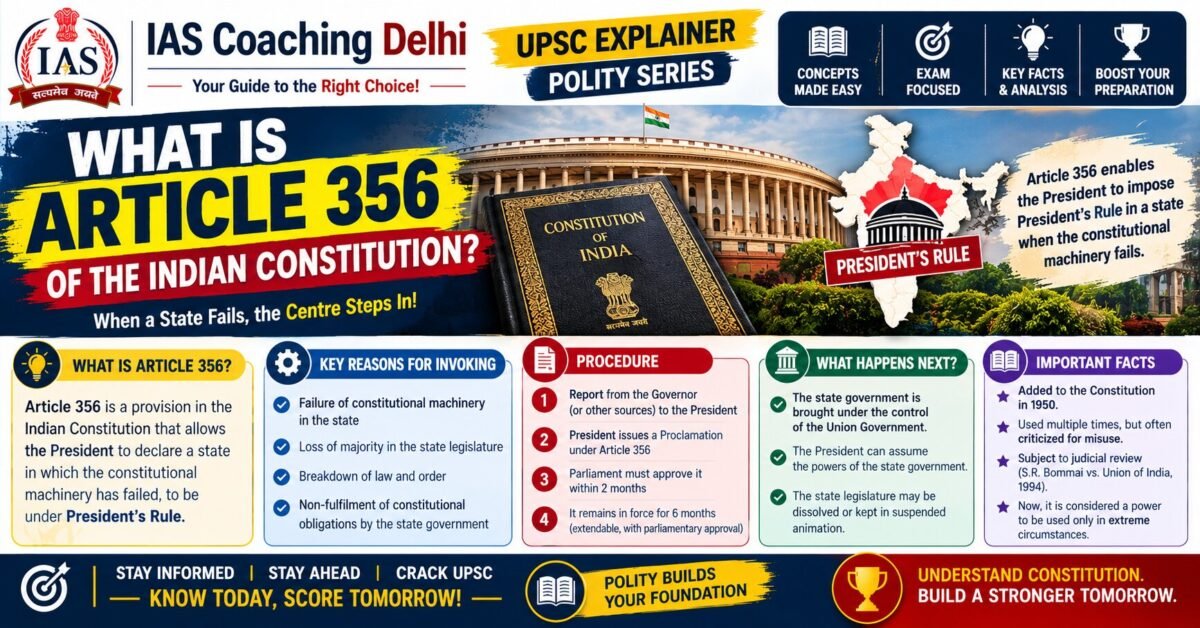
Article 356 is one of the most significant articles in the Indian Constitution from the point of view of UPSC Indian Polity syllabus of topics such as Centre-State Relations and federalism. This article talks about a situation where the constitutional apparatus of the state has failed, and thus allows the Union to take certain constitutional steps in such a state.
As an aspirant, you cannot just stop at learning the definition of Article 356. You must know in what situations Article 356 can be applied, what happens post the imposition of President’s rule in the state, Parliamentary control over its continuance and the verdict passed by the Supreme Court in S.R. Bommai v. Union of India.
Article 356 Explained in Simple Words
The easiest way to understand Article 356 is to think of it as a constitutional emergency provision for states. If the President is satisfied, based on a report from the Governor or otherwise, that the government of a state cannot be carried on according to the Constitution, a Proclamation can be issued under Article 356.
This is commonly known as President’s Rule. During its operation, the Union assumes certain functions of the state government, while Parliament can exercise the legislative powers of the state legislature within the constitutional framework.
For UPSC preparation, remember one important distinction: Article 356 does not mean that the Constitution of the state disappears or that the judiciary comes under Union control. The constitutional provision specifically protects the powers of High Courts from being assumed or suspended through such a Proclamation.
Why This Provision Matters for UPSC
Questions around Article 356 often connect several parts of the syllabus rather than testing the provision in isolation.
A strong preparation strategy should connect it with:
- Centre-State relations
- Federalism in India
- Governor’s constitutional role
- Emergency provisions
- Parliamentary control
- Judicial review
- S.R. Bommai judgment
- Constitutional morality
- Democratic accountability
This integrated approach is much more useful than learning Article 356 as a standalone constitutional fact.
When Can President’s Rule Be Imposed?
The central requirement is the failure of constitutional machinery in a state. Article 356 allows the President to act when satisfied that the state government cannot be carried on in accordance with constitutional provisions. The satisfaction may follow a Governor’s report, but the constitutional text also says “or otherwise”, meaning a Governor’s report is not the only possible source of material.
For exam preparation, candidates should avoid treating every political crisis as an automatic ground for President’s Rule. The provision concerns a constitutional failure, and its use has been subject to judicial scrutiny.
Situations Aspirants Should Understand
A UPSC candidate should be able to discuss situations such as:
- A government losing majority and being unable to establish constitutional legitimacy.
- A political deadlock making constitutional governance impossible.
- A breakdown that prevents the state government from functioning according to constitutional requirements.
- Circumstances where constitutional obligations cannot be effectively discharged.
However, political instability by itself should not automatically be equated with constitutional failure. This distinction is particularly important when writing a UPSC Mains answer on Article 356.
What Happens After Article 356 Is Imposed?
Once a Proclamation under Article 356 is issued, the Constitution permits the President to assume some or all functions of the state government and certain powers vested in the Governor or other state authorities, subject to the limitations mentioned in the Constitution. Parliament may also exercise the legislative powers of the state.
This is where many students make a mistake. They often write that the President simply “takes over the state.” That description is too broad.
A better UPSC answer should explain that the constitutional arrangement involves specific transfers or exercise of governmental and legislative powers, rather than suggesting unlimited central control.
Does the State Legislature Automatically Get Dissolved?
Not necessarily.
The Supreme Court’s reasoning in S.R. Bommai v. Union of India makes it clear that the constitutional powers under Article 356 do not automatically require dissolution of the state legislature. Different constitutional powers may operate in different ways depending on the circumstances.
This is a valuable point for Mains because it demonstrates that you understand the provision rather than simply reproducing a textbook definition.
Parliamentary Approval Is Essential
A Proclamation issued under Article 356 cannot continue indefinitely without parliamentary approval.
Under Article 356, the Proclamation must be laid before both Houses of Parliament and, except in the case of a revocation Proclamation, it ceases to operate after two months unless approved by resolutions of both Houses.
Once approved, President’s Rule normally continues for six months at a time. Its continuation beyond one year is subject to additional constitutional conditions, including the operation of a National Emergency and certification by the Election Commission concerning difficulties in holding elections.
What Should You Remember for Prelims?
For quick revision, remember this sequence:
Proclamation → Parliamentary approval within two months → Six-month continuation → Additional conditions for extension beyond one year → Maximum constitutional limit of three years.
The constitutional conditions are more important than memorising isolated numbers because UPSC can test them through statement-based questions.
Article 356 and the Role of the Governor
The Governor often becomes an important constitutional actor when President’s Rule is considered.
The Governor may submit a report regarding the functioning of the state government. However, the constitutional text does not restrict the President’s consideration only to such a report; Article 356 uses the expression “or otherwise.”
For UPSC preparation, this connects Article 356 with the broader debate about the Governor’s discretionary role and Centre-State relations.
When preparing this topic, do not study the Governor’s role separately from federalism. Instead, connect the concepts so that you can use them together in analytical answers.
S.R. Bommai Case: The Most Important Judicial Development
If you are preparing Article 356 for UPSC, the S.R. Bommai v. Union of India judgment deserves special attention.
The Supreme Court’s 1994 judgment examined whether the President’s action under Article 356 could be subjected to judicial review and addressed the constitutional limits surrounding the provision.
The judgment became a major landmark in Indian federalism. It established that a Proclamation under Article 356 is not beyond judicial scrutiny and strengthened constitutional safeguards against arbitrary use of the provision.
Floor Test and Majority
One of the most useful principles for UPSC answers is the importance of determining a government’s majority on the floor of the legislative assembly, rather than relying solely on subjective assessments outside the House. The Bommai judgment is widely associated with this constitutional principle.
This gives you a powerful way to connect:
Article 356 + Governor + Legislative Majority + Judicial Review + Federalism.
That combination can help you build a much stronger GS Paper II answer.
Article 356 vs National Emergency
Students sometimes confuse Article 356 with Article 352. They are different constitutional provisions.
| Feature | Article 356 | Article 352 |
| Main concern | Failure of constitutional machinery in a state | Emergency involving security of India or specified national threats |
| Scope | State-specific | National or specified territorial scope |
| Common name | President’s Rule | National Emergency |
| Parliamentary role | Approval required | Approval required |
| Constitutional theme | State governance and federalism | National security and emergency governance |
Understanding this distinction can help you avoid common mistakes in UPSC Prelims polity questions.
How to Prepare Article 356 for UPSC
Instead of reading the provision repeatedly, use a three-layer preparation method.
Step 1: Learn the Constitutional Provision
First understand:
- Meaning of constitutional machinery failure
- President’s powers
- Governor’s role
- Parliamentary approval
- Duration and extension
- Relationship with Article 357
Article 357 is particularly relevant because it deals with the exercise of legislative powers under a Proclamation issued under Article 356.
Step 2: Connect It With the Supreme Court
Next, study S.R. Bommai v. Union of India. Focus on judicial review, federalism, legislative majority, and constitutional limitations.
Step 3: Practice Mains Answers
Try questions such as:
“Discuss the constitutional safeguards against the misuse of Article 356.”
Or:
“How has judicial intervention strengthened federalism in the context of President’s Rule?”
Your answer should contain the constitutional provision, relevant judicial precedent, analysis, and a balanced conclusion.
How to Write a Better Article 356 Answer
A high-quality UPSC Mains response should not look like a constitutional definition copied from a book.
Use this structure:
Introduction: Define Article 356 and mention its purpose.
Body: Explain the constitutional mechanism, parliamentary control, Governor’s role, and limitations.
Judicial angle: Bring in S.R. Bommai.
Analysis: Discuss federalism, democratic accountability, and possible misuse.
Conclusion: Emphasise constitutional restraint and cooperative federalism.
This structure gives your answer both factual accuracy and analytical depth, which is important in GS Paper II.
Common Mistakes Aspirants Make
A few mistakes repeatedly reduce the quality of answers on constitutional provisions.
Treating President’s Rule as Unlimited Central Power
Article 356 gives the Union significant constitutional powers, but these powers are not unlimited. The provision operates within constitutional restrictions and is subject to parliamentary and judicial controls.
Ignoring S.R. Bommai
Writing about Article 356 without mentioning the landmark Supreme Court judgment can make an otherwise decent answer feel incomplete.
Confusing Political Crisis With Constitutional Failure
A government facing political difficulty does not automatically justify President’s Rule. Your answer should focus on whether constitutional governance has actually failed.
Forgetting Federalism
Article 356 is closely connected to India’s federal structure. A good answer should examine the balance between Union authority and state autonomy.
Why Article 356 Matters in Current UPSC Preparation
Constitutional provisions become easier to remember when you understand their practical significance. Article 356 sits at the intersection of Indian Polity, governance, federalism, constitutional law, and judicial review.
For an aspirant preparing for UPSC CSE, this makes the topic useful across multiple answer-writing themes. You can potentially use it while discussing the Governor, Centre-State relations, cooperative federalism, constitutional morality, democratic accountability, and judicial review.
This is also why revision should focus on conceptual connections rather than isolated facts.
Build a Stronger UPSC Polity Preparation Strategy
Aspirants preparing through IAS Coaching Delhi resources should approach constitutional topics with a combination of static concepts, landmark judgments, current developments, and answer-writing practice. The website already covers UPSC-oriented subjects such as Indian Polity Notes, Centre-State Relations, UPSC Exam Pattern, Civil Services Exam Preparation, and UPSC Preparation 2026, so Article 356 can be studied as part of this broader preparation framework.
For serious preparation, don’t stop after reading one explanation. Revise the constitutional provision, connect it with S.R. Bommai, solve Prelims questions, and then practise a 150- or 250-word Mains response.
That approach turns a static polity topic into an exam-ready preparation resource.
Conclusion
Article 356 is a constitutional provision that provides for the failure of the constitutional machinery in the state. The implementation of this article requires the involvement of the President, Parliament, the state government and constitutional institutions – this makes this topic very relevant for aspirants of the UPSC.
This topic can be prepared by not sticking only to rote learning but by comprehending the constitutional mechanism, revising the safeguards available in parliament, understanding the judgment of S.R. Bommai v. Union of India and practicing its application in questions of federalism and Center-State relations. Thus, you will be able to apply this topic in UPSC Prelims and GS Paper II Mains answers.
Frequently Asked Questions
Q.1 What is Article 356 in simple words?
Article 356 allows the President to take constitutional action when the government of a state cannot be carried on according to the Constitution. It is commonly associated with President’s Rule.
Q.2 What is Article 356 called?
Article 356 is commonly known as the provision for President’s Rule because it enables the Union to assume specified constitutional functions of a state government when the constitutional machinery has failed.
Q.3 Can Article 356 be challenged in court?
Yes. The Supreme Court’s judgment in S.R. Bommai v. Union of India established important principles concerning judicial review of a Proclamation under Article 356.
Q.4 How long can President’s Rule continue?
A Proclamation initially requires parliamentary approval within two months and is normally continued in periods of six months. Continuation beyond one year requires additional constitutional conditions, and the overall maximum is three years subject to those requirements.
Q.5 Why is Article 356 important for UPSC?
It is important because it connects Indian Polity, federalism, Centre-State relations, Governor’s role, parliamentary control, and judicial review. The S.R. Bommai judgment makes it particularly relevant for UPSC GS Paper II.