
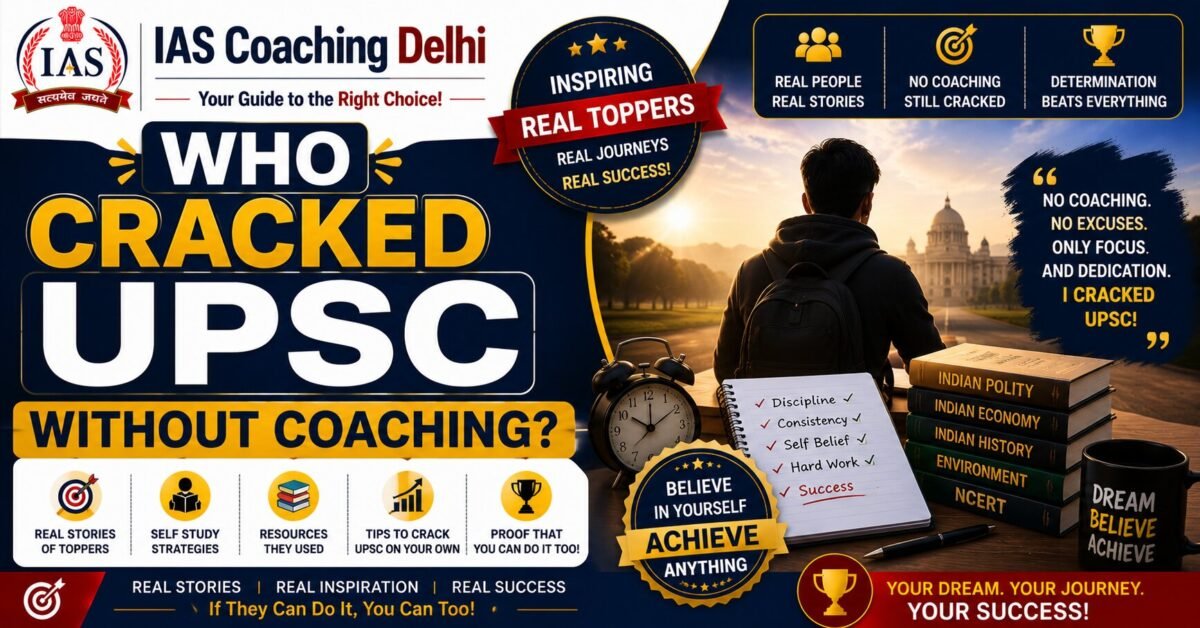
Year after year, thousands of UPSC aspirants pose the same query— Who Cracked UPSC Without Coaching? Your response may shock you, as many have successfully cracked the UPSC exam by studying on their own, through self-discipline and smart preparation.
Nevertheless, studying alone is not something for everyone, because UPSC is one of the toughest exams conducted in India and all aspirants have varying styles and methods of learning, background and preparation plans for the exams. While there are those who do extremely well by studying on their own, there are also those who benefit a lot more by being coached.
Now, if you are wondering if you must study on your own or be a part of a coaching institution, here is your guide to making the right decision.
Can You Really Crack UPSC Without Coaching?
The short answer is yes.
Many UPSC toppers have shared that they relied mainly on self-study, standard books, NCERTs, newspapers, mock tests, and answer-writing practice instead of classroom coaching. What they had in common was not luck—it was consistency, discipline, and a well-planned study routine.
Preparing without coaching means taking complete responsibility for your preparation. You need to understand the syllabus, analyze previous year question papers, choose reliable study resources, and regularly evaluate your progress.
Self-study also requires strong self-motivation. Without fixed class schedules, students must create their own study plans and stay committed over many months. Those who can maintain this discipline often perform well, even without joining a coaching institute.
Common Qualities of Aspirants Who Succeed Without Coaching
Successful self-study candidates usually develop habits that help them stay focused throughout their preparation.
Some of these qualities include:
- Clear understanding of the UPSC syllabus
- Consistent daily study routine
- Regular newspaper reading
- Effective note-making
- Strong answer-writing practice
- Frequent revision
- Mock test participation
- Ability to learn independently
These habits are often more important than the number of study hours. Quality preparation consistently produces better results than simply studying for long hours.
Self-Study vs Coaching: Which One Should You Choose?
There is no universal answer because every aspirant has different requirements.
| Self Study | Coaching Support |
| Flexible schedule | Structured timetable |
| Lower preparation cost | Expert mentorship |
| Complete independence | Regular guidance |
| Requires self-discipline | Continuous evaluation |
| Self-analysis required | Performance tracking |
Self-study works well for candidates who already have good academic discipline and know how to organize their preparation.
Coaching can be beneficial for aspirants who need structured guidance, doubt-solving support, or help understanding complex topics.
Instead of asking which method is better, ask yourself which method suits your learning style.
Challenges of Preparing Without Coaching
Although many candidates succeed independently, self-study comes with its own challenges.
One of the biggest difficulties is choosing the right study material. With thousands of books, YouTube channels, online notes, and current affairs resources available, beginners often become confused about what to study and what to ignore.
Another challenge is answer writing. Many aspirants continue preparing for months without getting their answers evaluated. This makes it difficult to identify mistakes before the actual examination.
Time management is another common issue. Without deadlines or classroom schedules, many students struggle to complete the syllabus on time.
Understanding these challenges early allows aspirants to build a preparation strategy that minimizes mistakes.
Situations Where Coaching Can Be Helpful
While coaching is not compulsory, it can provide value in certain situations.
You may benefit from coaching if you:
- Are preparing for UPSC for the first time
- Need guidance for answer writing
- Want regular mentorship
- Find it difficult to maintain discipline
- Need a structured preparation plan
- Prefer classroom learning
Coaching should be viewed as a support system rather than a shortcut to success.
Ultimately, your dedication determines your results.
How to Build an Effective Self-Study Plan
If you decide to prepare independently, having a structured study plan is essential.
Start by understanding the UPSC syllabus in detail. Divide the syllabus into manageable sections and create weekly study goals.
A balanced study schedule should include:
- Static subjects
- Current affairs
- Revision
- Answer writing
- Mock tests
- CSAT practice
Avoid collecting too many study resources. Instead, revise a limited number of reliable books multiple times.
Consistency matters far more than studying from dozens of different sources.
Smart Resources Used by Successful Self-Study Aspirants
Candidates who prepare independently usually rely on trusted resources rather than chasing every new material available online.
Commonly used resources include:
- NCERT textbooks
- Standard reference books
- Government reports
- PIB updates
- Newspapers
- Monthly current affairs magazines
- Previous year UPSC papers
- Mock tests
Selecting fewer high-quality resources helps improve revision and retention.
Mistakes That Prevent Aspirants From Clearing UPSC
Many candidates fail not because they lack intelligence but because they repeat avoidable mistakes.
Some common mistakes include:
- Ignoring the official syllabus
- Studying too many books
- Skipping answer writing
- Not revising regularly
- Depending only on current affairs
- Avoiding mock tests
- Comparing preparation with others
Recognizing these mistakes early can significantly improve your preparation strategy.
Real Examples of Aspirants Who Cracked UPSC Without Coaching
One of the reasons this question is searched so often is because many aspirants want proof that success is possible without joining a coaching institute. Over the years, several UPSC toppers have shared that they relied mainly on self-study, online resources, standard books, and disciplined revision instead of full-time classroom coaching.
What made these candidates successful was not a secret strategy or expensive study material. They followed a practical approach, remained consistent, and kept improving through regular answer writing and mock tests. Rather than changing resources repeatedly, they mastered a limited set of books and revised them multiple times.
At the same time, these toppers also admitted that self-study requires honesty and self-discipline. They regularly analyzed their weaknesses and worked on them. Their success proves that coaching is not compulsory, but a well-planned preparation strategy certainly is.
How to Decide Whether Self-Study Is Right for You
Instead of following what others are doing, evaluate your own preparation style before making a decision.
Self-study may be the right option if you:
- Can study consistently every day.
- Understand concepts without classroom support.
- Are comfortable making your own study schedule.
- Can evaluate your own progress.
- Stay motivated without external pressure.
You should consider professional guidance if you:
- Feel confused about where to start.
- Need regular mentoring.
- Struggle with answer writing.
- Find it difficult to stay disciplined.
- Want structured preparation with expert support.
There is no perfect choice for everyone. The best decision is the one that matches your learning style and long-term preparation goals.
A Practical Roadmap to Crack UPSC
Whether you choose self-study or coaching, your preparation should follow a structured path.
Step 1: Understand the UPSC Syllabus
Read the official syllabus carefully before opening any book. It acts as your roadmap throughout the preparation journey.
Step 2: Build Strong Fundamentals
Begin with NCERT books before moving to advanced reference material. Strong basics make complex topics much easier to understand.
Step 3: Stay Updated
Read a reliable newspaper daily and make short notes of important current affairs. Focus on understanding issues instead of memorizing facts.
Step 4: Practice Answer Writing
Writing practice improves analytical thinking and presentation skills. Start early instead of waiting until the Mains examination approaches.
Step 5: Attempt Mock Tests
Regular mock tests help improve speed, accuracy, and confidence. They also highlight weak areas that require additional attention.
Step 6: Revise Regularly
Revision is one of the biggest differences between successful and unsuccessful aspirants. Reading a book once is never enough. Multiple revisions improve retention and confidence.
When Professional Guidance Can Make a Difference
Although many candidates prepare independently, professional guidance can help reduce common mistakes and save valuable preparation time.
A structured coaching program often provides:
- A well-planned study schedule
- Expert faculty guidance
- Updated study material
- Regular mock tests
- Personalized feedback
- Answer-writing evaluation
- Interview preparation
For aspirants who struggle with planning or maintaining consistency, guided preparation can provide the direction needed to stay focused throughout the UPSC journey.
Preparing Smarter With Expert Support
Every UPSC aspirant has different strengths and challenges. Some students perform exceptionally well through self-study, while others improve significantly with proper mentoring and structured preparation.
If you are looking for expert guidance, trusted resources, and a systematic preparation approach, IAS Coaching Delhi offers valuable information about UPSC coaching institutes, preparation strategies, and admission guidance. The platform helps aspirants compare coaching options, understand different courses, and make informed decisions based on their preparation needs rather than marketing claims.
Choosing the right guidance at the right stage can help you prepare more confidently and avoid common preparation mistakes.
Conclusion
Thus, Who has cracked UPSC without coaching? Well, the answer is quite straightforward—a lot of aspirants have succeeded through self-study, planning, and hard work. The stories of their success illustrate that coaching is not an essential element for passing UPSC exam.
Nonetheless, success in UPSC examination does not depend on your choice to pursue coaching, but rather depends on how well prepared you will be regardless of the way chosen. If you are able to keep yourself consistent in studies, make proper plans, and regularly track your progress, then self-study might be a wonderful choice for you. Otherwise, if you feel the need to have professional help, mentorship, and proper learning environment, then coaching can help you achieve your goal.
FAQs
Q.1 Who cracked UPSC without coaching?
Many UPSC toppers have cleared the examination through self-study by following a disciplined study plan, revising consistently, and practicing answer writing regularly.
Q.2 Is coaching necessary to clear UPSC?
No. Coaching is not compulsory. While some aspirants succeed through self-study, others benefit from structured guidance and mentorship.
Q.3 How many hours should I study for UPSC without coaching?
There is no fixed number. Most successful aspirants focus on studying consistently with quality learning, regular revision, and mock tests rather than counting hours.
Q.4 Which books are enough for UPSC self-study?
NCERT textbooks, standard reference books, previous year question papers, current affairs resources, and mock tests form the foundation of effective self-study.
Q.5 Can beginners prepare for UPSC without coaching?
Yes. Beginners can prepare without coaching if they have a clear strategy, reliable study resources, and the discipline to follow a consistent preparation schedule.