
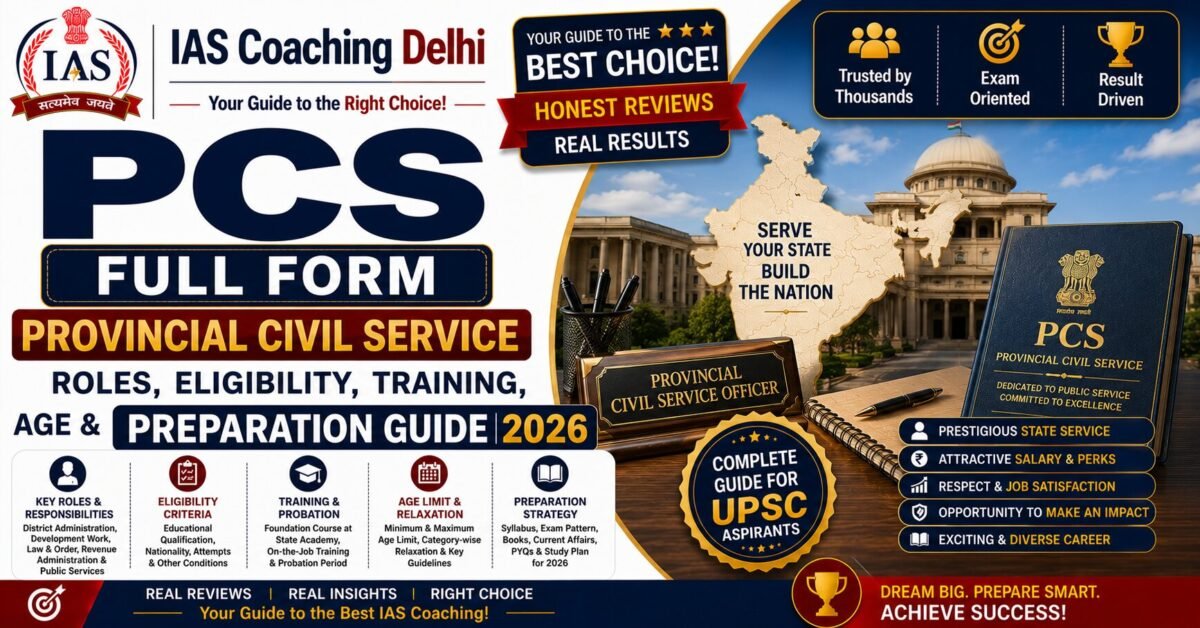
Each year, many aspirants aspire to bag a coveted government position through the Provincial Civil Services examination. Aspirants looking forward to building their careers in the field of state administrative services should first know about the PCS Full Form. Apart from knowing the acronym, aspirants will need a clear idea about the eligibility criteria, selection process, role of the job, training, and the best approach for preparation.
There has been a rising demand for State Civil Services as these jobs provide security, administrative powers, career growth, and an opportunity to serve society. But to succeed in any exam, one not only needs to work hard but also needs the right guidance and preparation strategy. This guide will help aspirants understand everything about the PCS examination and prepare effectively for 2026.
What is the PCS Full Form?
The PCS Full Form is Provincial Civil Services. It refers to state-level administrative services conducted by various State Public Service Commissions such as UPPSC, MPPSC, UKPSC, BPSC, RPSC, and other state commissions.
Unlike the UPSC Civil Services Examination, which recruits officers for All India and Central Services, the PCS examination recruits officers to serve within a particular state. Selected candidates are appointed to various administrative departments where they handle governance, revenue administration, law and order, development projects, and public welfare schemes.
For aspirants who want to build a respected career in state administration, PCS offers an excellent opportunity to work directly with government departments while contributing to policy implementation at the district and state levels.
Why is PCS Becoming a Popular Career Choice?
The competition for State Civil Services has increased steadily over the last few years. Candidates are no longer considering PCS as an alternative to UPSC. Instead, many aspirants choose it as their primary career goal because of the professional growth, stability, and leadership opportunities it offers.
Some of the major reasons candidates prefer PCS include:
- Administrative authority at the state level
- Attractive salary and government benefits
- Excellent career growth opportunities
- Job security
- Social respect and responsibility
- Opportunity to work in public administration
- Promotion opportunities to higher administrative positions
Apart from financial stability, PCS officers also play a significant role in implementing government policies, maintaining public administration, and improving governance at the grassroots level.
Roles and Responsibilities of a PCS Officer
A PCS officer performs a wide range of administrative duties depending on the department and designation. Their responsibilities directly influence governance, development, and public service delivery within the state.
Some common responsibilities include:
- Supervising district administration
- Implementing state government schemes
- Revenue administration
- Disaster management
- Law and order coordination
- Public grievance redressal
- Monitoring developmental projects
- Administrative inspections
- Coordination between departments
- Ensuring effective policy implementation
As officers gain experience and seniority, they may receive higher administrative responsibilities, making the role both challenging and rewarding.
PCS Eligibility Criteria 2026
Before starting preparation, every aspirant should understand the eligibility requirements. Although minor variations may exist across different State Public Service Commissions, the basic eligibility criteria remain similar.
Educational Qualification
Candidates should possess a bachelor’s degree from a recognized university. Students appearing in their final year may also be eligible according to the respective state notification.
Accepted educational backgrounds include:
- Arts
- Commerce
- Science
- Engineering
- Law
- Management
- Medical
- Agriculture
A graduation degree remains the minimum educational qualification for most PCS examinations.
Nationality
Applicants must be Indian citizens. Some state commissions may prescribe additional domicile requirements depending on reservation policies and recruitment rules.
Candidates should carefully read the official notification before applying.
PCS Age Limit
The age limit varies according to the recruiting State Public Service Commission.
Generally, candidates fall within the following age bracket:
| Category | Typical Age Limit |
| General Category | 21–40 Years |
| OBC | Age Relaxation as per Rules |
| SC/ST | Age Relaxation as per Rules |
| PwD | Additional Relaxation |
Since every state follows its own recruitment policy, applicants should verify the latest notification before submitting their application.
Selection Process
The recruitment process usually consists of multiple stages designed to evaluate both academic knowledge and administrative aptitude.
Preliminary Examination
The Preliminary Examination serves as the screening stage. It mainly consists of objective-type questions covering subjects such as:
- General Studies
- Current Affairs
- Indian Polity
- Economy
- Geography
- History
- Environment
- General Science
- Aptitude
Only candidates qualifying the Preliminary Examination move to the next stage.
Main Examination
The Main Examination evaluates analytical ability, conceptual understanding, and writing skills.
It generally includes descriptive papers covering:
- Essay
- General Studies
- General Hindi (for applicable states)
- Optional Subjects (where applicable)
Success in the Mains depends heavily on answer-writing practice, conceptual clarity, and regular revision.
Interview
Candidates who qualify the written examination are invited for the Personality Test.
The interview assesses:
- Leadership qualities
- Communication skills
- Decision-making ability
- Administrative aptitude
- Confidence
- Awareness of national and state issues
A balanced personality combined with sound knowledge significantly improves performance during this stage.
PCS Training Process
After final selection, candidates undergo professional training before receiving their postings.
Training focuses on developing administrative skills required for effective governance.
Training generally includes:
- Public Administration
- Government Procedures
- Revenue Administration
- Legal Framework
- Financial Management
- District Administration
- Field Visits
- Leadership Development
Practical exposure during training prepares officers for real administrative challenges after appointment.
Salary and Career Growth
One of the reasons many aspirants choose PCS is the attractive career progression.
Selected officers receive:
- Competitive salary
- Dearness Allowance
- House Rent Allowance
- Medical benefits
- Pension benefits (as applicable)
- Official accommodation (depending on posting)
- Government vehicle (for eligible posts)
Apart from financial benefits, officers receive opportunities for departmental promotions and higher administrative responsibilities based on experience and performance.
Common Mistakes Candidates Should Avoid
Many aspirants spend months preparing without a structured strategy. Avoiding common mistakes can save valuable time and improve overall performance.
Some mistakes include:
- Ignoring the latest syllabus
- Studying from too many sources
- Not practicing answer writing
- Neglecting current affairs
- Skipping mock tests
- Poor revision planning
- Lack of consistency
Building a realistic study schedule and following it regularly often produces better results than studying for long hours without direction.
Choose the Right Preparation Strategy
Preparing for PCS requires more than reading books. Candidates need a structured roadmap that combines conceptual learning, regular revision, mock tests, and answer-writing practice.
A well-planned preparation strategy should include:
- Understanding the latest syllabus
- Following a realistic study timetable
- Solving previous years’ question papers
- Regular mock test practice
- Daily newspaper reading
- Monthly current affairs revision
- Continuous answer-writing practice
Choosing the right guidance at the beginning of your preparation can help you avoid unnecessary mistakes and stay focused throughout your journey.
Best Books for PCS Preparation
Selecting the right study material is just as important as following a disciplined study plan. Many aspirants make the mistake of collecting too many books, which often leads to confusion and incomplete preparation. Instead, focus on a limited number of reliable resources and revise them multiple times.
For General Studies, NCERT books remain the foundation for building conceptual clarity. Standard reference books for Polity, History, Geography, Economy, Environment, and Modern India should be added gradually. Along with these, reading a daily newspaper and monthly current affairs magazine helps improve analytical understanding.
Candidates preparing for descriptive papers should also practice answer writing regularly. Solving previous years’ PCS question papers gives a clear idea of the exam pattern, question trends, and difficulty level. Combining quality resources with consistent revision is far more effective than studying from multiple sources.
PCS Preparation Strategy for 2026
Every successful candidate follows a preparation strategy rather than studying randomly. Since the competition is increasing every year, aspirants should begin their preparation well in advance and divide the syllabus into manageable sections.
A smart preparation plan includes:
- Understand the latest PCS syllabus before starting.
- Create a realistic daily and weekly study schedule.
- Build strong fundamentals using NCERT books.
- Cover one subject at a time instead of multitasking.
- Practice mock tests regularly.
- Revise completed topics every week.
- Improve answer-writing skills for the Mains examination.
- Stay updated with current affairs through trusted sources.
Consistency matters more than studying for long hours occasionally. Even five to six productive hours every day can produce excellent results when followed with discipline.
Online vs Offline PCS Coaching
Choosing between online and offline coaching depends on your learning style, availability, and personal preferences. Both options have their own advantages, and the right choice varies from one aspirant to another.
Online Coaching
Online coaching offers flexibility and convenience. It is suitable for working professionals and students who cannot relocate.
Benefits include:
- Learn from anywhere
- Recorded lectures for revision
- Flexible study schedule
- Lower travel expenses
- Easy access to digital study material
Offline Coaching
Classroom coaching provides a competitive learning environment and direct interaction with faculty members.
Advantages include:
- Face-to-face doubt clearing
- Better classroom discipline
- Peer learning
- Regular classroom discussions
- Immediate feedback from mentors
Candidates should choose the learning mode that matches their schedule, preparation level, and comfort.
How to Choose the Right PCS Coaching Institute
A coaching institute cannot guarantee selection, but the right guidance can simplify your preparation journey. Before enrolling, compare institutes based on quality rather than marketing claims.
Consider these factors before making your decision:
- Experienced faculty members
- Updated study material
- Regular mock tests
- Answer-writing practice
- Student mentorship
- Small or manageable batch size
- Doubt-clearing sessions
- Consistent academic support
Taking demo classes, reading genuine student reviews, and understanding the teaching methodology can help you choose the right institute.
Why Guided Preparation Makes a Difference
Competitive examinations like PCS require a well-planned approach. Self-study is essential, but expert guidance often helps candidates avoid common mistakes and stay focused on the syllabus.
For aspirants looking for structured preparation, IAS Coaching Delhi provides guidance through experienced mentors, updated study resources, regular test practice, and exam-oriented strategies. The focus remains on conceptual learning, answer-writing improvement, and current affairs integration rather than rote memorization.
A balanced combination of quality guidance, disciplined self-study, and regular evaluation helps candidates prepare with greater confidence and clarity.
Common Challenges Faced by PCS Aspirants
Most aspirants experience similar challenges during preparation. Recognizing these problems early can help you overcome them effectively.
Some common challenges include:
- Managing a vast syllabus
- Maintaining consistency
- Time management
- Current affairs revision
- Lack of answer-writing practice
- Low confidence after mock tests
- Balancing work and preparation
Instead of changing study material frequently, focus on strengthening concepts and revising regularly. Progress comes from consistency, not perfection.
Smart Revision Techniques
Revision is one of the most overlooked aspects of PCS preparation. Reading new topics without revising previously studied concepts often reduces retention.
Effective revision methods include:
- Weekly subject-wise revision
- Monthly current affairs recap
- Mind maps for quick learning
- Short handwritten notes
- Previous year question paper practice
- Mock test analysis
A proper revision cycle improves recall and boosts confidence before the examination.
Career Growth After Becoming a PCS Officer
A career in Provincial Civil Services offers long-term professional growth and diverse administrative responsibilities. Officers begin their careers in various state administrative departments and gradually move to higher positions based on seniority, performance, and departmental promotions.
Apart from financial benefits, PCS officers gain valuable administrative experience while contributing to governance and public welfare. Their work directly impacts policy implementation, public services, and district administration.
For candidates seeking a stable career with leadership opportunities and public service responsibilities, PCS remains one of the most respected career options in the state government sector.
Conclusion
The meaning of PCS Full Form is just the first step towards an excellent administrative career. Preparation for the exam requires good planning and preparation and also revision and proper guidance. Do not try to take any shortcuts but prepare properly for all the aspects and write answers well and stay abreast of the current affairs.
If you want to pursue your career in State Civil Services, begin your preparation with a proper strategy and proper study materials. With proper effort and guidance, you can definitely proceed towards realizing your dream of becoming a PCS officer in 2026.
Frequently Asked Questions (FAQs)
Q.1 What is the PCS Full Form?
The PCS Full Form is Provincial Civil Services, a state-level civil service examination conducted by various State Public Service Commissions.
Q.2 Who is eligible for the PCS examination?
Candidates with a bachelor’s degree from a recognized university who meet the prescribed age criteria can apply, subject to the eligibility conditions mentioned in the respective state notification.
Q.3 What is the age limit for PCS 2026?
The age limit varies by state. In most cases, the minimum age is 21 years, while the upper age limit and relaxations depend on the recruiting commission.
Q.4 Is coaching necessary for PCS preparation?
Coaching is not mandatory, but structured guidance, regular mock tests, and expert mentorship can help many aspirants prepare more effectively.
Q.5 How should I start preparing for PCS?
Begin by understanding the syllabus, selecting standard study material, creating a realistic timetable, following current affairs regularly, and practicing previous years’ question papers.