
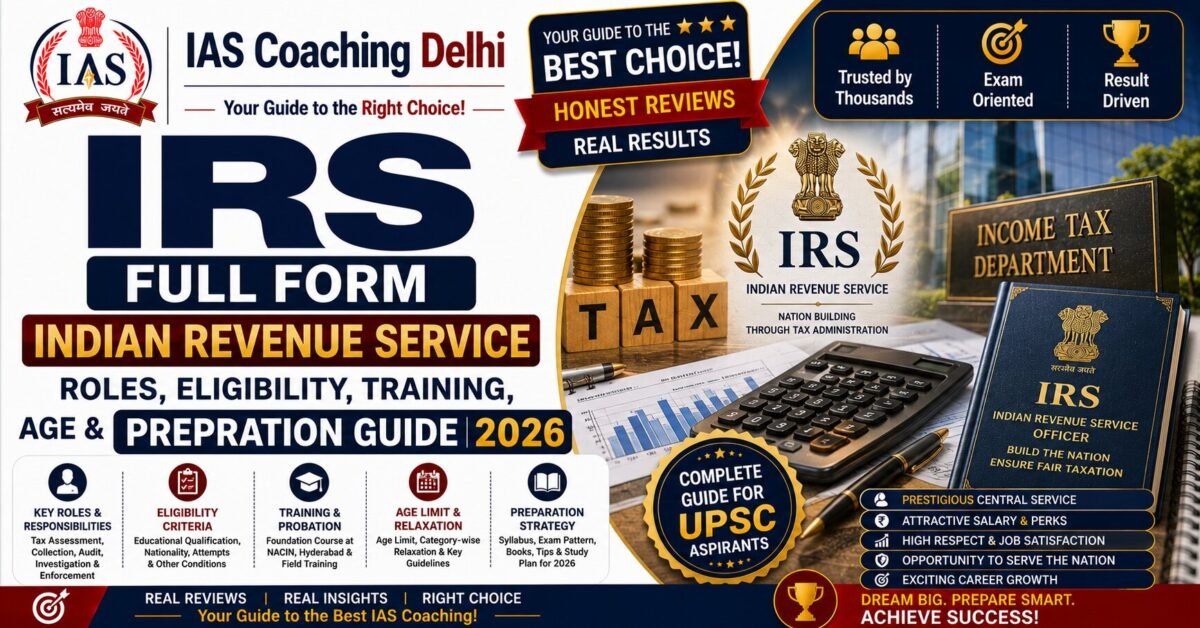
IRS Full Form is Indian Revenue Service, and it is one of the most respected Group ‘A’ Civil Services of India. Every year, many UPSC applicants try to get this job due to the respect, job security, and the chance of contributing something important to the nation in terms of taxes and finance.
In order to make a successful career in Civil Services, it is very important to know the duties, eligibility, process of training, and preparation strategy before filling up the UPSC application form. Here you will find all the information that you require to become an IRS officer in 2026.
What is the IRS Full Form?
The IRS Full Form stands for Indian Revenue Service, a Central Civil Service that functions under the Government of India. Officers are responsible for administering and enforcing the country’s direct and indirect tax laws while supporting economic growth and ensuring tax compliance.
The service is divided into two major branches:
- IRS (Income Tax) – Works under the Central Board of Direct Taxes (CBDT).
- IRS (Customs & Indirect Taxes) – Works under the Central Board of Indirect Taxes and Customs (CBIC).
Both branches play a significant role in strengthening India’s financial system through tax administration, revenue collection, policy implementation, and financial investigations.
For aspirants who enjoy administration, finance, law, and public service, the Indian Revenue Service offers an excellent career path with diverse responsibilities and long-term growth opportunities.
Why is the Indian Revenue Service a Popular Career Choice?
Many UPSC aspirants choose the Indian Revenue Service because it combines administrative authority with specialized financial responsibilities. Unlike many other government jobs, IRS officers work on policy implementation, tax intelligence, anti-smuggling operations, financial investigations, and revenue management.
Some of the key advantages include:
- Prestigious Group ‘A’ Civil Service
- Excellent career progression
- Attractive salary and government benefits
- Opportunity to work across India
- Exposure to financial administration
- Strong work-life balance in many postings
- Leadership opportunities in tax administration
Apart from career stability, IRS officers contribute directly to the nation’s economic development by ensuring transparency and improving tax governance.
Roles and Responsibilities of an IRS Officer
The responsibilities of an IRS officer vary depending on the department and posting. However, the primary objective remains the same—ensuring effective implementation of tax laws and protecting government revenue.
Key Responsibilities Include
- Tax assessment and administration
- Conducting financial investigations
- Preventing tax evasion
- Monitoring customs operations
- Implementing GST and indirect tax policies
- Intelligence gathering
- Handling revenue collection
- Policy execution
- Public awareness regarding taxation
- Coordinating with various government agencies
An IRS officer also works closely with legal experts, auditors, financial institutions, and investigative agencies whenever required.
IRS (Income Tax) vs IRS (Customs & Indirect Taxes)
Many candidates preparing for UPSC are unaware that the Indian Revenue Service consists of two different branches.
| Feature | IRS (Income Tax) | IRS (Customs & Indirect Taxes) |
| Governing Body | CBDT | CBIC |
| Main Responsibility | Direct Taxes | GST, Customs & Indirect Taxes |
| Focus Area | Income Tax Administration | Customs, GST & Border Revenue |
| Nature of Work | Tax Assessment & Investigation | Customs Enforcement & Revenue Collection |
Both services provide excellent career opportunities and are allocated through the UPSC Civil Services Examination based on rank and preference.
Eligibility Criteria for IRS in 2026
Before starting your preparation, it is important to understand the eligibility requirements.
Educational Qualification
Candidates must possess a bachelor’s degree from a recognized university.
Students appearing in the final year of graduation may also apply, provided they meet UPSC guidelines before the final selection process.
Nationality
Applicants must be Indian citizens for appointment to the Indian Revenue Service.
Age Limit
For the UPSC Civil Services Examination 2026, candidates must satisfy the age criteria prescribed in the official notification.
Generally:
- Minimum Age: 21 Years
- Maximum Age: 32 Years
Age relaxations are available for reserved categories according to Government of India rules.
Candidates should always verify the latest UPSC notification before applying, as eligibility conditions may be updated.
Educational Background Suitable for IRS
One of the biggest advantages of the UPSC examination is that candidates from any academic background can compete.
Students commonly come from:
- Engineering
- Commerce
- Science
- Arts
- Law
- Management
- Medical
Although there is no mandatory educational stream, candidates with strong analytical and reasoning skills often perform well during preparation.
Selection Process for Indian Revenue Service
The Indian Revenue Service is allocated through the UPSC Civil Services Examination, one of India’s most competitive examinations.
The selection process consists of three stages.
Stage 1 – Preliminary Examination
This is a screening examination consisting of objective-type papers.
It evaluates:
- General Studies
- CSAT
- Current Affairs
- Aptitude
- Logical Reasoning
Only candidates qualifying this stage become eligible for the Mains Examination.
Stage 2 – UPSC Mains Examination
The Mains examination is descriptive in nature and tests a candidate’s analytical ability, writing skills, subject knowledge, and overall understanding of national and international issues.
Preparation should focus on:
- Answer writing
- Essay writing
- Ethics
- Governance
- Economy
- Polity
- International Relations
- Optional Subject
This stage plays a major role in determining the final rank.
Stage 3 – Personality Test
The final stage evaluates more than academic knowledge.
The interview board assesses:
- Decision-making ability
- Leadership qualities
- Communication skills
- Confidence
- Administrative aptitude
- Awareness of current issues
A balanced personality combined with strong preparation significantly improves the chances of securing a good rank.
IRS Training Process
After final selection, IRS officers undergo professional training before taking charge of official responsibilities.
Training is designed to develop administrative competence, legal understanding, financial management skills, and practical exposure to taxation systems.
The training generally includes:
- Foundation Course
- Departmental Training
- Field Attachments
- Practical Tax Administration
- Legal Procedures
- Financial Investigation Techniques
- Public Administration
- Leadership Development
This structured training prepares officers to handle real-world responsibilities efficiently.
Salary and Career Growth
Many aspirants are attracted to the Indian Revenue Service because of its excellent career progression and attractive compensation package.
Apart from the basic salary under the government pay structure, officers receive several benefits, including:
- Dearness Allowance (DA)
- House Rent Allowance (HRA)
- Transport Allowance
- Medical Facilities
- Government Accommodation (as per eligibility)
- Pension and Retirement Benefits
- Official Vehicle (depending on posting)
With promotions and experience, officers move to senior administrative positions within the department, taking on larger responsibilities in policy implementation, investigation, and revenue management.
Why Early Preparation Makes a Difference
Every year, lakhs of candidates appear for the Civil Services Examination, but only a small percentage secure top ranks. Starting your preparation early gives you enough time to build concepts, revise regularly, and practice answer writing without unnecessary pressure.
Instead of depending only on memorization, focus on developing analytical thinking, improving writing skills, and understanding current affairs. A well-planned preparation strategy is always more effective than studying long hours without direction.
Best Preparation Strategy for IRS Exam 2026
Qualifying for the Civil Services Examination requires more than hard work—it demands consistency, smart planning, and the right strategy. Since the Indian Revenue Service is allocated through the UPSC Civil Services Examination, your preparation should focus on securing a competitive rank rather than targeting a particular service alone.
Begin by understanding the latest UPSC syllabus and exam pattern. Once you know what to study, divide the syllabus into manageable sections and prepare a realistic timetable. Cover one subject at a time while revising previously studied topics regularly. This approach helps improve retention and prevents information overload.
A balanced preparation strategy should include:
- Complete the NCERT books first.
- Build strong fundamentals for every subject.
- Read a quality daily newspaper.
- Follow one reliable current affairs source.
- Practice answer writing every week.
- Solve previous years’ question papers.
- Attempt mock tests regularly.
- Revise consistently instead of studying new topics every day.
Students who maintain discipline over several months generally perform better than those who rely on last-minute preparation.
Books and Study Resources for UPSC Preparation
Choosing the right study material is just as important as following the right strategy. Too many resources often create confusion and reduce revision time.
Some commonly recommended resources include:
General Studies
- NCERT Books (Class VI–XII)
- Indian Polity by M. Laxmikanth
- Indian Economy by Ramesh Singh
- Certificate Physical & Human Geography by G.C. Leong
- Spectrum Modern History
- Environment resources recommended by UPSC mentors
Current Affairs
- The Hindu or The Indian Express
- PIB Updates
- Yojana Magazine
- Kurukshetra Magazine
- Monthly Current Affairs Compilations
Answer Writing
- Daily practice questions
- Previous Year Papers
- UPSC Test Series
Instead of collecting multiple books on the same topic, revise selected resources multiple times.
Common Mistakes UPSC Aspirants Should Avoid
Many capable candidates fail not because they lack knowledge, but because they make avoidable mistakes during preparation.
Some of the most common mistakes include:
- Ignoring the official UPSC syllabus
- Collecting too many study materials
- Skipping answer-writing practice
- Neglecting current affairs
- Not revising regularly
- Depending only on coaching notes
- Avoiding mock tests
- Poor time management
Avoiding these mistakes can significantly improve your preparation quality and overall confidence.
How to Improve Your UPSC Rank
Every UPSC aspirant dreams of securing a rank that opens the door to their preferred service. Achieving a higher rank requires continuous improvement throughout the preparation journey.
Focus on these areas:
- Improve conceptual clarity.
- Practice writing structured answers.
- Strengthen ethics and essay preparation.
- Analyze mock test performance.
- Revise regularly.
- Stay consistent with current affairs.
- Develop analytical thinking instead of rote learning.
Small improvements made consistently over time often produce remarkable results in the final examination.
Skills Required to Become a Successful IRS Officer
Success in the Indian Revenue Service depends on much more than clearing the examination. Officers are expected to handle administrative responsibilities, financial matters, and public interactions with professionalism.
Important skills include:
- Analytical thinking
- Decision-making ability
- Leadership skills
- Communication skills
- Problem-solving ability
- Integrity and honesty
- Financial awareness
- Time management
- Public administration skills
Developing these qualities during UPSC preparation can also improve interview performance.
Career Growth and Promotion Opportunities
The Indian Revenue Service offers excellent long-term career prospects. Officers receive regular promotions based on experience, departmental performance, and service rules.
An IRS officer may progress through positions such as:
- Assistant Commissioner
- Deputy Commissioner
- Joint Commissioner
- Additional Commissioner
- Commissioner
- Principal Commissioner
- Chief Commissioner
- Principal Chief Commissioner
Senior officers also contribute to policymaking, tax reforms, and national-level financial administration.
Why the Right Guidance Matters
UPSC preparation is a long journey, and many aspirants benefit from expert mentorship, structured study plans, and regular evaluation. While self-study remains essential, professional guidance can help candidates understand the exam pattern, improve answer-writing skills, and stay focused throughout their preparation.
At IAS Coaching Delhi, aspirants receive guidance designed around the latest UPSC pattern, including structured classroom learning, experienced faculty support, regular mock tests, current affairs coverage, and performance analysis. The focus is on helping students build strong fundamentals, improve writing skills, and prepare confidently for every stage of the Civil Services Examination.
Is IRS a Good Career Option?
For candidates looking for a respected government career with leadership opportunities and long-term growth, the Indian Revenue Service is an excellent choice.
Some reasons why aspirants prefer this service include:
- Prestigious Group ‘A’ Central Service
- Stable government career
- Attractive salary and allowances
- Opportunities for promotion
- Nationwide postings
- Administrative authority
- Financial and taxation expertise
- Scope for continuous professional growth
Choosing the Civil Services should always be based on your interest in public service rather than salary or status alone.
Conclusion
Getting the IRS Full Form is just the start of your road to becoming one of the finest Civil Services of India. The Indian Revenue Service gives you an excellent career, wherein you can help manage the finance of your nation and at the same time grow professionally.
Passing the UPSC Civil Services Exam requires proper planning, preparation, practice, and guidance. Whether you have started preparing or are looking to improve your performance next time around, being focused on your syllabus and having a proper study schedule will definitely help you achieve your goal.
FAQs
Q.1 What is the IRS Full Form?
The IRS Full Form is Indian Revenue Service, a prestigious Group ‘A’ Central Civil Service recruited through the UPSC Civil Services Examination.
Q.2 Can graduates from any stream apply for the IRS?
Yes. Candidates with a bachelor’s degree from a recognized university can apply, provided they meet the UPSC eligibility criteria.
Q.3 Is the IRS officer selected through a separate examination?
No. IRS officers are selected through the UPSC Civil Services Examination based on merit, rank, and service preference.
Q.4 What is the age limit for the IRS Exam in 2026?
Generally, candidates should be between 21 and 32 years, with age relaxation available for eligible reserved categories as per UPSC rules.
Q.5 How can I prepare effectively for the IRS Exam?
Build strong fundamentals, follow the official syllabus, practice answer writing, revise regularly, solve previous years’ papers, and take mock tests consistently to improve your performance.