
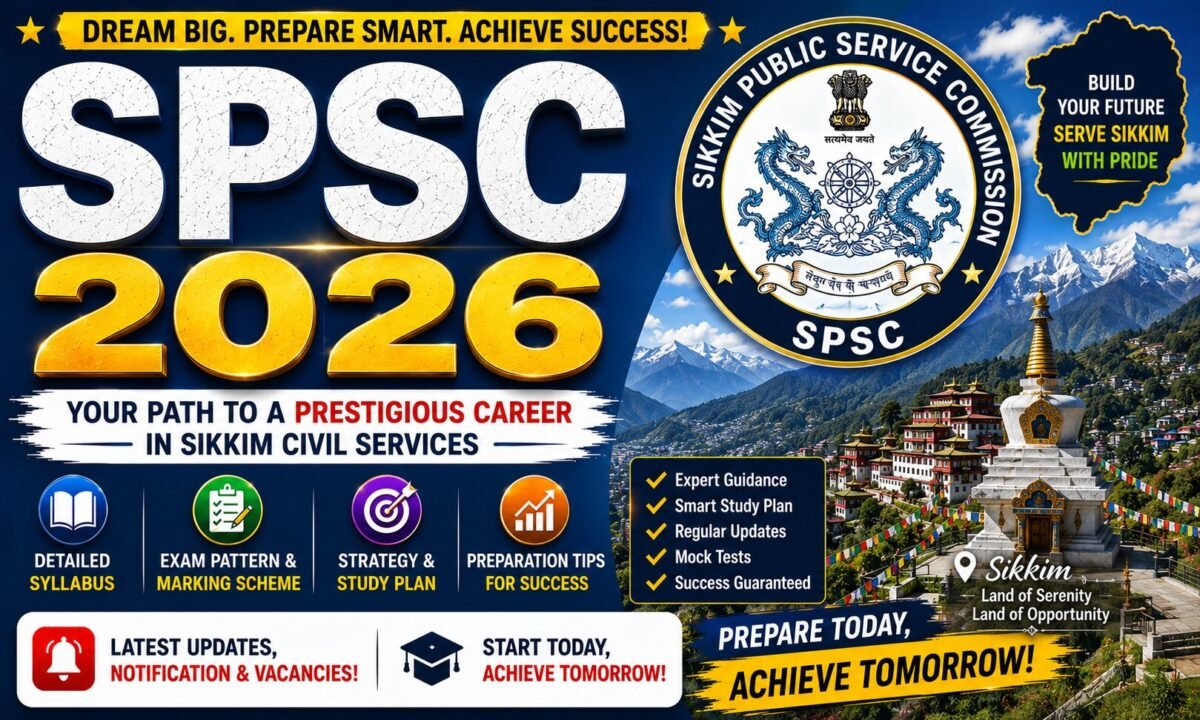
The SPSC 2026 examination is one of the most important state-level civil services exams for candidates aspiring to secure prestigious government positions in Sikkim. Conducted by the Sikkim Public Service Commission, this examination provides opportunities to work in various administrative departments and contribute to the state’s development.
Every year, thousands of aspirants prepare for the recruitment process with the goal of securing a respected government job. Understanding the notification details, eligibility criteria, syllabus, age limit, and preparation strategy is essential for success. If you are planning to appear for the upcoming recruitment cycle, this detailed guide will help you understand everything about SPSC 2026 in a simple and structured manner.
What is SPSC?
Sikkim Public Service Commission (SPSC) is the constitutional body responsible for recruiting eligible candidates for various state government departments in Sikkim.
The commission conducts competitive examinations and interviews to select qualified candidates for administrative, executive, and departmental positions.
The recruitment process ensures transparency and merit-based selection, making it one of the most trusted government recruitment systems in the state.
SPSC 2026 Notification Overview
The official notification is expected to provide complete information regarding vacancies, eligibility requirements, application dates, examination schedule, and selection procedures.
Candidates should regularly check the official commission website for updates regarding:
- Application start date
- Last date to apply
- Preliminary examination date
- Main examination schedule
- Interview process
- Result announcements
The notification serves as the primary document that guides candidates throughout the recruitment cycle.
Why Choose SPSC as a Career Option?
Government jobs through the Sikkim Public Service Commission offer excellent career opportunities and long-term stability.
Some major benefits include:
- Attractive salary packages
- Job security
- Career growth opportunities
- Pension and retirement benefits
- Work-life balance
- Opportunity to serve society
These advantages make state civil service examinations highly competitive among graduates.
SPSC 2026 Eligibility Criteria
Before applying, candidates must ensure they satisfy all eligibility requirements mentioned in the notification.
Educational Qualification
Applicants must possess a bachelor’s degree from a recognized university or institution.
Candidates appearing in their final year may also be eligible depending on notification guidelines.
Nationality
Applicants must fulfill citizenship requirements specified by the commission.
Additional Requirements
Certain posts may require:
- Knowledge of local languages
- Computer proficiency
- Specialized qualifications
Candidates should carefully verify post-specific eligibility before submitting applications.
SPSC 2026 Age Limit
Age eligibility plays an important role during the application process.
Generally, candidates are expected to fall within the prescribed age bracket mentioned in the official notification.
Age Relaxation
Relaxation may be available for reserved categories as per government rules.
Categories often eligible for relaxation include:
- Scheduled Castes
- Scheduled Tribes
- Other Backward Classes
- Persons with Disabilities
Applicants should refer to the official notification for exact age-related details.
SPSC Selection Process
The recruitment procedure usually consists of multiple stages designed to evaluate candidates comprehensively.
Preliminary Examination
The preliminary stage serves as a screening test.
It generally contains objective-type questions covering:
- General Studies
- Current Affairs
- Aptitude
- Reasoning
- History and Geography
Main Examination
Candidates qualifying for prelims move to the mains stage.
This examination assesses:
- Analytical abilities
- Subject knowledge
- Writing skills
- Administrative understanding
Interview
The final stage involves a personality assessment.
The interview panel evaluates:
- Communication skills
- Leadership qualities
- Decision-making ability
- Awareness of current issues
Final merit is prepared based on performance across all required stages.
SPSC 2026 Exam Pattern
Understanding the examination structure helps candidates prepare more effectively.
Preliminary Exam Pattern
The preliminary examination usually consists of objective questions.
Common topics include:
- General Knowledge
- Indian Polity
- Economy
- Environment
- Science and Technology
- Current Affairs
Main Exam Pattern
The mains examination generally includes descriptive papers that test conceptual clarity and writing ability.
Candidates are expected to provide detailed answers and demonstrate analytical thinking.
SPSC 2026 Syllabus
The syllabus forms the foundation of preparation and should be studied carefully.
General Studies
Topics usually include:
- Indian History
- Geography
- Constitution
- Governance
- Economy
- International Relations
Current Affairs
Questions may cover:
- National events
- International developments
- Government schemes
- Sports
- Awards and recognitions
Logical Reasoning
Candidates should prepare:
- Analytical reasoning
- Data interpretation
- Problem-solving
- Mental ability
Essay Writing
The mains examination often evaluates candidates’ ability to present ideas clearly and logically.
Regular writing practice significantly improves performance in this section.
Best Preparation Strategy for SPSC 2026
Success in state civil service examinations depends on consistency and smart planning.
Understand the Syllabus
Begin by carefully reviewing the complete syllabus and exam pattern.
A clear understanding prevents unnecessary study and saves valuable time.
Create a Study Plan
Divide preparation into manageable sections.
Allocate dedicated time for:
- Static subjects
- Current affairs
- Revision
- Mock tests
Focus on NCERT Books
NCERT books help build strong fundamentals for subjects such as history, geography, and polity.
Practice Mock Tests
Regular testing improves:
- Accuracy
- Time management
- Confidence
Mock exams also help identify weak areas requiring additional attention.
Revise Consistently
Revision is one of the most important aspects of preparation.
Candidates should revise important concepts multiple times before the examination.
Common Mistakes to Avoid
Many aspirants make avoidable mistakes during preparation.
Ignoring the Syllabus
Studying without understanding the syllabus often results in wasted effort.
Lack of Revision
Even strong preparation can fail without proper revision.
Excessive Resource Collection
Using too many books creates confusion and reduces efficiency.
Ignoring Current Affairs
Current events play a significant role in both prelims and mains.
Daily newspaper reading should become a habit.
Importance of Current Affairs
Current affairs are crucial for scoring well in competitive examinations.
Candidates should focus on:
- Government policies
- International relations
- Economic developments
- Environmental issues
- Important appointments
Maintaining concise notes helps during revision.
Time Management Tips
Effective time management increases productivity and reduces stress.
Follow Daily Targets
Set realistic goals and track progress regularly.
Maintain Balance
Avoid studying one subject continuously for long periods.
Mix static subjects with current affairs and answer writing practice.
Take Short Breaks
Short breaks improve concentration and prevent burnout.
Consistency matters more than studying for extremely long hours.
Recommended Books for Preparation
Some commonly recommended resources include:
History
- NCERT History Books
- Indian History reference books
Geography
- NCERT Geography Series
- Atlas-based learning
Polity
- Indian Constitution and Governance books
Economy
- Basic economics textbooks
- Government reports
Current Affairs
- Daily newspapers
- Monthly current affairs magazines
Candidates should avoid collecting too many resources and focus on revision.
Career Opportunities After Clearing SPSC
Successful candidates may be appointed to various administrative and departmental positions.
These roles often involve:
- Policy implementation
- Public administration
- Development planning
- Revenue administration
- Government project management
The positions offer both responsibility and opportunities for professional growth.
Why Early Preparation Matters
Competition increases every year, making early preparation essential.
Starting preparation well in advance allows candidates to:
- Build strong concepts
- Complete the syllabus comfortably
- Practice answer writing
- Improve confidence
A structured approach significantly increases the chances of success.
Conclusion
The SPSC 2026 examination presents an excellent opportunity for candidates seeking a rewarding career in public service. Understanding the notification details, eligibility criteria, age requirements, exam pattern, and syllabus is the first step toward effective preparation.
Success requires dedication, discipline, and a smart study strategy. By focusing on concept clarity, current affairs, regular revision, and mock tests, aspirants can improve their performance and move closer to their goal of securing a prestigious government position through the Sikkim Public Service Commission.
FAQs
Q.1 What is SPSC?
SPSC stands for Sikkim Public Service Commission, which conducts recruitment examinations for various state government posts.
Q.2 Who can apply for SPSC 2026?
Candidates holding a recognized bachelor’s degree and meeting the eligibility criteria can apply.
Q.3 What is the age limit for SPSC 2026?
The age limit is specified in the official notification, along with category-wise relaxation provisions.
Q.4 What subjects are included in the SPSC syllabus?
The syllabus generally includes history, geography, polity, economy, current affairs, reasoning, and general studies topics.
Q.5 Is current affairs important for SPSC preparation?
Yes, current affairs play a major role in both preliminary and main examinations.
Q.6 How many stages are there in the SPSC selection process?
The process typically includes a preliminary examination, mains examination, and interview.
Q.7 Which books are best for SPSC preparation?
NCERT books, standard reference materials, and current affairs resources are commonly recommended.
Q.8 When should candidates start preparing for SPSC 2026?
Early preparation is recommended to allow sufficient time for syllabus coverage, revision, and mock test practice.