
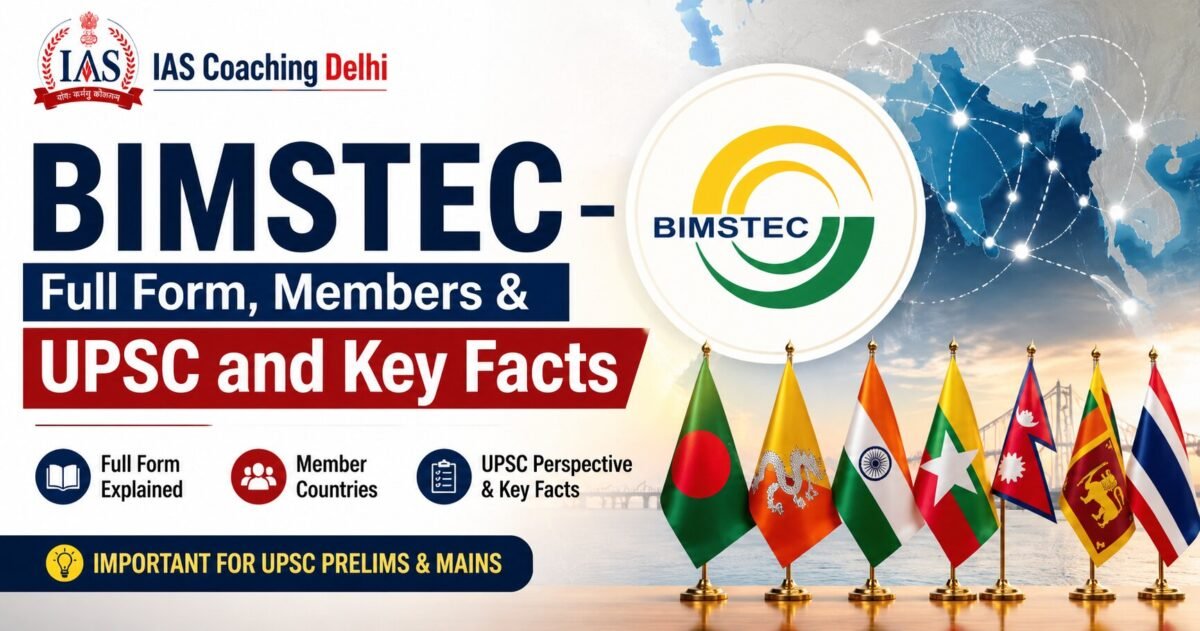
The full form of BIMSTEC is Bay of Bengal Initiative for Multi-Sectoral Technical and Economic Cooperation. BIMSTEC is an important topic in International Relations, specifically for those who are appearing in the UPSC exams and will be facing questions on the neighbourhood policy of India.
One of the reasons why this topic will make an ideal one for exam preparation is because it relates to various current affairs topics. Currently, BIMSTEC comprises countries like Bangladesh, Bhutan, India, Myanmar, Nepal, Sri Lanka, and Thailand and provides India with an opportunity to connect with South Asia and Southeast Asia.
In case you are appearing for the UPSC exams and want to use such international organizations as scoring topics, then the first thing you need to do is avoid memorizing facts in isolation. Instead, you need to have a comprehensive understanding of the organization’s objectives, structure, role of India, recent developments, etc.
BIMSTEC Full Form and Meaning for UPSC
The BIMSTEC Full Form refers to a regional grouping focused on cooperation among countries around the Bay of Bengal. It was established in 1997, initially with four members, and later expanded to its present seven-member structure.
For an aspirant, BIMSTEC should not be studied simply as another international organisation. It is better understood as a bridge between South Asia and Southeast Asia, particularly because its membership includes countries from both regions.
Its relevance becomes clearer when linked with India’s strategic priorities:
- Neighbourhood First policy
- Act East Policy
- Indo-Pacific engagement
- Bay of Bengal maritime cooperation
- Regional connectivity
- Economic integration
- Disaster management
- Counter-terrorism and security cooperation
This makes BIMSTEC a useful topic for both UPSC Prelims and Mains preparation.
BIMSTEC Member Countries
There are seven BIMSTEC member countries:
| Member Country | Region |
| Bangladesh | South Asia |
| Bhutan | South Asia |
| India | South Asia |
| Myanmar | Southeast Asia |
| Nepal | South Asia |
| Sri Lanka | South Asia |
| Thailand | Southeast Asia |
The official BIMSTEC Secretariat confirms these seven members.
For quick UPSC revision, remember that Myanmar and Thailand provide the Southeast Asian connection, while Bangladesh, Bhutan, India, Nepal, and Sri Lanka are South Asian members.
This geographical composition is one reason BIMSTEC has strategic importance for India’s regional diplomacy.
Why BIMSTEC Matters for India
For UPSC preparation, India’s relationship with BIMSTEC deserves special attention because it supports several foreign-policy objectives at the same time.
India has historically faced limitations in regional cooperation through some South Asian mechanisms. BIMSTEC provides an alternative platform that includes key Bay of Bengal and Southeast Asian partners without Pakistan as a member.
Its importance for India can be understood through five major areas:
- Regional connectivity: Better road, rail, maritime, and other links can strengthen trade and movement.
- Act East Policy: BIMSTEC connects India’s eastern and northeastern interests with Southeast Asia.
- Maritime security: Cooperation in the Bay of Bengal has strategic importance for India.
- Economic opportunities: Regional trade and investment can support economic integration.
- Disaster cooperation: Countries around the Bay of Bengal face cyclones, floods, earthquakes, and other natural hazards.
For Mains preparation, these connections can help you move beyond simple factual answers and develop analytical responses.
BIMSTEC and India’s Act East Policy
One of the easiest ways to connect this topic with UPSC Mains is through India’s Act East Policy.
India’s Northeast is geographically positioned as a gateway toward Southeast Asia. Stronger connectivity with Myanmar and Thailand can therefore support India’s economic and strategic objectives in the region.
BIMSTEC provides a framework for cooperation that links India’s neighbourhood with Southeast Asia. Its Connectivity sector is therefore particularly important for aspirants preparing questions related to the Northeast, regional integration, and India’s external relations.
Thailand leads the Connectivity sector under the present division of responsibilities.
Seven Key Sectors of BIMSTEC Cooperation
One of the most important areas to prepare for BIMSTEC UPSC questions is its present sectoral structure.
BIMSTEC cooperation is organised around seven broad sectors:
- Trade, Investment and Development
- Environment and Climate Change
- Security
- Agriculture and Food Security
- People-to-People Contact
- Science, Technology and Innovation
- Connectivity
The organisation also works through sub-sectors including Blue Economy, Mountain Economy, Energy, Disaster Management, Fisheries and Livestock, Poverty Alleviation, Health, and Human Resource Development.
This seven-sector structure is particularly useful for revision because it replaced the earlier, more fragmented arrangement of cooperation areas.
BIMSTEC Sectoral Leadership
For a strong Prelims strategy, candidates should also remember which member country leads each broad sector.
| Sector | Lead Member |
| Trade, Investment & Development | Bangladesh |
| Environment & Climate Change | Bhutan |
| Security | India |
| Agriculture & Food Security | Myanmar |
| People-to-People Contact | Nepal |
| Science, Technology & Innovation | Sri Lanka |
| Connectivity | Thailand |
The current allocation is listed by the BIMSTEC Secretariat.
India’s leadership of the Security sector is particularly relevant. Its sub-sectors include counter-terrorism and transnational crime, disaster management, and energy.
BIMSTEC Charter: A Must-Prepare Area
The BIMSTEC Charter is another important point for UPSC aspirants.
The Charter was adopted and signed during the Fifth BIMSTEC Summit on 30 March 2022 in Colombo, Sri Lanka. It provides a formal institutional framework for the organisation.
For examination purposes, remember the year 2022 and connect the Charter with BIMSTEC’s institutional development.
This is more useful than trying to memorise lengthy provisions. Focus on what the Charter represents: a move toward a more structured and rules-based regional organisation.
BIMSTEC Summit and Decision-Making
The BIMSTEC Summit is the highest decision-making body of the organisation. It consists of the Heads of State or Government of the member countries.
According to the BIMSTEC Secretariat, the Summit provides policy guidance, takes decisions on important matters, considers membership applications, and authorises the establishment or dissolution of sectoral bodies and BIMSTEC entities. Decisions are made through consensus.
For UPSC preparation, this becomes particularly useful when studying the institutional structure of regional organisations.
Recent BIMSTEC Developments for UPSC
Current affairs should form an important part of your BIMSTEC preparation.
The Sixth BIMSTEC Summit was held in Bangkok on 4 April 2025, and recent developments have focused on strengthening implementation across the organisation’s priority sectors.
For example, the BIMSTEC Environment and Climate Change Plan of Action was adopted at the Sixth Summit. It focuses on biodiversity, waste management, and climate change.
The organisation has also moved forward with cooperation on maritime transport. At the 20th BIMSTEC Ministerial Meeting in Bangkok, member states signed the BIMSTEC Agreement on Maritime Transport Cooperation, marking an important step for regional maritime connectivity.
These developments are especially valuable for candidates preparing UPSC current affairs notes for International Relations.
BIMSTEC and Maritime Connectivity
The Bay of Bengal is strategically important for India because of its location, shipping routes, coastal economies, and maritime security concerns.
BIMSTEC’s focus on connectivity therefore has implications beyond simple transportation. Better maritime cooperation can support trade, logistics, regional supply chains, and stronger economic links among member countries.
The BIMSTEC Agreement on Maritime Transport Cooperation is an example of how the grouping is attempting to convert regional cooperation into practical mechanisms.
For Mains answers, this can be connected with blue economy, maritime security, regional connectivity, and India’s Indo-Pacific interests.
BIMSTEC and Disaster Management
The Bay of Bengal region is highly vulnerable to natural disasters. Cyclones, floods, earthquakes, landslides, and other hazards can affect several countries simultaneously.
This makes disaster management cooperation an important area for regional engagement.
Under BIMSTEC’s current structure, disaster management comes under the Security sector, which is led by India.
For UPSC Mains, this provides an excellent example of how regional organisations can address challenges that cannot be managed effectively by one country alone.
BIMSTEC vs SAARC: What UPSC Aspirants Should Prepare
A common mistake is to study BIMSTEC and SAARC separately without understanding their relationship.
A comparison makes the strategic significance easier to understand:
| Aspect | BIMSTEC | SAARC |
| Regional focus | Bay of Bengal, South & Southeast Asia | South Asia |
| Members | 7 | 8 |
| Southeast Asian members | Myanmar, Thailand | No |
| India included | Yes | Yes |
| Pakistan included | No | Yes |
| Major focus | Multi-sectoral regional cooperation | South Asian cooperation |
The comparison is particularly useful for UPSC Mains, where questions may require an assessment of India’s regional diplomacy.
Rather than presenting BIMSTEC as a replacement for SAARC, a stronger answer should explain that the two organisations have different geographical and institutional contexts.
Challenges Facing BIMSTEC
BIMSTEC has significant potential, but its success depends on implementation.
Some challenges include:
- Slow progress on regional trade arrangements
- Connectivity gaps
- Different economic and political conditions among members
- Limited institutional capacity
- Security challenges in the region
- Need for stronger implementation mechanisms
The organisation itself has been working toward institutional reform and revitalisation. Its Eminent Persons’ Group reviewed the existing regional cooperation framework and recommended measures to strengthen BIMSTEC’s future direction.
For an exam answer, acknowledging both potential and limitations makes the analysis more balanced.
How to Prepare BIMSTEC for UPSC
If you are studying BIMSTEC for UPSC, avoid creating pages of disconnected facts. Instead, prepare the topic through a compact framework.
Your revision notes should cover:
- Full form
- Establishment
- Member countries
- Secretariat
- Charter
- Seven sectors
- Sectoral leadership
- India’s role
- BIMSTEC and Act East Policy
- BIMSTEC and Indo-Pacific
- Connectivity
- Maritime cooperation
- Recent summits
- Current affairs
- Challenges
- BIMSTEC vs SAARC
For Prelims, focus on factual accuracy. For Mains, practise using BIMSTEC as an example while answering questions on India’s neighbourhood policy, regional organisations, connectivity, maritime security, and the Indo-Pacific.
A good preparation strategy is to update your notes whenever a new summit, agreement, plan of action, or ministerial decision appears in current affairs.
How to Use BIMSTEC in UPSC Mains Answers
The biggest advantage of preparing this topic properly is that BIMSTEC can support answers across multiple themes.
For example, you can use it while discussing:
- India’s neighbourhood diplomacy
- Act East Policy
- Indo-Pacific strategy
- Regional connectivity
- Maritime security
- Blue Economy
- Disaster management
- Economic integration
- Multilateral cooperation
Instead of writing only that BIMSTEC is a regional organisation, explain why it matters to India and what practical outcomes it can deliver.
That approach makes your answer more analytical and less descriptive.
How Expert Guidance Can Strengthen UPSC Preparation
And the paragraph can be:
At IAS Coaching in Delhi, the focus is on helping aspirants build a structured and practical approach to UPSC preparation. Experienced guidance, well-organised study material, current-affairs integration, answer-writing practice, and regular assessment can help students understand complex topics such as BIMSTEC more effectively. The aim is to connect static concepts with current developments so that aspirants can use them confidently in both Prelims and Mains.
Final Thoughts
While the BIMSTEC full form seems to be a straightforward Prelims fact, the organisation holds immense relevance to UPSC preparation due to its seven members, Bay of Bengal region, sectoral cooperation, connectivity, security implications, and maritime engagement.
In order to develop a comprehensive understanding of the organisation, it is necessary for the aspirants to link up static information with the happenings around. The basic framework of static facts should be ready for Prelims, while the role of India, Act East policy, connectivity, and maritime cooperation should be used to form better Mains responses.
FAQs
Q.1 What is the BIMSTEC Full Form?
The BIMSTEC Full Form is Bay of Bengal Initiative for Multi-Sectoral Technical and Economic Cooperation. It is a regional organisation comprising seven countries.
Q.2 How many countries are members of BIMSTEC?
BIMSTEC has seven members: Bangladesh, Bhutan, India, Myanmar, Nepal, Sri Lanka, and Thailand.
Q.3 Why is BIMSTEC important for UPSC?
BIMSTEC is important for UPSC Prelims and Mains because it connects with India’s neighbourhood policy, Act East Policy, Indo-Pacific strategy, regional connectivity, maritime security, and economic cooperation.
Q.4 Which sector is led by India in BIMSTEC?
India leads the Security sector, which includes Counter-Terrorism and Transnational Crime, Disaster Management, and Energy as sub-sectors.
Q.5 When was the BIMSTEC Charter adopted?
The BIMSTEC Charter was signed and adopted at the Fifth BIMSTEC Summit in Colombo on 30 March 2022.