
Why CRISPR Matters for UPSC Aspirants
Biotechnology has stopped being an area which can be learned just by learning a couple of definitions. The recent trends in UPSC exam papers make it increasingly relevant to study science with application, healthcare, technology, ethics, and policy making. Thus, CRISPR Full Form, along with the topic of gene-editing technologies becomes one of the interesting topics for Science & Technology for Prelims as well as GS Paper III aspirants.
While preparing for UPSC, the aim cannot be that of becoming a molecular biologist. One must develop a practical understanding of CRISPR and CRISPR-Cas9 mechanisms, genome editing and its applications, limitations and ethical dilemmas associated with the field.
CRISPR Full Form: What Does It Mean?
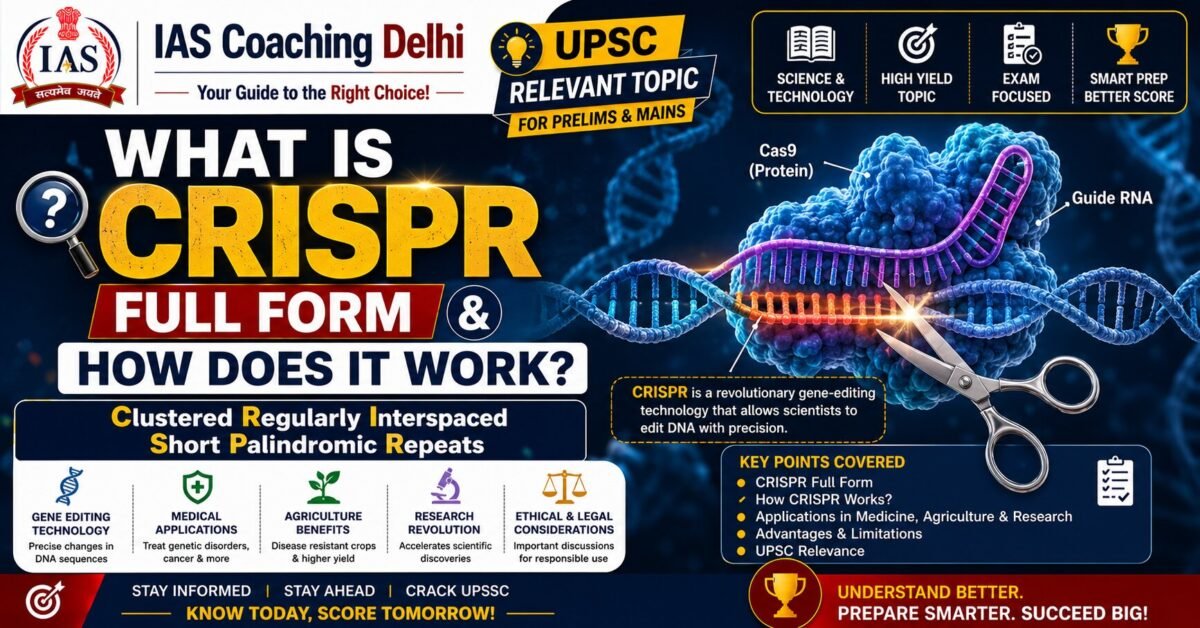
The CRISPR Full Form is Clustered Regularly Interspaced Short Palindromic Repeats. The name sounds complicated, but the basic idea is easier to understand.
CRISPR refers to repeated DNA sequences found naturally in bacteria and archaea. These sequences are part of an adaptive defence system that helps microorganisms recognise and respond to invading genetic material, such as that from viruses. The National Center for Biotechnology Information describes CRISPR sequences as important components of bacterial and archaeal CRISPR-Cas systems.
For UPSC preparation, remember one simple connection:
CRISPR → natural microbial defence system → adapted as a gene-editing tool.
That connection is much more useful for examination purposes than trying to memorise complicated molecular terminology without understanding the concept.
What Is CRISPR Gene Editing?
CRISPR gene editing is a biotechnology technique that allows scientists to make targeted changes to DNA. One of the best-known versions is the CRISPR-Cas9 system, which uses a guide RNA to direct the Cas9 enzyme toward a selected DNA sequence.
Think of DNA as an enormous instruction manual. If one particular sentence contains an error, traditional approaches may struggle to locate and modify exactly that portion. CRISPR-based systems provide researchers with a way to guide molecular machinery toward a chosen genetic sequence and make an edit.
The technology therefore became important because it made targeted genome editing more practical and flexible for research. The National Institute of General Medical Sciences explains that CRISPR is now widely used as a genetic engineering technique, building on repetitive sequences originally identified in bacterial DNA.
For an aspirant, the key terms to connect are gene editing, genome editing, guide RNA, Cas9, DNA, biotechnology, genetic medicine, and targeted modification.
How Does CRISPR-Cas9 Work?
The easiest way to understand the mechanism is to imagine a highly targeted editing system with three broad stages: recognition, cutting, and repair.
First, scientists design a guide RNA that matches the DNA sequence they want to target. The guide RNA directs the Cas protein toward that particular region. In the commonly discussed CRISPR-Cas9 system, Cas9 acts as a molecular nuclease capable of cutting DNA.
Next, the Cas9 enzyme makes a cut in the targeted DNA. The cell then attempts to repair the break. Depending on the method and circumstances, this repair can disrupt a gene or, when an appropriate repair template is supplied, introduce a desired sequence change.
This is where genome editing becomes powerful. Researchers are not simply cutting DNA randomly; they are using a guide sequence to direct the editing machinery toward a chosen genetic location.
The CRISPR-Cas9 Process in Simple Terms
- Guide RNA: Identifies the target DNA sequence.
- Cas9 enzyme: Acts as the molecular cutting tool.
- Target DNA: The selected genetic region.
- DNA repair: The cell repairs the cut, allowing researchers to achieve a desired genetic change.
For UPSC, this four-step framework is enough to build a strong conceptual answer without getting buried in laboratory-level details.
CRISPR vs Traditional Genetic Engineering
Understanding the difference between CRISPR and broader genetic engineering can help you avoid confusion in objective questions.
Traditional genetic engineering includes several methods used to modify genetic material. CRISPR is one particular family of genome-editing approaches that can provide targeted modification of DNA.
The distinction is important because genetic engineering is the broader field, while CRISPR-Cas systems represent a specific set of molecular tools derived from a naturally occurring biological defence mechanism.
| Feature | CRISPR-Based Editing | Traditional Genetic Engineering |
| Basic idea | Targeted genetic modification | Broader genetic manipulation |
| Major tool | Guide RNA + Cas protein | Multiple techniques |
| Targeting | Highly programmable | Depends on technique |
| Main applications | Research, medicine, agriculture | Research, medicine, agriculture |
| UPSC relevance | Biotechnology and genetic medicine | Biotechnology and GM technology |
This distinction becomes particularly useful when solving statement-based questions where UPSC may deliberately mix a broad scientific category with a specific technology.
Where Can CRISPR Technology Be Used?
The commercial and medical potential of genome editing is one reason this technology remains highly relevant. Applications are being explored across medicine, agriculture, biological research, and biotechnology.
Medical Applications
Gene editing has attracted significant attention in the treatment of inherited disorders. A major real-world development is Casgevy, a therapy that uses cells edited with CRISPR/Cas9.
The U.S. FDA currently lists Casgevy as an approved cellular and gene therapy product. Its approved indications include sickle cell disease with recurrent vaso-occlusive crises and transfusion-dependent beta-thalassemia, with the eligible age range expanded in 2026.
This is particularly important for UPSC because it connects a scientific concept with healthcare, biotechnology, genetic medicine, regulation, and public policy.
Agricultural Biotechnology
CRISPR-based techniques are also being researched for agriculture. Scientists can investigate traits associated with crop quality, resistance, productivity, and environmental stress.
For aspirants, the important connection is:
Genome editing → crop improvement → food security → agricultural biotechnology.
This allows you to connect Science & Technology with Agriculture and broader development issues.
Biomedical Research
Researchers use gene-editing systems to study gene function and understand how particular genetic changes influence biological processes. This can support research into diseases and potential therapeutic approaches.
The wider importance is not simply that CRISPR can “change genes.” Its value lies in giving researchers a programmable way to investigate specific genetic sequences.
CRISPR and Genetic Medicine
The emergence of CRISPR-based therapies has changed the discussion around genetic medicine. Instead of only managing symptoms, researchers are exploring approaches that address genetic mechanisms underlying certain diseases.
Casgevy provides a practical example. According to the FDA, the treatment uses a patient’s own blood stem cells, which are edited using CRISPR/Cas9 before being returned to the patient. In sickle cell disease, the treatment is designed to increase fetal haemoglobin, helping reduce the biological process responsible for sickling.
For UPSC preparation, this example can strengthen an answer on gene therapy, biotechnology, healthcare innovation, or emerging medical technologies.
However, aspirants should avoid presenting CRISPR as a universal cure. Gene editing remains a technically complex field, and its applications depend on the disease, target, delivery method, safety profile, regulation, and clinical evidence.
Advantages of CRISPR Technology
CRISPR has attracted enormous interest because of its potential to make targeted genetic modification more accessible to researchers.
Some important advantages include:
- Targeted editing: The system can be directed toward specific DNA sequences.
- Programmability: Guide RNA can be designed for different targets.
- Research value: It helps scientists investigate gene functions.
- Medical potential: It has enabled development of gene-editing therapies.
- Agricultural potential: It can support research into improved crop traits.
- Versatility: CRISPR systems can be adapted for different biological applications.
For a UPSC answer, however, listing advantages alone is not enough. A stronger response balances benefits with limitations, safety, ethics, regulation, and accessibility.
Limitations and Risks of CRISPR
No emerging technology is completely risk-free. One of the major concerns in genome editing is the possibility of off-target effects, where changes occur at unintended locations in the genome.
Other concerns include the difficulty of delivering gene-editing components to the right cells, controlling the outcome of DNA repair, long-term safety assessment, and ensuring that therapies are accessible.
There are also ethical questions. Editing somatic cells to treat disease is different from editing germline cells, because germline changes may potentially be inherited by future generations.
This creates a wider policy debate involving bioethics, human genome editing, informed consent, regulation, equity, and responsible innovation.
For UPSC, this is where a simple scientific topic can become a strong GS Paper III answer. Instead of writing only about how CRISPR works, discuss its applications + benefits + risks + ethical safeguards + regulatory oversight.
CRISPR and India’s Biotechnology Landscape
For Indian civil services aspirants, the topic becomes more valuable when connected with India’s growing biotechnology ecosystem. Science and Technology questions increasingly reward candidates who can connect a technology with its wider social and economic implications.
A strong preparation strategy should therefore connect CRISPR technology with:
- Biotechnology research
- Genetic diseases
- Gene therapy
- Agricultural innovation
- Food security
- Bioethics
- Healthcare accessibility
- Regulation of emerging technologies
- India’s biotechnology ecosystem
This approach also prevents a common mistake: treating Science & Technology as a collection of isolated definitions. Your aim should be to understand how a technology can affect society, governance, healthcare, agriculture, and the economy.
How to Prepare CRISPR for UPSC Prelims
For Prelims, focus on conceptual accuracy and terminology.
You should remember:
- CRISPR is associated with repeated DNA sequences.
- CRISPR systems naturally occur in bacteria and archaea.
- Cas proteins are CRISPR-associated proteins.
- Cas9 is a DNA-cutting enzyme used in a widely known CRISPR editing system.
- Guide RNA helps direct the editing machinery toward a target.
- Genome editing does not mean changing an organism’s entire DNA.
- CRISPR has applications beyond medicine.
UPSC can turn a simple concept into a tricky statement by using absolute words such as “always,” “entire genome,” or “only.” Read every statement carefully rather than selecting an answer based on one familiar keyword.
How to Use CRISPR in UPSC Mains Answers
For Mains, don’t stop after defining the technology. Build a balanced answer.
A practical structure is:
Introduction: Define CRISPR and mention its relevance to genome editing.
Body: Explain its mechanism briefly, followed by applications in healthcare, agriculture, and research.
Challenges: Discuss off-target effects, delivery challenges, ethical concerns, regulation, and affordability.
Way Forward: Mention responsible research, strong regulatory systems, ethical oversight, safety assessment, and equitable access.
This structure turns a technical topic into a Science & Technology + governance + ethics answer.
Why This Topic Is Worth Preparing Now
CRISPR is no longer purely theoretical. The regulatory approval of CRISPR/Cas9-edited therapy demonstrates that genome editing has moved from laboratory research into real-world medical treatment. In July 2026, the FDA expanded Casgevy’s approval to patients aged 2 years and older for specified sickle cell disease and transfusion-dependent beta-thalassemia indications.
That kind of development is exactly why UPSC aspirants should track biotechnology through current affairs. Your preparation should not depend on memorising yesterday’s definition. Instead, connect the technology, application, policy relevance, ethical concerns, and latest developments.
For students using the resources at IAS Coaching Delhi, this topic fits naturally into Science & Technology and biotechnology preparation rather than requiring a separate, isolated study track. The website already uses an application-oriented approach to Science & Technology, linking static concepts with current affairs and examination requirements.
Expert Guidance for UPSC Preparation
Complex Science & Technology topics become easier when they are explained with the right academic context. IAS Coaching Delhi focuses on connecting technical concepts with UPSC requirements, helping aspirants understand not only what a technology is but also its applications, limitations, ethical concerns, and relevance to current affairs.
For topics such as CRISPR, effective preparation should combine conceptual clarity, reliable sources, current developments, and exam-focused guidance. This helps students build stronger Prelims knowledge while also developing the analytical approach needed for GS Paper III answers.
This type of preparation can help aspirants avoid unnecessary technical details and focus on the points that actually matter from the UPSC examination perspective.
Conclusion
The meaning of the CRISPR Full Form is just the beginning of the matter. In the context of preparation for the UPSC examination, one needs to be aware of the fact that CRISPR means Clustered Regularly Interspaced Short Palindromic Repeats, and that CRISPR-Cas systems have developed into genome editing techniques from a natural microbial defense system.
Where one can score is by associating the concept with applications related to gene editing, genetic medicine, agriculture, biotechnology, ethics, regulation, and the latest advancements like CRISPR-based treatments. One needs to prepare the topic in the context of an application-based Science & Technology concept.
FAQs
Q.1 What is the CRISPR Full Form?
The CRISPR Full Form is Clustered Regularly Interspaced Short Palindromic Repeats. It refers to repeated DNA sequences that form part of natural defence systems in bacteria and archaea.
Q.2 What is CRISPR-Cas9 used for?
CRISPR-Cas9 is used as a genome-editing tool. A guide RNA directs the Cas9 enzyme toward a selected DNA sequence, where Cas9 can cut the DNA and enable targeted genetic modification.
Q.3 Is CRISPR the same as gene therapy?
No. CRISPR is a gene-editing technology, while gene therapy is a broader category of medical approaches that modify or introduce genetic material to treat disease. CRISPR can be used as part of certain gene-editing therapies.
Q.4 Is CRISPR important for UPSC?
Yes. CRISPR is relevant to Science & Technology, biotechnology, genetic medicine, healthcare, agriculture, bioethics, and current affairs. Its applications make it useful for both Prelims and GS Paper III preparation.
Q.5 What is the biggest concern with CRISPR?
Important concerns include unintended genetic changes, delivery challenges, long-term safety, ethical issues, regulation, and equitable access to advanced genetic treatments.
Q.6 Is CRISPR currently used in approved medical treatment?
Yes. The FDA lists Casgevy as an approved cellular and gene therapy product using cells edited with CRISPR/Cas9 for specified indications, including sickle cell disease and transfusion-dependent beta-thalassemia.