
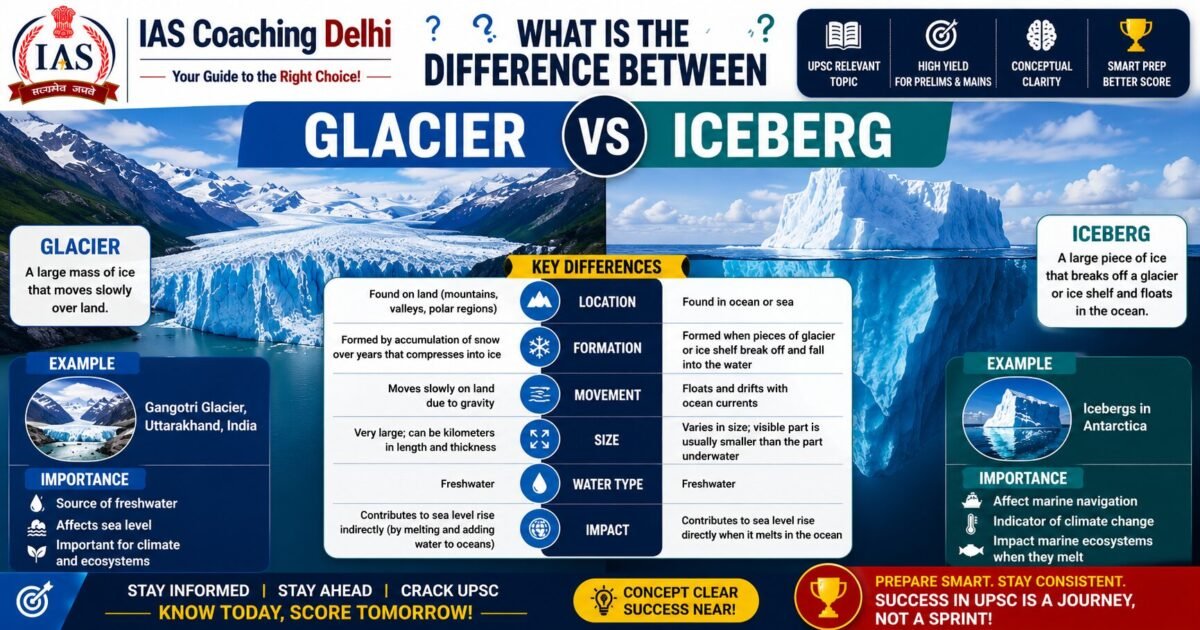
If you are preparing for the UPSC and need a quick and exam-specific knowledge of the differences between Glacier and Iceberg, then you will find the below comparison of the two terms without using any superfluous scientific terminologies.
The following point of comparison will be very useful for preparing the subject areas of Geography, Environment & Ecology, and General Studies for the UPSC Examination. In place of committing to memory two definitions from textbooks, you can use the below comparison to develop a concept.
Glacier vs Iceberg: The Quick Answer
The simplest way to remember the distinction is this: a glacier is a large, long-lasting mass of ice formed on land that moves under gravity, while an iceberg is a piece of glacial or ice-shelf ice that has broken away and is floating in water. USGS defines a glacier as a perennial accumulation of ice and snow originating on land and moving downslope under its own weight. NOAA describes an iceberg as ice that has broken from glaciers or ice shelves and is floating in open water.
| Feature | Glacier | Iceberg |
| Formation | Develops from accumulated snow on land | Breaks away from a glacier or ice shelf |
| Location | Mainly on land | Floats in ocean, sea, lake, or other water |
| Movement | Flows slowly under gravity | Drifts with currents and winds |
| Duration | Can persist for decades, centuries, or longer | Usually temporary and eventually melts |
| Connection to land | Generally connected to a land-based ice mass | Free-floating after separation |
| Main process | Accumulation and flow | Calving, drifting, melting |
| UPSC relevance | Geography, climate and environment | Oceanography, cryosphere and climate |
This table is worth revising before an exam because it captures the core distinction in a few seconds.
What Is a Glacier?
A glacier is not simply a huge block of frozen water. It is a dynamic body of ice formed over long periods when snowfall accumulates faster than it melts. Under pressure, layers of snow gradually transform into dense glacier ice. Once the ice becomes sufficiently thick, gravity causes it to flow downhill or outward.
That movement is what makes a glacier different from ordinary snow or stationary ice. Even though its movement can be extremely slow, a glacier behaves more like a slow-moving river of ice than a frozen object sitting permanently in one place.
For UPSC preparation, remember three words: land, accumulation, movement. If these three ideas are clear, you already understand the foundation of the concept.
How Do Glaciers Form?
Glacier formation is a long-term natural process. In regions where snowfall repeatedly accumulates and does not completely melt during warmer periods, layers of snow become compressed. Over many years, the snow undergoes physical changes and gradually becomes dense crystalline ice.
The accumulated mass eventually begins to move because of gravity. USGS notes that glaciers are sensitive indicators of climate because their size and behaviour respond to changes in temperature and precipitation.
This makes glaciers particularly important for candidates studying climate change, physical geography, environmental processes, and the cryosphere.
What Is an Iceberg?
An iceberg is a large piece of ice that has separated from a glacier or ice shelf and is floating in water. The separation process is called calving. Once the ice breaks away, it can drift with ocean currents and winds, sometimes travelling far from its original source.
Here is the easiest mental picture: imagine a glacier as a huge ice mass connected to land. When a section at its edge breaks away and enters the water, that detached section can become an iceberg.
This is why saying that an iceberg is simply “frozen ocean water” is incorrect. NASA specifically distinguishes icebergs from sea ice, explaining that icebergs are floating fragments of glaciers or ice shelves.
The Biggest Difference: Where They Are Found
Location is perhaps the fastest way to solve a multiple-choice question on this topic.
A glacier originates and exists primarily as a land-based ice formation. An iceberg, on the other hand, becomes a floating body of ice after breaking away from a glacier or ice shelf.
So remember:
Glacier → land-based ice mass
Iceberg → floating detached ice
This distinction becomes particularly useful when UPSC combines geography with environment-based statements. If an option says that an iceberg is a form of sea ice, treat it carefully. Sea ice forms when ocean water freezes, whereas an iceberg generally originates from land-based glacial ice or an ice shelf.
Glacier and Iceberg: Difference in Movement
Movement is another major point of comparison.
A glacier flows because of its own weight and gravity. Its movement can include internal deformation of the ice and sliding over its underlying surface. USGS describes glacier movement as downslope or outward movement caused by gravity.
An iceberg behaves differently. After calving, it is no longer part of the land-based glacier system. It floats and can be transported by ocean currents, wind, and water movement.
That means the movement of a glacier is primarily linked to gravity and the underlying landscape, while an iceberg’s journey is strongly influenced by the surrounding water and atmospheric conditions.
Glacier vs Iceberg: How Are They Formed?
The formation processes also provide an easy way to separate the two.
Glacier Formation
The process begins with repeated snowfall. When snow survives seasonal melting, additional layers accumulate. Pressure gradually compresses these layers, transforming them into glacier ice. Once enough ice accumulates, gravity drives the glacier’s slow movement.
Iceberg Formation
An iceberg usually forms when a glacier or ice shelf reaches a water body and a section breaks away. This process is called calving. The newly separated ice mass then floats or drifts through the water.
USGS specifically defines an iceberg as a block of ice that has broken or calved from a glacier and is floating in marine or fresh water.
For exam revision, use this sequence:
Snow accumulation → glacier formation → movement → calving → iceberg
That simple chain can help you answer both direct and statement-based questions.
Why Does an Iceberg Float?
An iceberg floats because ice is less dense than liquid water. However, most of the iceberg remains below the surface, which creates the familiar image of a small visible portion above water and a much larger submerged portion.
NOAA uses specific physical criteria for classifying an iceberg, including minimum height above sea level, thickness, and surface area. Smaller pieces may instead be classified as bergy bits or growlers.
For UPSC aspirants, the key takeaway is not to memorise every measurement unless specifically required by a question. Understanding the relationship between density, buoyancy, and floating ice is more useful for conceptual preparation.
Why Do Icebergs Look White or Blue?
Icebergs are commonly associated with white or blue colours. Their appearance depends on the structure and density of the ice, light interaction, air bubbles, and sometimes biological or mineral material.
NOAA explains that compressed ice can lose many of its air bubbles. Dense ice allows more light to penetrate, while shorter wavelengths such as blue and green can become more visible.
This is a useful example of how a geography topic can overlap with basic science and environmental processes. UPSC increasingly rewards candidates who can connect concepts rather than study every subject in isolation.
Why Glaciers Matter for Climate and Environment
Glaciers are important indicators of environmental change. Their mass changes depending on the balance between snow accumulation and ice loss. When melting and calving exceed the addition of new ice, glaciers can shrink.
USGS identifies glaciers as sensitive indicators of climate change and reports that glaciers respond to variations in temperature and precipitation.
For UPSC preparation, this connects directly with:
- Climate change
- Global warming
- Cryosphere
- Sea-level change
- Water resources
- Mountain ecosystems
- Glacial lake outburst floods
- Physical geography
The concept becomes much easier when you study it as part of a larger environmental system instead of memorising an isolated definition.
Why Icebergs Matter for Geography and Ocean Studies
Icebergs also have geographical importance because their movement connects land-based ice with marine systems. Once detached, they can drift across large areas and eventually melt.
Large icebergs can also create navigation hazards. NOAA notes that icebergs may drift considerable distances from their origin and are monitored because of their potential risks to shipping.
For competitive-exam preparation, this makes icebergs relevant to oceanography, polar regions, maritime navigation, climate science, and the cryosphere.
Glacier, Iceberg and Sea Ice: Do Not Confuse Them
One common mistake is treating glacier ice, iceberg ice, and sea ice as the same thing.
They are connected, but their origins differ.
Glacier ice develops from accumulated snow on land. An iceberg is a detached piece of glacier or ice-shelf ice floating in water. Sea ice, in contrast, forms when seawater freezes.
NASA explicitly states that icebergs are not sea ice; they are floating fragments of glaciers or ice shelves.
This three-way comparison is particularly valuable for UPSC Prelims because examination questions can present apparently similar terms in a statement-based format.
A Simple UPSC Revision Trick
If you have only 30 seconds before revising this topic, remember:
Glacier = formed on land + moves slowly + long-lasting
Iceberg = breaks away + floats in water + drifts
Sea ice = frozen seawater
This approach is more useful than memorising lengthy definitions. Once the three origins are clear, most basic comparison questions become much easier.
For Mains, take the concept one step further. Connect glaciers with climate change, water security, Himalayan geography, and sea-level rise. Connect icebergs with polar geography, ocean currents, navigation, and cryosphere dynamics.
How to Prepare This Topic for UPSC
A focused preparation strategy can turn a small geography concept into useful marks across different sections of the examination. Start with the basic distinction, then add formation, movement, climate relevance, and related terminology.
A practical revision method is:
- Learn the three core definitions.
- Make a glacier-versus-iceberg comparison table.
- Understand calving and glacier flow.
- Add sea ice to your comparison.
- Solve relevant UPSC-style MCQs.
- Practise explaining the concept in 100–150 words.
- Connect the topic with current environmental developments.
This approach prevents information overload while giving you enough conceptual depth for both Prelims and Mains.
Common Mistakes to Avoid
Many students make simple mistakes because they rely on visual memory rather than understanding the process.
Avoid these errors:
- Calling an iceberg a glacier.
- Saying icebergs are formed directly from seawater.
- Assuming glaciers are completely stationary.
- Confusing sea ice with glacial ice.
- Studying definitions without understanding calving.
- Ignoring the climate connection.
- Memorising statistics without understanding their relevance.
A concept-first approach is usually more effective for UPSC because questions often test whether you can distinguish closely related ideas.
How IAS Coaching Delhi Can Support Your UPSC Preparation
For aspirants who want structured preparation rather than scattered study material, IAS Coaching Delhi focuses on concept-based learning, exam-oriented resources, and guidance across core UPSC subjects. Its website already organizes preparation material around areas such as Environment, Geography, Science & Technology, current affairs, syllabus, and exam analysis, making this topic naturally suited to an integrated study approach.
The value of such structured guidance is not simply learning another definition. It is learning how to connect static concepts with UPSC Prelims statements, Mains analysis, current affairs, and answer writing. That approach is especially useful for topics where Geography, Environment, and Science overlap.
Conclusion
The difference between glacier and iceberg does not involve complex definitions. It involves their formation, place of occurrence, movements, and processes through which they occur. A glacier is formed from accumulated snow on land and moves gradually due to the force of gravity, while an iceberg is a part of floating ice broken off from the glaciers or ice shelves.
As far as the UPSC examiners are concerned, there is nothing better than establishing connections of this fundamental difference with physical geography, climate change, oceanography, and the cryosphere.
Frequently Asked Questions
Q.1 What is the main difference between a glacier and an iceberg?
A glacier is a large, long-lasting ice mass that forms on land and moves under gravity. An iceberg is a piece of ice that has broken away from a glacier or ice shelf and is floating in water.
Q.2 Are icebergs made from seawater?
Generally, no. Icebergs originate from glacial ice or ice shelves, while sea ice forms when seawater freezes.
Q.3 What is glacier calving?
Calving is the process in which pieces of ice break away from the edge or front of a glacier or ice shelf. A detached piece can become an iceberg when it enters and floats in water.
Q.4 Which is more important for UPSC: glaciers or icebergs?
Both can be relevant. Glaciers connect with physical geography, climate change, water resources, and the cryosphere, while icebergs connect with polar geography and ocean-related topics.
Q.5 How can I remember the glacier and iceberg difference for UPSC?
Use the simplest formula: glacier = land + flow; iceberg = detached ice + water. Then add sea ice as a third category: sea ice = frozen seawater.