
One Nation One Election is the significant amendment in the electoral system of India which needs to be taken into account. As a UPSC aspirant, you cannot ignore the fact that the topic is relevant to the subjects like Indian Polity, Constitutional Governance, Federalism, Electoral Reforms, Parliamentary Democracy, and Current Affairs.
The topic has become relevant again due to the fact that the Constitution (129th Amendment) Bill, 2024 and the Union Territories Laws (Amendment) Bill, 2024 are still under consideration of the Joint Parliamentary Committee. In 2026, the committee has completed its deliberations with legislators, experts, civil society representatives and other stakeholders.
UPSC aspirants who will be appearing for their UPSC prelims and mains exams in 2027 can benefit from taking a balanced view on the topic. You should know what simultaneous elections are all about, how the new model would function, and what constitutional changes are needed.
One Nation One Election: What Does It Actually Mean?
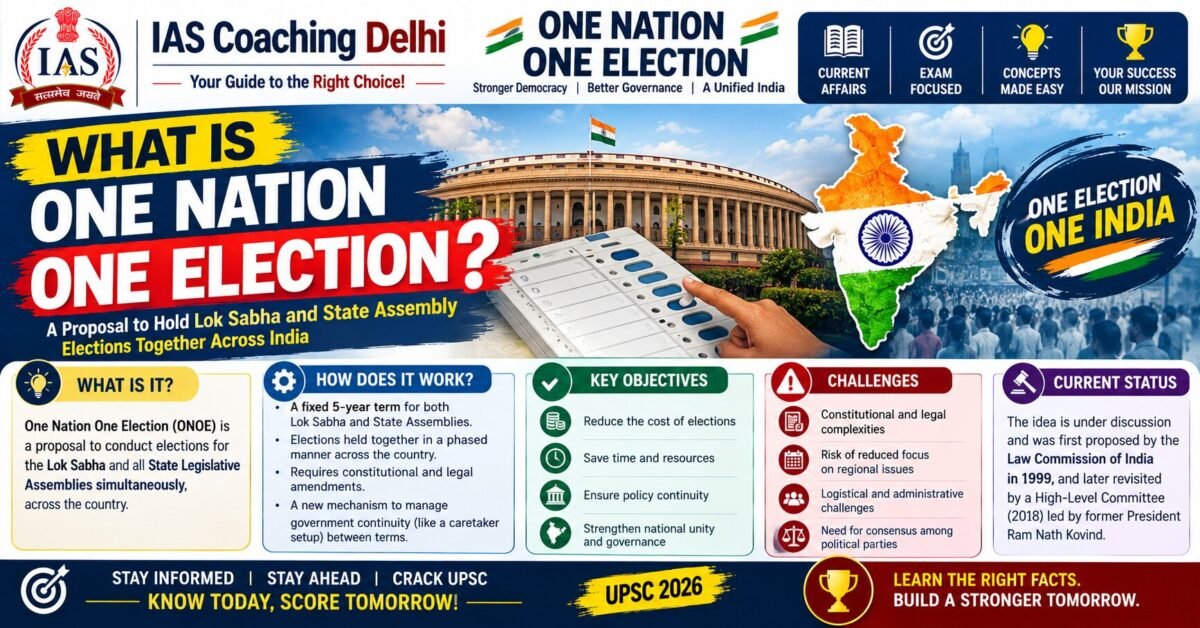
One Nation One Election refers to the proposal to hold elections to the Lok Sabha and State Legislative Assemblies together, rather than conducting elections for different legislatures at different times.
It does not necessarily mean that voters across India would cast their votes on one single day. The proposed framework can involve elections being conducted together in phases, depending on administrative and logistical requirements. A Joint Parliamentary Committee member also clarified in May 2026 that simultaneous elections do not mean voting everywhere on one day.
For an aspirant, the easiest way to understand the concept is this: instead of India entering an election cycle somewhere almost every year, the proposed system would attempt to create a coordinated election cycle.
That distinction is important because the phrase sounds simpler than the constitutional and administrative changes required to implement it.
Why Is Simultaneous Election Reform Being Discussed?
Frequent elections require repeated mobilisation of election personnel, security forces, administrative machinery and other resources. They can also trigger repeated periods of the Model Code of Conduct, which may affect the timing and implementation of government decisions.
The government’s stated rationale includes reducing election-related expenditure, administrative burden and repeated disruptions to governance. The High-Level Committee headed by former President Ram Nath Kovind had also examined these issues while developing a framework for simultaneous elections.
For UPSC preparation, this creates a useful governance question:
Can electoral efficiency be improved without weakening federalism and democratic accountability?
That is exactly the kind of balanced issue-based thinking that can strengthen a Mains answer.
What Is the Current Status of One Nation One Election in 2026?
This is one of the most important points to understand before using the topic in an answer.
As of September 2026, the proposed constitutional framework has not become an implemented nationwide system. The Constitution (129th Amendment) Bill, 2024 and the Union Territories Laws (Amendment) Bill, 2024 are still listed as being in committee.
The Joint Parliamentary Committee has continued stakeholder consultations during 2026. Its consultations have examined issues such as premature dissolution of legislatures, the remaining tenure of assemblies, Election Commission powers, federalism and the Basic Structure Doctrine.
Therefore, aspirants should avoid writing that simultaneous elections have already been implemented.
For UPSC Current Affairs preparation, the safer approach is to describe it as a proposed electoral reform currently undergoing parliamentary consideration and consultation.
How Would the Proposed System Work?
The proposed constitutional amendment seeks to create a framework under which elections to the Lok Sabha and State Assemblies can be synchronised.
According to the bill analysis, the framework would involve a notification following a general election, after which the terms of State Assemblies constituted under the new cycle would align with the Lok Sabha’s term. If a legislature is dissolved prematurely, an election could be held for the remaining period rather than beginning a completely new five-year cycle.
This is an important distinction.
Suppose a State Assembly falls after two years. Under the proposed model described in the bill, a fresh election would not necessarily create another full five-year term. The newly elected assembly could serve only the remaining period needed to restore the common electoral cycle.
Such provisions show why this reform is much more complex than simply deciding to conduct elections together.
Constitutional Changes Behind the Proposal
The proposed reform requires changes to the constitutional framework governing legislative terms and elections.
The Constitution (129th Amendment) Bill, 2024 proposes changes involving Articles 82A, 83 and 172, among other provisions, to establish the simultaneous election framework. A separate Union Territories legislation seeks to extend the arrangement to UT legislatures.
For UPSC aspirants, these provisions deserve careful revision because the topic combines:
- Constitutional amendments
- Tenure of legislatures
- Election Commission of India
- Federalism
- Parliamentary government
- Electoral reforms
- Basic Structure Doctrine
Instead of treating these as separate chapters, connect them through the electoral reform debate.
Potential Advantages of One Nation One Election
Supporters of the proposal argue that a coordinated election cycle could reduce the frequency and cost of elections.
Reduced Election Expenditure
Holding elections repeatedly requires considerable spending on election administration, campaigning, security and logistics. A synchronised system could potentially reduce some recurring expenses.
Less Administrative Disruption
Teachers, government employees, police personnel and other public resources are frequently deployed for election duties. Reducing the number of election cycles could lessen this recurring administrative burden. Government representatives have highlighted this concern during consultations.
Greater Policy Continuity
Frequent elections can encourage governments and political parties to focus heavily on short-term electoral considerations. Supporters argue that a stable election cycle could give governments more uninterrupted time to focus on policy implementation.
Reduced Model Code Disruptions
Repeated elections can lead to repeated application of the Model Code of Conduct. Supporters of simultaneous elections argue that fewer election periods could reduce interruptions associated with the electoral cycle.
However, these are arguments in favour, not guaranteed outcomes. A strong UPSC answer should distinguish between the proposed benefits and proven results.
What Are the Major Concerns?
The debate becomes more interesting when we look at the challenges.
Federalism and State Autonomy
India follows a federal system with a strong Union government. State elections are an important mechanism through which voters express state-level preferences.
Critics question whether synchronising elections could make national political issues dominate State Assembly elections. This raises concerns about the political space available for regional parties and state-specific issues.
What Happens If a Government Falls Early?
This is one of the biggest practical questions.
A government may lose its majority before completing its full term. The proposed framework addresses premature dissolution by linking a fresh election to the remaining period of the common cycle.
However, this creates another question: would a government elected for a shortened period have enough time to establish effective governance?
These are exactly the kinds of constitutional and administrative questions that UPSC Mains candidates should analyse.
Constitutional and Legal Complexity
Synchronising elections requires more than changing election dates. It involves constitutional amendments, legislative changes and coordination among multiple institutions.
The parliamentary committee has specifically examined issues involving premature dissolution, Election Commission powers and constitutional principles.
Logistical Requirements
Simultaneous elections would require extensive coordination involving:
- Election personnel
- Security forces
- Electronic Voting Machines
- Voter-verifiable paper audit systems
- Polling infrastructure
- Election schedules
- Administrative machinery
The scale of such coordination would be significant.
One Nation One Election and the Basic Structure Doctrine
The Basic Structure Doctrine is another major constitutional dimension of this debate.
India’s Constitution allows Parliament to amend the Constitution, but the Supreme Court has held that Parliament cannot destroy its basic structure.
Therefore, any major electoral reform must be assessed against fundamental constitutional principles such as democracy, federalism and representative government.
This is particularly useful for UPSC Mains because candidates can connect electoral reform with constitutional supremacy, judicial review and federalism rather than discussing the proposal only from an administrative perspective.
One Nation One Election: How Should UPSC Aspirants Prepare?
If you are preparing for UPSC, simply reading a newspaper article on this topic is not enough.
Build your preparation around four layers:
First, understand the constitutional framework. Revise Articles related to Parliament, State Legislatures, election provisions and constitutional amendments.
Second, follow the current legislative status. The status of the bills can change, so use reliable parliamentary and government sources for the latest developments.
Third, prepare both sides of the debate. Do not write an answer that sounds like political advocacy. UPSC rewards balanced analysis.
Fourth, practise answer writing. Try questions such as:
“Discuss the potential benefits and constitutional challenges associated with simultaneous elections in India.”
A strong answer should cover efficiency, governance, expenditure, federalism, electoral accountability, constitutional amendments and implementation challenges.
How IAS Coaching Delhi Can Help With Current Affairs Preparation
Current affairs becomes much easier when aspirants learn how to connect news with the UPSC syllabus. At IAS Coaching Delhi, the preparation approach focuses on linking contemporary developments with core subjects such as Indian Polity, Governance, Constitution and Current Affairs.
Rather than treating every headline as a separate topic, aspirants can develop issue-based notes covering the background, constitutional provisions, arguments, challenges and possible reforms.
This approach is particularly useful for topics like electoral reforms, where the same issue can appear in Prelims, Mains and interview discussions from different angles.
For students looking for structured UPSC preparation and current affairs guidance, building this habit early can make revision much more effective.
AEO Quick Answer: What Should You Remember?
If you are searching for a quick UPSC-ready explanation, remember these points:
- Meaning: Simultaneous elections to the Lok Sabha and State Assemblies.
- Current status: The proposed framework is still under parliamentary consideration as of September 2026.
- Key Bills: Constitution (129th Amendment) Bill, 2024 and Union Territories Laws (Amendment) Bill, 2024.
- Major objectives: Reduce repeated election expenditure, administrative burden and governance disruption.
- Major concerns: Federalism, premature dissolution, constitutional amendments, logistics and political representation.
- UPSC relevance: Indian Polity, Governance, Constitutional Issues, Electoral Reforms and Current Affairs.
Why This Topic Matters for Your UPSC Strategy
One Nation One Election is an excellent example of how UPSC converts a contemporary political debate into a multidimensional examination topic.
The subject connects constitutional law with governance, federalism with electoral administration, and democratic accountability with institutional reform. That makes it valuable for both objective preparation and analytical writing.
For Prelims, focus on constitutional provisions, bills and institutional mechanisms. For Mains, focus on arguments, challenges, constitutional principles and a balanced way forward.
Most importantly, do not prepare this topic as a simple “for or against” debate. UPSC expects an administrator’s perspective: identify the problem, assess the proposed solution, recognise its limitations and suggest practical safeguards.
Conclusion
One Nation One Election is an electoral reform suggested to conduct Lok Sabha and State Legislative Assembly elections simultaneously. It has several advantages such as reduced cost of holding elections, less administrative trouble and policy continuity, but certain apprehensions exist regarding federalism, early dissolving of state legislature, constitution guarantees and its implementation.
One Nation One Election is still pending in parliament since September 2026 and the JPC is engaged in discussions on it.
The right strategy for UPSC aspirants is to study the topic under Constitution, Electoral Reforms, Federalism and Governance and not learn facts separately. A holistic approach backed up by current events and writing answers will enable you to convert it into an UPSC preparation topic.
FAQs
Q.1 What is One Nation One Election?
One Nation One Election is a proposed system for holding Lok Sabha and State Assembly elections together through a coordinated electoral cycle.
Q.2 Has One Nation One Election been implemented in India?
No. As of September 2026, the proposed constitutional framework remains under parliamentary consideration and the relevant bills are listed as being in committee.
Q.3 Which bills are related to simultaneous elections?
The main proposals are the Constitution (129th Amendment) Bill, 2024 and the Union Territories Laws (Amendment) Bill, 2024.
Q.4 What are the major benefits of simultaneous elections?
Potential benefits include reducing repeated election expenditure, lowering administrative deployment, limiting repeated Model Code of Conduct periods and creating greater continuity in governance.
Q.5 What are the major challenges of One Nation One Election?
Major concerns include federalism, premature dissolution of legislatures, constitutional amendments, logistical requirements, election management and maintaining a balance between national and state-level political issues.
Q.6 Why is this topic important for UPSC?
The issue is relevant to Indian Polity, Constitution, Governance, Federalism, Electoral Reforms and Current Affairs, making it useful for both UPSC Prelims and Mains preparation.