
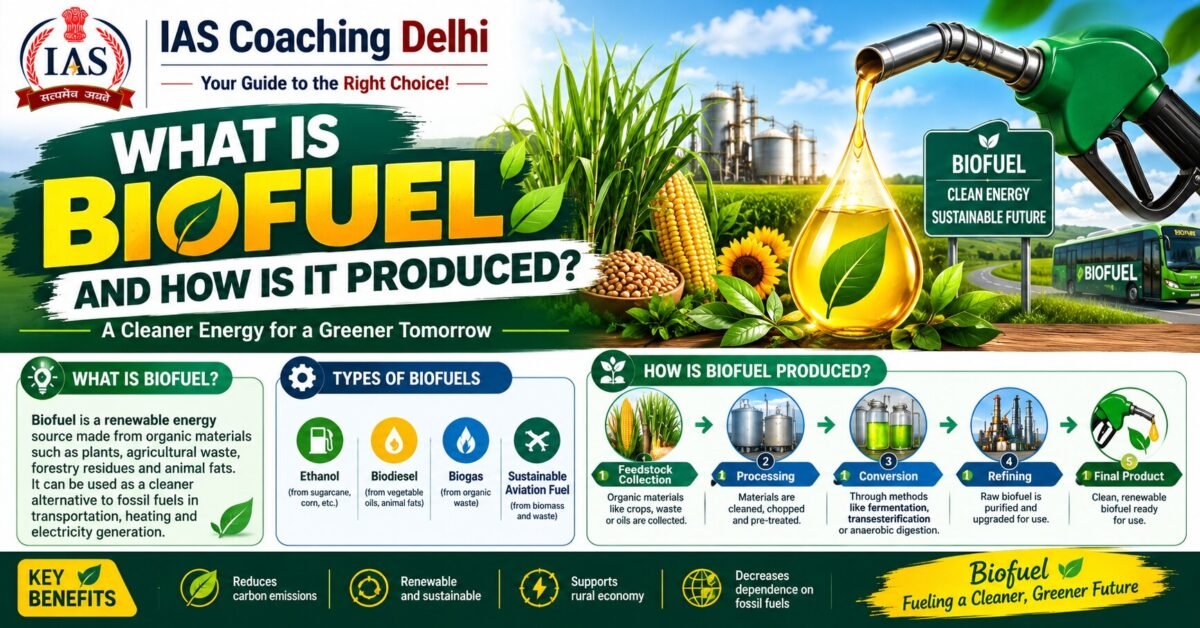
For aspirants of UPSC, What is biofuel is not merely a question from a definition standpoint. The subject matter links Environment and Ecology, Indian Economy, Agriculture, Energy Security, Science & Technology, Climate Change and Government policies. Hence, it becomes all the more significant and relevant for UPSC aspirants as one single topic may come up in various forms in UPSC Prelims and Mains exams.
The increasing demand for alternative fuel sources which are cleaner than fossil fuel sources is leading to the rise in significance of biofuels among nations. In India, the field of biofuels has become increasingly relevant because of ethanol blending, compressed biogas, agricultural residues, waste management and energy security.
What Is Biofuel in Simple Terms?
Biofuel is a fuel produced from biological material, commonly known as biomass. This material can come from crops, agricultural residues, animal waste, used cooking oil, forestry resources, organic waste, and other renewable biological sources.
In simple words, instead of extracting fuel from underground fossil deposits formed over millions of years, biofuel production uses recently available biological material as its feedstock. Depending on the raw material and technology, the final product may be a liquid fuel, gaseous fuel, or another usable form of bioenergy.
The International Energy Agency classifies liquid biofuels as fuels derived from biomass or waste feedstocks, including ethanol, biodiesel, and biojet fuels. Biogas is produced separately through the biological breakdown of organic matter in an oxygen-free environment.
For UPSC preparation, remember this simple chain:
Biomass → Conversion Process → Biofuel → Energy Use
This basic framework makes it easier to understand the different production methods and their environmental and economic implications.
Why Biofuels Matter for India’s Energy Future
India imports a substantial share of its fossil fuel requirements, making energy security an important policy concern. Biofuels can contribute to diversification by creating domestic sources of transport and energy fuels from agricultural products, waste, and residues.
The opportunity is particularly relevant for an agricultural economy. Crop residues and organic waste can become useful feedstocks instead of being treated only as disposal problems. Government programmes also connect bioenergy with waste management, rural employment, cleaner cooking fuels, and agricultural benefits.
For an aspirant, the topic becomes much easier when studied through these four dimensions:
- Energy security: Reduces dependence on imported fossil fuels.
- Agriculture: Creates additional value from crops and residues.
- Environment: Can reduce lifecycle emissions when sustainably produced.
- Economy: Creates opportunities in processing, infrastructure, and rural industries.
This interdisciplinary approach is also consistent with the way modern UPSC questions connect environment with economy, agriculture, and current affairs. Your existing UPSC-focused content already follows this concept-oriented approach, particularly in Environment, Geography, and current-affairs preparation.
Main Types of Biofuel You Should Know
Not every biofuel is produced in the same way. The feedstock, technology, and final application determine the type of fuel.
Bioethanol
Bioethanol is ethanol produced from biomass or biodegradable organic material. It can be produced from sugar-containing or starch-rich feedstocks and can be blended with petrol for use in suitable vehicles.
In India, ethanol blending has become an important part of the country’s alternative-fuel strategy. The government’s policy framework has promoted ethanol production from multiple feedstocks, including non-food materials through advanced production routes.
For UPSC, connect bioethanol with:
- Ethanol blending programme
- Sugar industry
- Agricultural feedstocks
- Energy security
- 1G and 2G ethanol
- Carbon emissions
Biodiesel
Biodiesel is a renewable diesel-equivalent fuel that can be produced from vegetable oils, animal fats, and waste oils through processes such as transesterification. Advanced routes can also use waste and non-food feedstocks.
Used cooking oil is particularly interesting because it turns a waste product into an energy resource. This illustrates a larger principle of the circular economy: waste from one activity can become a useful input for another.
Biogas and Biomethane
Biogas is a gaseous biofuel produced when organic matter breaks down in the absence of oxygen. The process is called anaerobic digestion.
Its major component is methane, along with carbon dioxide and smaller quantities of other gases. The exact composition depends on the feedstock and production process.
When biogas is purified to remove carbon dioxide and other contaminants, it can be upgraded into biomethane, which is also known as renewable natural gas.
How Is Biofuel Produced?
The production process depends heavily on the type of fuel being made. There is no single manufacturing method for every biofuel.
A typical production chain includes:
Feedstock Collection → Pre-treatment → Conversion → Purification → Quality Testing → Fuel Use
Each stage has a specific purpose. The feedstock must first be collected and prepared. It may then undergo biological, chemical, or thermochemical conversion before the desired fuel is separated, purified, and made ready for use.
This is why modern biofuel technology is often described as a biorefining process. Biorefining can involve several stages, including pretreatment, fermentation, gasification, pyrolysis, and upgrading.
How Bioethanol Is Produced
Bioethanol production commonly begins with a feedstock containing fermentable sugars or materials that can be converted into sugars.
The broad process looks like this:
- Feedstock preparation – Crops or biomass are collected and processed.
- Sugar release – Starch or complex carbohydrates may be converted into simpler sugars.
- Fermentation – Microorganisms convert sugars into ethanol.
- Distillation – Ethanol is separated and concentrated.
- Dehydration and purification – Remaining water and impurities are removed.
- Blending or distribution – The finished fuel can be supplied for approved applications.
Conventional ethanol can rely on food-energy crops, while advanced or cellulosic ethanol can use agricultural wastes and residues. This distinction is important because advanced technologies can reduce direct competition with food crops.
How Biodiesel Is Produced
Biodiesel production follows a different chemical route.
Vegetable oils, animal fats, or suitable waste oils are first collected and processed. In a conventional biodiesel pathway, the oil reacts with an alcohol in the presence of a catalyst through a process known as transesterification.
The process produces biodiesel along with glycerol as a by-product.
The basic sequence is:
Oil or Fat → Pre-treatment → Chemical Reaction → Separation → Purification → Biodiesel
The quality of the raw material matters because impurities, moisture, and free fatty acids can affect processing efficiency. This is one reason advanced biodiesel systems increasingly explore waste oils, residues, and other alternative feedstocks.
How Biogas Is Produced
Biogas production is based on biological decomposition rather than the chemical conversion used for conventional biodiesel.
Organic materials such as animal manure, food waste, sewage, and agricultural residues can be placed inside an airtight anaerobic digester. Microorganisms then break down the material without oxygen.
The process generates biogas and a nutrient-rich digestate.
According to the IEA, biogas generally contains methane, carbon dioxide, and small amounts of other gases, while its methane concentration can vary depending on the feedstock and production pathway.
The resulting gas can be used for heating, electricity generation, cooking, or upgraded into biomethane for suitable applications.
What Are 1G, 2G and Advanced Biofuels?
This classification is particularly useful for UPSC aspirants.
First-generation biofuels (1G) generally use food-based feedstocks such as sugar, starch, or vegetable oils.
Second-generation biofuels (2G) use non-food biomass, agricultural residues, lignocellulosic materials, and wastes. The objective is to increase fuel production without depending as heavily on food crops.
Advanced biofuel technologies can also include pathways using waste oils, residues, non-food crops, and sophisticated conversion technologies. The IEA identifies waste and residue-based production as an important area for future biofuel expansion.
For exam preparation, do not memorize the terms in isolation. Understand the feedstock → technology → fuel → sustainability relationship.
Biofuel vs Fossil Fuel
| Factor | Biofuel | Fossil Fuel |
| Main source | Biomass and organic matter | Coal, crude oil and natural gas |
| Resource nature | Renewable when sustainably managed | Finite |
| Production period | Relatively short biological cycles | Geological timescales |
| Common examples | Ethanol, biodiesel, biogas | Petrol, diesel, coal, natural gas |
| Waste utilisation | Can use agricultural and organic waste | Generally not based on waste feedstocks |
| Energy security | Can support domestic fuel supply | Often linked with import dependence |
However, calling every biofuel automatically “clean” would be an oversimplification. Environmental performance depends on feedstock, land use, farming practices, processing energy, transportation, and the entire lifecycle of the fuel.
That distinction is important for UPSC Mains answers because strong answers show both benefits and limitations rather than presenting renewable energy as a perfect solution.
Major Benefits of Biofuel Production
Biofuel development can create several economic and environmental opportunities when production is properly planned.
Supports Energy Security
Domestic production can diversify the energy mix and reduce dependence on imported petroleum products.
Converts Waste Into Value
Agricultural residues, food waste, used cooking oil, and animal waste can become useful feedstocks instead of remaining disposal challenges.
Supports Rural Economies
Biofuel supply chains can create demand for agricultural residues, processing facilities, transportation, and local employment.
Helps Decarbonise Difficult Sectors
The IEA identifies biofuels as particularly relevant to transport, including areas where direct electrification can be difficult.
Supports Circular Economy
Biofuel systems can connect agriculture, waste management, energy production, and industry into a more circular resource model.
Challenges You Should Not Ignore
A balanced understanding is essential. Biofuel production also presents challenges.
Large-scale dependence on food crops can create food-versus-fuel concerns. Intensive cultivation can also create pressure on land and water resources. The actual climate benefit depends on the complete lifecycle of production.
Other challenges include:
- Feedstock availability
- Collection and transportation costs
- Processing infrastructure
- Technology requirements
- Water and land demand
- Competition with food crops
- Lifecycle greenhouse-gas emissions
This is why advanced feedstocks such as agricultural waste and residues are gaining attention. The IEA expects waste, residues, and non-food energy crops to play a substantially larger role in future biofuel demand.
India’s Biofuel Policy and Current Direction
India’s National Policy on Biofuels provides an important policy framework for the sector. The Ministry of Petroleum and Natural Gas lists the original 2018 policy and its 2022 amendment among the country’s biofuel policy documents.
The policy framework has promoted ethanol blending, biodiesel, and advanced biofuel pathways. Government programmes have also encouraged production from non-food feedstocks, including cellulosic and lignocellulosic materials.
The Ministry of New and Renewable Energy has separately supported biogas and waste-to-energy initiatives. Its National Bioenergy Programme includes Waste-to-Energy, Biomass, and Biogas components.
For UPSC, this makes biofuel a strong example of how energy policy, environmental sustainability, agricultural waste management, rural development, and technology can intersect.
How to Prepare Biofuel for UPSC
If you are studying biofuel for the Civil Services Examination, avoid learning only a one-line definition. Build a compact framework around the topic.
Focus on:
- Definition and classification
- Types of biofuels
- Feedstocks
- Production technologies
- 1G vs 2G biofuels
- Ethanol blending
- Biodiesel
- Biogas and biomethane
- Waste-to-energy
- Energy security
- Environmental impacts
- Food-versus-fuel debate
- Government policies
- Current developments
For Prelims, focus on factual distinctions, feedstocks, processes, and policy terms.
For Mains, practise linking biofuels with energy security, climate change, agriculture, circular economy, rural employment, and sustainable development. This approach is consistent with the broader UPSC preparation strategy of connecting individual topics with multiple GS areas rather than treating them as isolated facts.
Why Concept-Based Preparation Works Better
Environment questions are increasingly interconnected with current affairs and policy. Recent UPSC-oriented analysis on your website similarly emphasizes conceptual clarity and links Environment with Geography, Agriculture, Science & Technology, and current developments.
That is exactly how biofuel should be approached.
Instead of memorising ten separate facts, understand one complete chain:
Biomass → Feedstock → Conversion Technology → Fuel → Application → Environmental Impact → Government Policy
Once this chain is clear, you can handle definition-based Prelims questions as well as analytical Mains questions much more confidently.
Conclusion
Knowing about biofuels becomes easy when one studies biofuels not just from the point of view of their definitions but by looking at the entire energy chain they form. Biofuels can be produced from biological materials in various ways such as fermentation, transesterification, anaerobic digestion, gasification, and many others.
For aspirants who are preparing for UPSC, the importance of biofuels lies not in knowing just the topic. It is a very relevant topic which is connected with many other important topics like energy security, agriculture, waste management, climatic policies, rural development, and many more.
FAQs
Q.1 What is biofuel?
Biofuel is a fuel produced from biological materials such as crops, agricultural residues, organic waste, vegetable oils, and animal waste. Common examples include bioethanol, biodiesel, and biogas.
Q.2 How is biofuel produced?
Production depends on the fuel type. Ethanol can be produced through fermentation, biodiesel through processes such as transesterification, and biogas through anaerobic digestion of organic matter.
Q.3 What are the main types of biofuel?
The major forms include bioethanol, biodiesel, biogas, biomethane, and advanced biofuels. They differ in feedstock, production technology, and application.
Q.4 Why are biofuels important for India?
Biofuels can support energy security, waste utilisation, agricultural income, rural employment, and lower-carbon transport, while helping diversify India’s energy sources.
Q.5 Is biofuel important for UPSC?
Yes. Biofuels can be studied under Environment and Ecology, Economy, Agriculture, Science & Technology, Energy Security, and Current Affairs, making the topic relevant to multiple parts of the UPSC syllabus.