
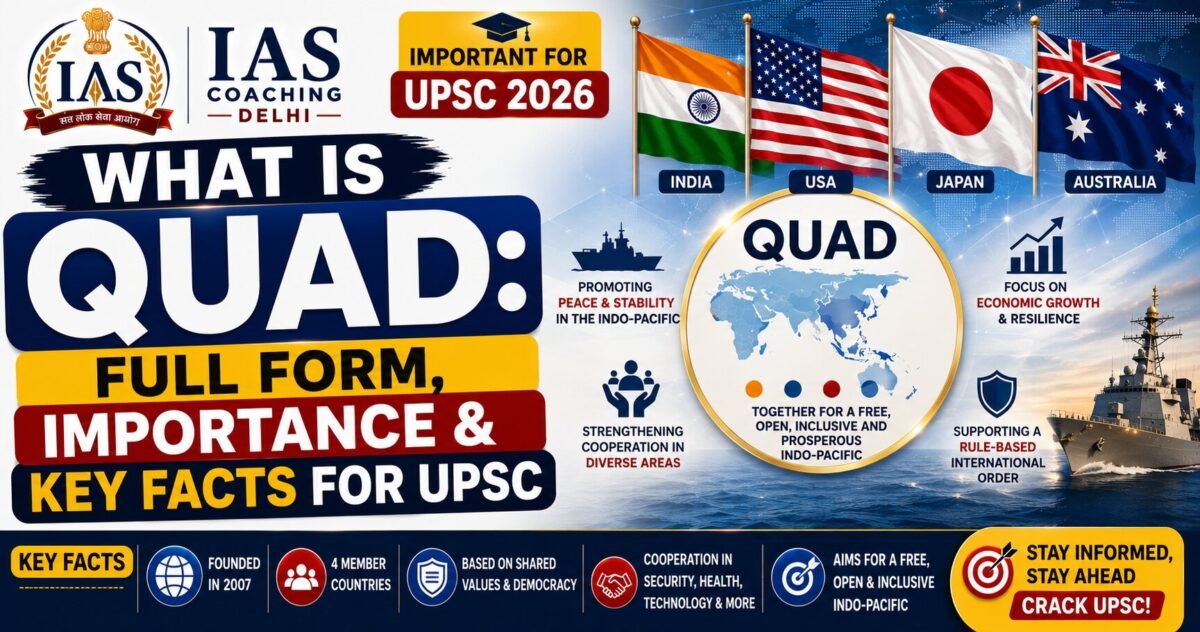
If you are preparing for Civil Services Examination, then you have definitely encountered the word QUAD in terms of current affairs, international relations, or editorials. It has become essential for all aspirants to know about the QUAD Full Form and its relevance in geopolitics in today’s world. Questions from QUAD are asked in Prelims, Mains, and sometimes even Personality Test.
It is imperative for an aspirant to go beyond rote learning about such topics as QUAD. You need to know why it is strategically significant, what are its constituent countries, objectives, and how it impacts the foreign policy of India. This article aims to provide you with all the details regarding it in a lucid manner.
QUAD Full Form and Meaning
The QUAD Full Form is Quadrilateral Security Dialogue. It is a strategic partnership between India, the United States, Japan, and Australia. The grouping focuses on strengthening cooperation in the Indo-Pacific region through diplomacy, security collaboration, economic development, technology, disaster management, and maritime security.
Unlike a formal military alliance, the QUAD functions as a platform where member countries discuss shared regional interests and coordinate on important global challenges. Over the years, it has expanded beyond security issues to include climate action, emerging technologies, cybersecurity, healthcare, resilient supply chains, and critical infrastructure.
For UPSC aspirants, understanding the evolution of QUAD is important because it connects with International Relations, India’s Foreign Policy, Indo-Pacific Strategy, and Current Affairs.
Why QUAD is Important for UPSC Preparation
International organizations and strategic partnerships are a regular part of the UPSC syllabus. Every year, UPSC asks conceptual as well as current affairs-based questions related to global institutions and India’s diplomatic relations.
The importance of QUAD can be understood from multiple perspectives:
- Frequently discussed in UPSC Current Affairs
- Relevant for International Relations in GS Paper II
- Useful for Essay Paper topics
- Important for Interview discussions
- Connected with India’s foreign policy and maritime strategy
Instead of learning isolated facts, aspirants should understand why India actively participates in the QUAD and how it supports national interests.
Students preparing under structured guidance often learn how to interlink such topics with broader concepts like geopolitics, diplomacy, regional security, and global governance. This analytical approach helps in writing better answers in the Mains examination.
Member Countries of QUAD
The Quadrilateral Security Dialogue consists of four democratic countries that share common interests in maintaining peace, stability, and economic growth across the Indo-Pacific region.
| Country | Role in QUAD |
| India | Strategic partner focusing on regional stability and maritime cooperation |
| United States | Supports security cooperation and a free Indo-Pacific |
| Japan | Promotes economic partnerships and infrastructure development |
| Australia | Strengthens regional collaboration and maritime security |
Each member contributes differently, but all work towards maintaining a rules-based international order.
For UPSC, candidates should remember not only the names of the member countries but also their strategic priorities within the grouping.
History and Evolution of QUAD
The concept of the Quadrilateral Security Dialogue first emerged in 2007 following cooperation among the four countries during humanitarian relief efforts after the 2004 Indian Ocean tsunami.
Although the initiative slowed down for several years due to changing political priorities, it was revived in 2017 as geopolitical developments in the Indo-Pacific gained greater importance.
Since its revival, QUAD has witnessed significant progress through:
- Regular ministerial meetings
- Annual leaders’ summits
- Joint working groups
- Cooperation in technology and innovation
- Vaccine partnerships
- Supply chain resilience initiatives
Its expanding agenda reflects changing global priorities and demonstrates how strategic partnerships evolve beyond traditional security concerns.
Objectives of QUAD
Many aspirants memorize the objectives but fail to explain them in answer writing. Instead of listing points, try understanding the broader vision behind the grouping.
The primary objectives include:
Promoting a Free and Open Indo-Pacific
The QUAD supports freedom of navigation, peaceful dispute resolution, and respect for international law across the Indo-Pacific region.
Maritime Security
The member countries cooperate to improve maritime awareness, disaster response, and naval coordination in strategically important sea routes.
Economic Cooperation
QUAD promotes resilient global supply chains, infrastructure development, and sustainable economic growth among regional partners.
Emerging Technologies
Another important objective is cooperation in areas such as:
- Artificial Intelligence
- Critical technologies
- Cybersecurity
- Semiconductor supply chains
- Digital infrastructure
These areas have become increasingly relevant for UPSC because technology now plays an important role in international relations.
Climate Change and Healthcare
Recent QUAD initiatives also focus on:
- Clean energy
- Climate resilience
- Pandemic preparedness
- Public health cooperation
- Disaster management
This broader agenda reflects the evolving nature of international partnerships.
India’s Role in QUAD
India plays a significant role within the Quadrilateral Security Dialogue due to its strategic location in the Indo-Pacific and its growing influence in global diplomacy.
For India, participation supports several national priorities, including:
- Maritime security
- Regional connectivity
- Economic cooperation
- Technological partnerships
- Strategic autonomy
Unlike traditional military alliances, India’s participation aligns with its independent foreign policy while strengthening cooperation with like-minded democracies.
Understanding this balance between strategic partnerships and independent diplomacy is important for writing high-quality UPSC answers.
Why QUAD Matters in International Relations
The Indo-Pacific has become one of the most strategically significant regions in the world. A large portion of global trade passes through this region, making stability essential for economic growth.
The QUAD contributes by encouraging:
- Regional cooperation
- Secure sea lanes
- Disaster response coordination
- Technology partnerships
- Infrastructure development
- Rules-based international order
These topics frequently appear in UPSC Mains under International Relations and Current Affairs.
Instead of remembering isolated facts, aspirants should learn to connect QUAD with India’s larger diplomatic and strategic objectives.
How to Prepare QUAD for UPSC
Many students spend too much time collecting information from multiple sources. A smarter approach is to prepare the topic systematically.
While studying QUAD, focus on:
- Full form
- Member countries
- Objectives
- Timeline
- India’s role
- Indo-Pacific strategy
- Recent summits
- Current affairs updates
- Previous year UPSC questions
Making concise revision notes and regularly updating them with current developments will improve retention.
For aspirants aiming for higher scores, integrating current affairs with static concepts is one of the most effective preparation strategies. This is why many serious candidates prefer structured mentorship and exam-oriented guidance while preparing International Relations topics.
QUAD Summit and Recent Developments (UPSC Perspective)
For UPSC aspirants, simply knowing the QUAD Full Form is not enough. The examination increasingly focuses on the practical significance of international groupings and their role in global affairs. That is why candidates should stay updated with recent QUAD meetings, joint statements, and new areas of cooperation.
In recent years, QUAD leaders have expanded their agenda beyond maritime security. Discussions now include critical technologies, cybersecurity, resilient supply chains, climate action, clean energy, space cooperation, and disaster response. These developments make QUAD an important topic for both Current Affairs and International Relations.
While preparing for the exam, aspirants should regularly revise official summit outcomes instead of relying only on short current affairs notes. Linking recent developments with the static syllabus helps improve answer quality in the Mains examination and prepares candidates for interview discussions.
QUAD vs NATO vs AUKUS
Many UPSC aspirants confuse these international groupings because all of them involve strategic cooperation. However, their objectives and structure are quite different.
| Feature | QUAD | NATO | AUKUS |
| Full Form | Quadrilateral Security Dialogue | North Atlantic Treaty Organization | Australia-UK-US Partnership |
| Members | India, USA, Japan, Australia | 30+ Member Nations | Australia, United Kingdom, United States |
| Nature | Strategic Partnership | Military Alliance | Defence & Technology Partnership |
| Main Focus | Indo-Pacific Cooperation | Collective Defence | Advanced Defence Technology |
| Military Treaty | No | Yes | No |
For UPSC, understanding these differences is more valuable than memorizing definitions. Comparative questions are frequently asked in both the Prelims and Mains examinations.
Advantages of QUAD for India
India’s participation in QUAD supports several long-term strategic objectives. Instead of viewing it only from a defence perspective, aspirants should understand its wider diplomatic and economic significance.
Strengthens India’s Global Position
Participation in QUAD enhances India’s role as an important player in Indo-Pacific affairs. It also strengthens diplomatic engagement with major democratic nations.
Supports Maritime Security
Safe and secure sea routes are essential for India’s trade and economic growth. Cooperation through QUAD helps improve maritime awareness and regional stability.
Promotes Technology Collaboration
The partnership encourages cooperation in areas such as:
- Artificial Intelligence
- Semiconductor manufacturing
- Cybersecurity
- Digital infrastructure
- Critical and emerging technologies
These sectors are increasingly important from both examination and policy perspectives.
Economic Opportunities
QUAD initiatives encourage stronger supply chains, infrastructure investment, and innovation. These efforts contribute to sustainable economic development while reducing dependence on single-source supply networks.
Challenges Before QUAD
Despite its growing influence, QUAD also faces several challenges that UPSC aspirants should understand.
Different Strategic Priorities
Each member country has its own foreign policy objectives. Balancing these priorities while maintaining cooperation can sometimes be challenging.
Regional Geopolitical Tensions
The Indo-Pacific region remains strategically sensitive. Changing geopolitical situations often influence diplomatic decisions and regional partnerships.
Implementation of Initiatives
Although many agreements are announced during summit meetings, successful implementation requires long-term coordination and policy commitment from all member countries.
Managing Strategic Balance
India follows a policy of strategic autonomy. Therefore, maintaining balanced relations with different global powers while participating in QUAD remains an important aspect of Indian foreign policy.
Understanding these challenges helps aspirants write balanced and analytical answers in the UPSC Mains examination.
Preparation Strategy for QUAD in UPSC
International Relations can become scoring if studied systematically. Rather than memorizing isolated facts, aspirants should build conceptual clarity.
A practical strategy includes:
- Study the evolution of QUAD chronologically.
- Understand the objectives instead of rote learning.
- Connect static concepts with current affairs.
- Read official summit statements for authentic information.
- Practice answer writing using recent developments.
- Revise maps related to the Indo-Pacific region.
Many successful candidates also prepare short notes covering important international organizations together. This approach makes revision faster before the examination.
Common Mistakes UPSC Aspirants Make
Even well-prepared candidates sometimes lose marks because of avoidable mistakes.
Some common errors include:
- Confusing QUAD with NATO or AUKUS.
- Memorizing facts without understanding their significance.
- Ignoring recent summit developments.
- Writing one-sided answers without mentioning challenges.
- Depending only on coaching notes instead of official sources.
Avoiding these mistakes can improve both conceptual understanding and answer-writing quality.
Why Concept-Based Learning Matters
International Relations is one of the most dynamic sections of the UPSC syllabus. Topics like QUAD evolve continuously as global events unfold.
Instead of preparing only factual information, aspirants should focus on:
- Cause and effect relationships
- India’s diplomatic priorities
- Global strategic developments
- Contemporary geopolitical issues
This approach helps candidates answer analytical questions with greater confidence.
For students looking to strengthen their UPSC preparation, structured guidance and regular current affairs analysis can make a significant difference. Platforms like IAS Coaching Delhi provide exam-oriented resources, expert mentorship, and updated study materials that help aspirants understand complex topics in a simple and practical manner.
Conclusion
Knowing the QUAD Full Form is not enough to prepare this topic of UPSC. Candidates must also understand other aspects of QUAD such as its objectives, members of QUAD, strategic significance, role of India in QUAD, recent updates regarding QUAD, and significance of QUAD in the Indo-Pacific Region.
While preparing for UPSC, one must adopt concept-based learning rather than rote learning of facts. Revision, keeping oneself up-to-date with the current affairs, and practicing answers will prove helpful in building a solid base in International Relations. Proper preparation and appropriate guidance will turn a difficult topic like QUAD into a high-scoring topic.
Frequently Asked Questions
Q.1 What is the QUAD Full Form?
The QUAD Full Form is Quadrilateral Security Dialogue, a strategic partnership between India, the United States, Japan, and Australia.
Q.2 Why is QUAD important for UPSC?
QUAD is an important topic because it is part of the UPSC syllabus under International Relations, Current Affairs, and India’s Foreign Policy.
Q.3 Which countries are members of QUAD?
The four member countries are India, the United States, Japan, and Australia.
Q.4 Is QUAD a military alliance?
No. QUAD is a strategic partnership focused on cooperation in areas such as maritime security, technology, economic resilience, and regional stability. It is not a formal military alliance like NATO.
Q.5 How should I prepare QUAD for the UPSC Exam?
Study the concept, objectives, member countries, India’s role, Indo-Pacific strategy, recent summit outcomes, and practice previous years’ UPSC questions to build a complete understanding.