
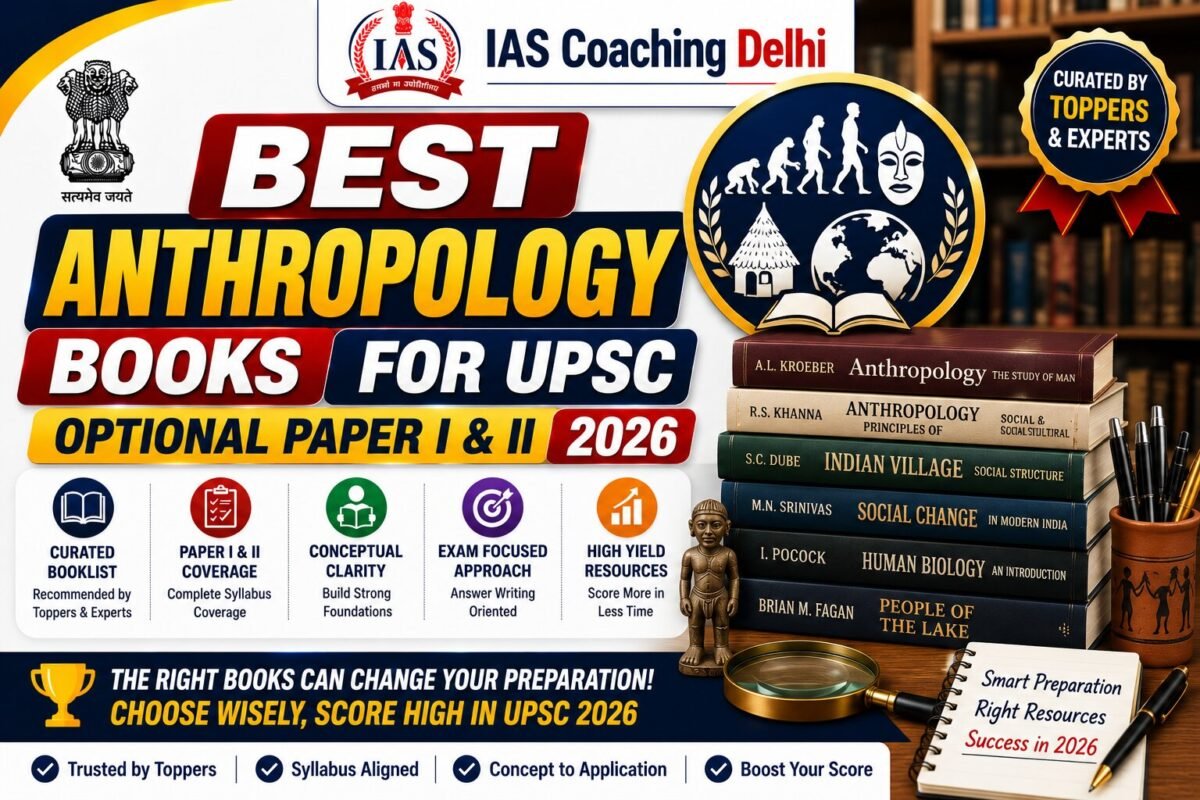
For those who plan to take Anthropology as an optional subject, picking the Best Anthropology Books For UPSC is probably one of the most crucial decisions they have to make. A concise list of books will not only save them from preparation months but will also prevent them from referring to unnecessary sources.
Most of the aspirants face problems due to the reason that they end up buying numerous books. It would be more beneficial for them to prepare a small collection of good sources for both Paper I & Paper II. This book list is specifically meant for the candidates who are preparing for UPSC.
What Makes a Good Anthropology Book for UPSC?
A good Anthropology book should cover the syllabus clearly, use simple language, and help you write analytical answers. It should also include diagrams, case studies, thinkers, and examples that can be used directly in Mains answers.
Before purchasing any book, check whether it is useful for revision, answer writing, and repeated reading. A book that looks comprehensive but is difficult to revise may not be the best choice during the final months of preparation.
Recommended Booklist for Paper I and Paper II
| Book / Source | Best Use |
| Physical Anthropology | Human evolution, genetics, and physical anthropology basics |
| Anthropology: Theories and Concepts | Social anthropology, theories, and thinkers |
| An Introduction to Social Anthropology | Basic concepts and anthropological approaches |
| Indian Anthropology | Paper II, Indian society, tribes, and culture |
| Tribal India | Tribal issues and contemporary relevance |
| Class notes and PYQs | Revision and answer writing practice |
Core Books to Buy First
If you are starting from scratch, do not buy ten books at once. Begin with a small set that covers most of the syllabus and revise them multiple times.
Physical Anthropology by P. Nath
This is one of the most commonly recommended books for biological anthropology. It is useful for topics such as human evolution, genetics, race, and primatology.
The book is detailed, so make concise notes while reading. Focus on diagrams and repeated revision rather than trying to memorize every line.
Anthropology: Theories and Concepts by Nadeem Hasnain
This book is helpful for understanding anthropological theories and thinkers. It explains important concepts in a relatively simple manner.
Use it mainly for Paper I. While reading, prepare short summaries of each theory and thinker for quick revision before the exam.
An Introduction to Social Anthropology by Majumdar and Madan
This is a good foundational book for beginners. It helps in building conceptual clarity for social anthropology topics.
Do not try to read it like a storybook. Read topic-wise according to the syllabus and connect each concept with previous year questions.
Best Books for Anthropology Optional Paper I
Paper I focuses on physical anthropology, social anthropology, theories, and anthropological thought. A strong foundation here makes Paper II easier as well.
Biological Anthropology
For topics such as human evolution, genetics, and primatology, use a standard source and revise diagrams regularly.
Useful source:
- Physical Anthropology
Anthropological Theories
This section is scoring if your concepts are clear. Prepare concise notes for each thinker and compare different theories.
Useful source:
- Anthropology: Theories and Concepts
Social Anthropology
For kinship, marriage, family, religion, and economic organization, use one primary source and supplement it with class notes or previous year questions.
Useful source:
- An Introduction to Social Anthropology
Best Books for Anthropology Optional Paper II
Paper II is often considered more scoring because it deals with Indian society, tribal communities, culture, and contemporary issues. The key is to use updated examples and government reports wherever relevant.
Indian Anthropology
This should be one of your main sources for Paper II. It covers topics such as India’s social structure, communities recognized as Scheduled Tribes, caste, religion, and cultural diversity.
Useful source:
- Indian Anthropology
Tribal India
This book is useful for tribal issues, development programs, displacement, and contemporary challenges faced by tribal communities.
Useful source:
- Tribal India
Current Affairs and Government Reports
Paper II answers become stronger when supported with recent examples. Use selective current affairs, government reports, and committee recommendations instead of collecting too many magazines.
Smart Book Selection for 2026 Aspirants
The biggest mistake is buying too many books and reading each one only once. A better strategy is to select a limited number of sources and revise them repeatedly.
Choose books that help you:
- Understand concepts clearly
- Make short revision notes
- Add diagrams and examples in answers
- Practice previous year questions
- Revise quickly before the exam
For most serious aspirants, four to six core books are enough when combined with PYQs, notes, and regular answer writing practice.
How to Use These Books Efficiently
Reading the right books is only half the preparation. The other half is how you revise and convert information into Mains-ready answers.
A practical approach is:
- Read one topic according to the syllabus.
- Prepare short notes in your own words.
- Add diagrams, examples, and case studies.
- Solve previous year questions for that topic.
- Revise the same notes multiple times.
This method is more effective than reading multiple books without revision.
Recommended Starting Set
If you are beginning Anthropology preparation for UPSC 2026, start with this limited set:
- Physical Anthropology
- Anthropology: Theories and Concepts
- An Introduction to Social Anthropology
- Indian Anthropology
- Tribal India
- Previous year questions and answer writing practice
This combination is sufficient for most aspirants when revised properly.
Serious UPSC Aspirants?
For a reliable UPSC preparation strategy, focus on authentic syllabus coverage, standard reference books, previous year questions, and repeated revision. At IAS Coaching Delhi, the emphasis is on practical preparation methods that help aspirants choose limited resources and build answer-writing confidence.
Best Books for Anthropology Revision Before UPSC Mains
Revision is where most aspirants either improve their scores or lose valuable marks. Reading new books in the last few months rarely helps. Instead, focus on revising your selected resources multiple times.
Create concise notes from your standard books and keep them limited to important definitions, thinkers, diagrams, tribal examples, and current affairs. These notes should become your primary revision material before the examination.
A practical revision strategy includes:
- Revise one topic every week.
- Practice answer writing after every revision.
- Update notes with current examples.
- Memorize important anthropologists and theories.
- Revise diagrams regularly.
The more times you revise the same notes, the more confident you become during the Mains examination.
Which Anthropology Books Should Beginners Buy?
Many beginners believe buying more books means better preparation. In reality, a focused approach works much better.
If you are preparing for UPSC 2026, start with a few trusted books instead of collecting every recommendation available online. Once your concepts become clear, you can add supplementary material only if required.
Recommended Starter Combination
| Purpose | Recommended Source |
| Physical Anthropology | P. Nath |
| Social Anthropology | Majumdar & Madan |
| Anthropology Theories | Nadeem Hasnain |
| Indian Anthropology | Standard Indian Anthropology Text |
| Tribal Issues | Tribal India |
| Practice | UPSC Previous Year Questions |
This combination covers most of the syllabus without overwhelming your preparation.
How Many Books Are Enough for Anthropology Optional?
One of the most common mistakes UPSC aspirants make is collecting too many books.
For most candidates, five to six standard books are sufficient. Instead of reading ten different sources once, revise the same books multiple times.
A successful preparation strategy usually includes:
- Limited study material
- Strong conceptual clarity
- Regular revision
- Answer writing practice
- Previous year question analysis
Quality of preparation always matters more than the quantity of books you own.
Common Mistakes While Selecting Anthropology Books
Many aspirants spend weeks searching for the “perfect” booklist instead of actually studying.
Avoid these common mistakes:
- Buying too many books at once
- Ignoring the official UPSC syllabus
- Not solving previous year questions
- Reading without making notes
- Frequently changing study resources
- Depending only on coaching notes
- Skipping revision
A disciplined study plan with limited resources usually produces better results than constantly changing books.
How to Combine Books with Answer Writing Practice
Reading books alone is not enough to score well in Anthropology Optional. You must learn how to convert knowledge into structured answers.
After completing every topic:
- Solve 3–5 previous year questions.
- Write answers within the UPSC time limit.
- Use headings and subheadings.
- Include flowcharts wherever possible.
- Draw neat diagrams to improve presentation.
- Add tribal examples and case studies.
This approach improves answer quality and develops confidence before the examination.
Should You Buy New Editions Every Year?
This is another question many aspirants ask before starting preparation.
For core Anthropology subjects, standard books remain relevant for several years because the concepts do not change frequently.
However, you should regularly update:
- Current affairs
- Tribal welfare schemes
- Government reports
- Census-related information
- Constitutional developments
- Committee recommendations
Instead of replacing your entire book collection every year, simply update your notes with recent developments.
How to Choose the Right Anthropology Books for UPSC 2026
Before purchasing any book, ask yourself a few simple questions.
Does the book:
- Cover the UPSC syllabus?
- Explain concepts clearly?
- Help with answer writing?
- Include diagrams and illustrations?
- Support quick revision?
- Match previous year question trends?
If the answer is yes, it is worth adding to your preparation.
Avoid purchasing books simply because they are popular on social media.
Build a Smart Anthropology Preparation Strategy
Books are only one part of Anthropology Optional preparation. A complete strategy includes planning, consistency, and regular evaluation.
An effective preparation routine should include:
- Standard books
- Daily revision
- Weekly answer writing
- Previous year questions
- Monthly current affairs updates
- Diagram practice
- Mock tests
This balanced approach helps you prepare for both Paper I and Paper II without feeling overwhelmed.
Conclusion
How To Select Best Anthropology Books for UPSC 2026 is neither about accumulating the most number of books nor even choosing the best books. Only a few standard books, supplemented by consistent revision, writing of answers, and analysis of past years’ questions are more than enough to develop an excellent preparation of Anthropology Optional.
For those who are planning to prepare for UPSC 2026, it should be noted that keeping limited resources, doing consistent revision and focusing on concepts rather than volume of reading material is what is needed to succeed in Anthropology Optional. One can also get professional help at IAS Coaching Delhi.
Frequently Asked Questions (FAQs)
Q.1 Which are the Best Anthropology Books For UPSC beginners?
Beginners should start with standard books like P. Nath, Majumdar & Madan, Nadeem Hasnain, and a reliable source for Indian Anthropology, along with previous year questions.
Q.2 Are coaching notes enough for Anthropology Optional?
Coaching notes are helpful for revision, but they should be supplemented with standard reference books and regular answer-writing practice.
Q.3 How many books should I study for Anthropology Optional?
Most aspirants can complete the syllabus effectively with five to six standard books, combined with current affairs and PYQs.
Q.4 Is Anthropology Optional scoring in UPSC?
Yes. Anthropology is considered a popular optional because of its concise syllabus, overlap with General Studies, and diagram-based answer-writing opportunities.
Q.5 Can I prepare Anthropology Optional without coaching?
Yes. With the right books, a structured study plan, previous year questions, and consistent revision, many aspirants prepare Anthropology Optional successfully through self-study.