
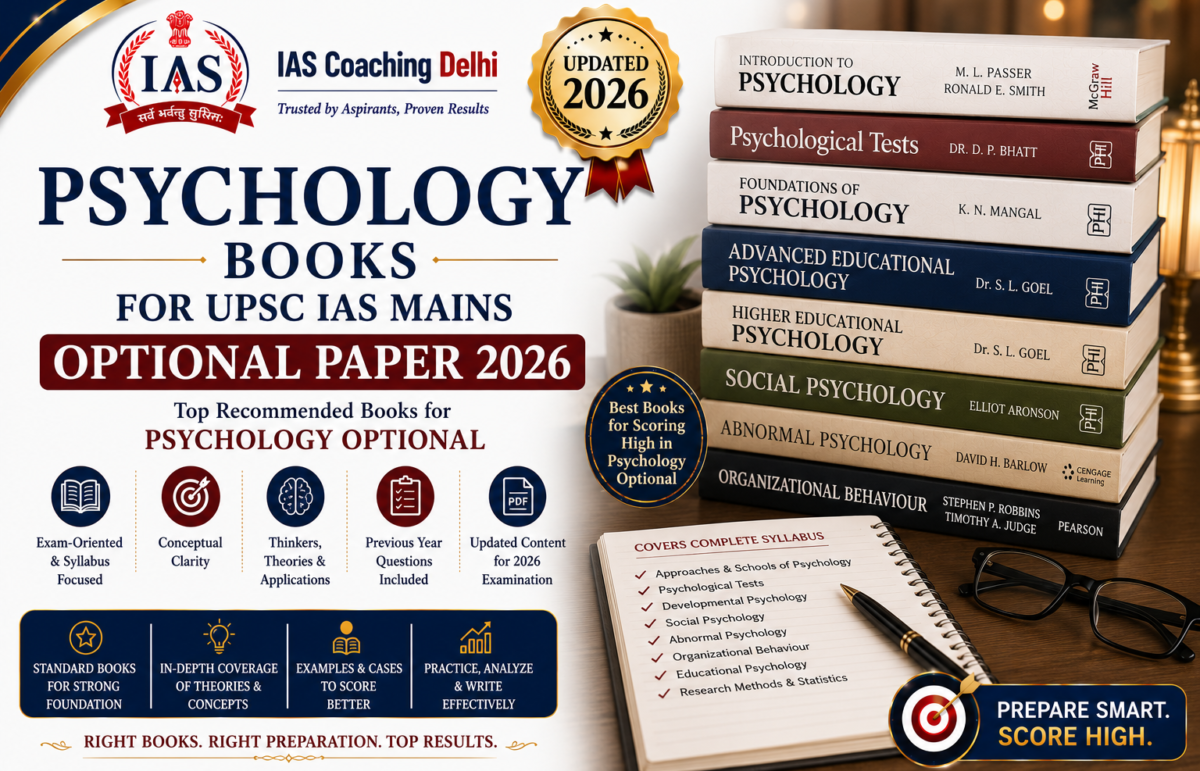
Choosing the right Psychology Books is very crucial for your UPSC IAS Psychology Syllabus preparation. First, regular books will give you a clear explanation of the basic psychology theories. With your basics cleared, everything becomes easy for you to understand.
Second, right books help you revise quickly before the exam. You save yourself from losing valuable time on irrelevant material. Moreover, standard authors use practical examples and case studies. With the help of those examples, you can answer in a structured way in your UPSC Mains Optional papers.
Why Picking the Right Books Is So Important
Your books set the tone for your entire UPSC IAS Psychology Books plan. If you pick bad resources, you end up confused and behind schedule.
Good standard books explain core ideas with simple clarity. You understand complex theories without any problem. These books also give you clean diagrams, classical experiment examples, and real case studies. When you write these details in your UPSC Mains Optional answers, the examiner instantly sees that you know your stuff.
Quick Overview: Best Psychology Books for UPSC 2026
Here is a simple summary table showing the main books you will need:
| Book Title | Author / Publisher | Best For | Level | Recommended Paper |
| NCERT Class 11 & 12 | NCERT | Basic Definitions & Core Terms | Beginner | Paper 1 & Paper 2 |
| Psychology | Robert A. Baron | Core Theoretical Foundation | Intermediate | Paper 1 |
| Introduction to Psychology | Morgan & King | In-depth Experiments & Concepts | Intermediate | Paper 1 |
| Psychology | Saundra K. Ciccarelli | Easy Visual Concepts | Beginner | Paper 1 |
| Applied Psychology | Smarak Swain | Real-world Applications & Topics | Intermediate | Paper 2 |
| Abnormal Psychology | Carson & Butcher | Clinical Topics & Disorders | Advanced | Paper 2 |
| Research Methods in Behavioral Sciences | A. K. Singh | Statistics & Testing | Advanced | Paper 1 & Paper 2 |
Top Psychology Books for Paper 1
Psychology Paper 1 focuses on theoretical foundations, brain processes, memory, learning, and basic research methods. You need books that explain these theoretical topics thoroughly.
1. Psychology by Robert A. Baron
This book is an absolute must-have for Psychology Paper 1. Baron presents clear explanations supported by colorful illustrations, simple diagrams, and practical life examples.
Why read it: It builds high conceptual clarity without feeling like a dry academic text.
Keep in mind: The book is thick. Stick closely to the Psychology Syllabus and skip chapters you do not need.
2. Introduction to Psychology by Morgan & King
Morgan & King gives you a deeper look into traditional psychology concepts. It covers technical topics like physiological psychology, perception, and memory experiments in great detail.
Why read it: It offers solid depth on classical experiments.
Keep in mind: The language is traditional and dense. Read it after you finish basic introductory texts.
3. Tests, Measurements and Research Methods by A. K. Singh
Many students feel nervous about statistics, psychological tests, and research designs. A. K. Singh solves this problem cleanly.
Why read it: It covers research methodology, variables, and testing methods directly aligned with the syllabus.
Keep in mind: Focus only on the chapters mentioned in the syllabus to save time.
Top Psychology Books for Paper 2
Psychology Paper 2 tests how well you apply theoretical ideas to real human problems, social issues, work settings, and health contexts.
1. Applied Psychology by Smarak Swain
This book is tailored specifically for UPSC Psychology Optional candidates. It bridges theoretical ideas with real Indian social scenarios, modern mental health issues, and development challenges.
Why read it: It provides point-wise content and ready-to-use case studies for Paper 2 answers.
Keep in mind: Treat it as a practical guide rather than a standalone textbook for basic definitions.
2. Abnormal Psychology by Carson, Butcher, and Coleman
Paper 2 includes topics on therapeutic approaches, mental disorders, stress management, and clinical interventions. Carson and Butcher cover these topics with great authority.
Why read it: It gives clear descriptions of clinical disorders, symptoms, and therapies.
Keep in mind: You only need a few specific chapters from this massive textbook.
3. Social Psychology by Baron and Byrne
Understanding how people interact in groups, how attitudes form, and how prejudice spreads is essential for Paper 2.
Why read it: It offers excellent material on leadership, group dynamics, and conflict resolution.
Keep in mind: Select topics carefully so you do not spend time reading general theories not required for the exam.
How to Use NCERT Books for Basics
If you are new to the subject, starting directly with thick foreign textbooks can feel intimidating. NCERT Psychology Books offer a gentle, smooth start.
Which NCERTs to Read
- Class 11 NCERT: Explains fundamental questions, methods of study, sensory systems, learning, and human development.
- Class 12 NCERT: Covers personality theories, intelligence, psychological disorders, and therapeutic techniques.
Why They Help
NCERT books introduce important terminology in clean, basic English. They give you plain definitions that you can memorize easily. Read both textbooks from cover to cover before opening advanced reference materials.
Making the Most of IGNOU Study Material
Many toppers rely on IGNOU Psychology Notes to fill gaps in their preparation.
Why IGNOU Material Works
Standard imported textbooks often lack material on specific topics like Indian family dynamics, community mental health, and local social problems. IGNOU BA and MA modules cover these specific units thoroughly.
How to Use These Notes
Download digital modules for free from eGyanKosh. Search directly for the specific topic you need rather than downloading full course packages. Add brief summary notes into your regular Psychology Notes so you have everything in one place.
Step-by-Step Preparation Strategy
Having the Best Books for UPSC Psychology is only step one. You also need a solid execution plan to stay on track.
Read NCERT Foundations ──> Study Core Textbooks ──> Make Visual Notes ──> Solve Past Year Questions
1. Set a Daily Schedule
Dedicate around 2.5 to 3 hours every day strictly to your optional subject. Spend the first two hours studying new topics and the last 30 minutes revising previous lessons.
2. Build Short, Clean Notes
Never rewrite full textbook paragraphs into your notebook. Instead, create clean flowcharts, mind maps, and bullet lists. Write down the psychologist’s name, core theory, key experiment, and one practical application for each concept.
3. Solve Past Year Questions (PYQs)
Go through the last 10 years of UPSC question papers. You will notice that UPSC frequently repeats basic themes like memory models, leadership styles, or stress reduction techniques.
4. Practice Regular Answer Writing
Start writing practice answers once you complete around 30% to 40% of the syllabus. Pay close attention to your structure, introduction, diagrams, and real-world examples.
8 Mistakes to Avoid When Selecting Books
- Buying Every Recommended Book: Collecting too many reference texts creates confusion and eats up shelf space.
- Skipping NCERT Textbooks: Moving straight to advanced books without basic clarity makes learning harder.
- Reading Non-Syllabus Chapters: Reading textbooks front-to-back wastes critical study hours.
- Ignoring Paper 2 Applied Books: Spending all your time on Paper 1 leaves you unprepared for application-based questions.
- Relying Solely on Coaching Summaries: Summaries often miss deep insights and classical experiment details that examiners look for.
- Forgetting the Indian Context: Using only Western examples in Paper 2 answers hurts your final score.
- Neglecting Statistics & Research Methods: Ignoring A.K. Singh leaves easy scoring questions unanswered.
- Switching Booklists Mid-Way: Changing your core sources midway breaks your study flow and ruins revision plans.
Smart Tips to Complete Your Reading Faster
- Keep the Syllabus Nearby: Keep a printout of the official syllabus right next to your study table. Cross out topics as you finish them.
- Try the Skimming Technique: Scan chapter headings, key terms, and summary boxes before reading the actual chapter text.
- Turn Text into Visual Diagrams: Draw quick flowcharts for psychological processes like memory encoding or classical conditioning.
- Set Realistic Target Dates: Set small, realistic goals (like completing two chapters per week) to maintain steady momentum.
Frequently Asked Questions (FAQs)
Q1. Which is the best Psychology book for UPSC?
Psychology by Robert A. Baron is the best single book for Paper 1. For Paper 2, Applied Psychology by Smarak Swain is ideal for quick, practical preparation.
Q2. How many books are enough for Psychology Optional?
Stick to 4 or 5 core resources. NCERTs, Robert Baron, Smarak Swain, and A.K. Singh give you complete coverage without overwhelming your schedule.
Q3. Can beginners prepare Psychology Optional?
Yes! Psychology is logical, relatable, and easy to pick up. Starting with basic NCERT books gives you all the confidence you need to tackle advanced topics.
Q4. Are NCERT books enough for UPSC Psychology Optional?
NCERTs are necessary for building basic terminology, but they do not offer enough detail for full Mains answer writing. You must combine them with standard reference texts.
Q5. Should I read IGNOU notes for Psychology Optional?
IGNOU materials are great for niche topics like community psychology, organizational behavior, or development issues where standard textbooks offer limited coverage.
Conclusion
UPSC Psychology Preparation becomes quite easy when your list of resources is kept clean and short. Instead of looking for all books that are available in the market, select just a few Psychology Books that you trust and study them properly as many times as possible. Along with this, answer writing and analyzing past papers should be a part of your preparation. Get your NCERTs now and begin your preparation with full dedication!