
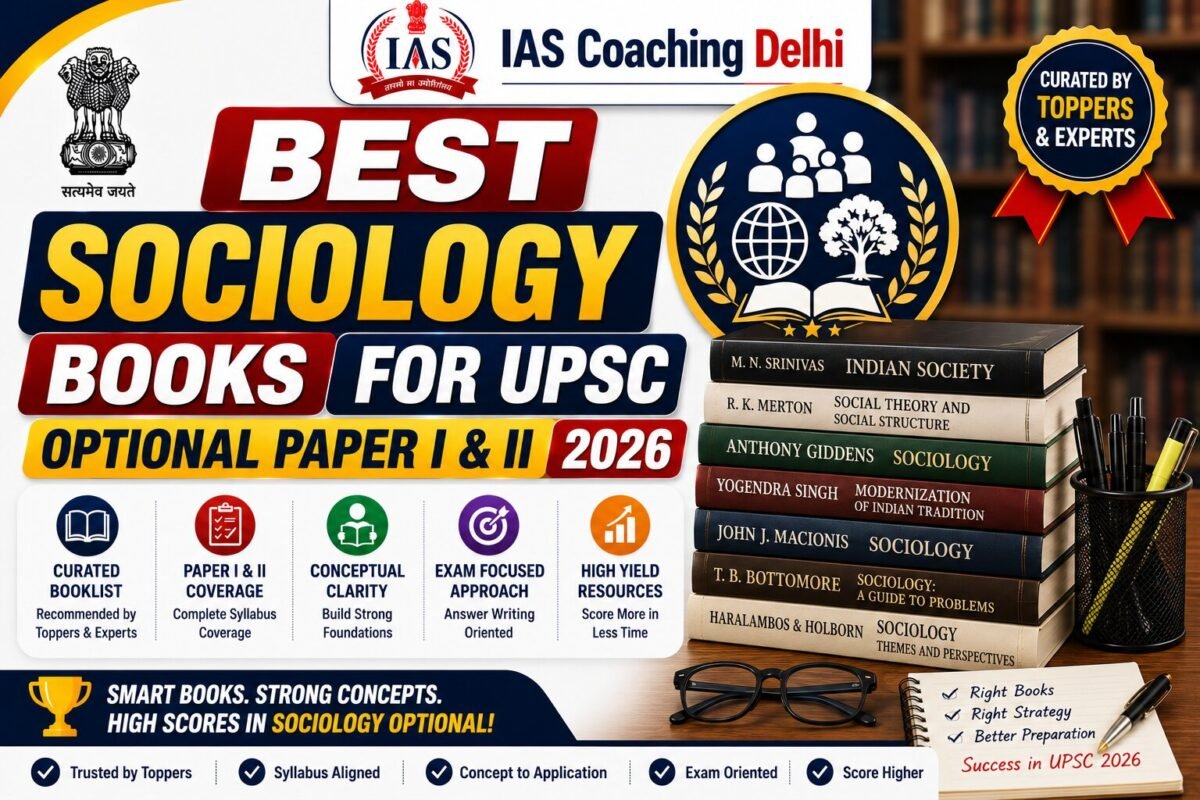
Starting the preparation for the UPSC Civil Services Examination with Sociology as your optional paper begins with one crucial step—the choice of the best books. There are numerous books available in the market but not all the books may be relevant to your preparation process. Selecting the Best Sociology Books For UPSC may make your preparation easier, increase your conceptual understanding, and aid in answering questions in Paper I and Paper II.
A good list of books isn’t about gathering more study material; it’s about making wise choices. Toppers and experts have often advised aspirants to limit their choices to only a few high-quality books covering the complete syllabus. If you are making your preparation strategy for Sociology Optional in 2026, then this article is definitely going to benefit you.
Why Choosing the Right Sociology Books Matters
One of the biggest mistakes aspirants make is referring to too many books. While multiple resources may seem helpful initially, they often create confusion and make revision difficult. A carefully selected set of books allows you to complete the syllabus faster and revise multiple times before the examination.
The UPSC Mains examination tests your understanding, analytical ability, and answer-writing skills rather than memorization. Therefore, your study material should explain concepts clearly, include examples, and align with the latest UPSC syllabus. Investing in trusted Sociology Optional books also saves time by reducing the need to search for information from multiple sources.
Instead of buying every popular title available online, focus on resources that are regularly recommended by successful candidates and experienced faculty members.
How to Select the Best Sociology Books For UPSC
Choosing the right study material requires more than checking online ratings. Before purchasing any book, compare it with the current UPSC syllabus and evaluate whether it covers the required topics in a simple and structured manner.
A good Sociology Optional book should offer:
- Complete syllabus coverage
- Easy-to-understand explanations
- Updated examples and case studies
- Concept-based learning
- Useful diagrams and illustrations
- Answer-writing support
- Practice questions for revision
Quality always matters more than quantity. A small collection of well-selected books is far more effective than a shelf full of unread material.
Best Sociology Books For UPSC Paper I
Paper I mainly focuses on sociological thinkers, concepts, theories, and research methods. Strong conceptual understanding is essential because these topics form the foundation of the entire optional subject.
Below are some of the most recommended books for Sociology Optional Paper I.
1. Haralambos and Holborn – Sociology
This book is widely considered one of the strongest resources for Sociology Optional preparation. It explains theories, concepts, and sociological perspectives in a detailed yet understandable manner.
Best For:
- Basic concepts
- Sociological theories
- Thinkers
- Social institutions
Why choose this book?
- Comprehensive coverage
- Clear explanations
- Excellent conceptual clarity
- Useful examples
2. IGNOU Sociology Study Material
IGNOU notes remain one of the most trusted resources for Sociology Optional because they explain topics in a simple academic language.
They are especially useful for:
- Beginners
- Revision
- Concept building
- Answer enrichment
Many successful candidates use IGNOU material alongside standard textbooks instead of relying on it alone.
3. Ritzer – Sociological Theory
Understanding sociological thinkers is essential for scoring well in Paper I.
George Ritzer’s book covers:
- Karl Marx
- Max Weber
- Emile Durkheim
- Talcott Parsons
- Robert Merton
- Contemporary theories
Although the book is slightly advanced, it becomes highly valuable once your basics are clear.
Best Sociology Books For UPSC Paper II
Paper II focuses on Indian Society, social issues, development, politics, caste, religion, and contemporary changes.
This paper requires linking theoretical concepts with current affairs and real-life examples.
1. Indian Society by Ram Ahuja
Ram Ahuja is among the most recommended authors for Indian Sociology.
The book covers:
- Caste system
- Family
- Marriage
- Tribal society
- Social change
- Globalization
- Rural and urban society
Its simple language makes it suitable for both beginners and advanced aspirants.
2. Social Problems in India – Ram Ahuja
Understanding social issues is essential for writing analytical UPSC answers.
This book explains:
- Poverty
- Unemployment
- Corruption
- Violence
- Gender inequality
- Population
- Education
- Social justice
Many topics can also be linked with General Studies papers, making it a valuable resource beyond Sociology Optional.
3. NCERT Sociology Books
NCERT textbooks provide a strong foundation before moving to advanced reference books.
Recommended titles include:
- Introducing Sociology
- Understanding Society
- Indian Society
They simplify basic concepts and improve understanding of the subject.
Recommended Sociology Booklist at a Glance
| Book | Paper | Best For |
| Haralambos & Holborn | Paper I | Concepts & Theory |
| IGNOU Notes | Paper I & II | Basics & Revision |
| George Ritzer | Paper I | Sociological Thinkers |
| Ram Ahuja – Indian Society | Paper II | Indian Society |
| Ram Ahuja – Social Problems | Paper II | Contemporary Issues |
| NCERT Sociology | Foundation | Beginners |
Should You Buy All These Books?
Not necessarily.
One common misconception among aspirants is that buying more books automatically leads to better preparation. In reality, successful candidates often rely on a limited number of standard resources and revise them multiple times.
If you’re just starting, begin with NCERTs and one standard reference book for each paper. As your preparation progresses, you can add specialized books only where necessary. This approach keeps your preparation focused and avoids information overload.
Online vs Printed Sociology Books
Many aspirants today prefer digital resources, while others are more comfortable with printed books. Both options have their own advantages.
Printed Books
- Better for long study sessions
- Easier to highlight important points
- Comfortable for revision
Digital Resources
- Accessible anywhere
- Easy to search specific topics
- Cost-effective for many students
The ideal strategy is to use printed books as your primary source and digital material for current updates and supplementary reading.
Build a Smart Sociology Preparation Strategy
Having the Best Sociology Books For UPSC is only one part of the preparation journey. Equally important is knowing how to use them effectively.
Create a weekly study schedule that includes concept learning, note-making, revision, and answer-writing practice. Allocate separate time for Paper I and Paper II while ensuring that current affairs related to Indian society are regularly incorporated into your preparation.
Avoid switching between multiple resources after every recommendation on social media. Consistency with a selected booklist often produces better results than constantly changing study material.
Avoid These Common Mistakes While Buying Sociology Books
Many UPSC aspirants spend more time collecting study material than actually studying it. This habit often leads to confusion, information overload, and poor revision. Instead of purchasing every recommended title, focus on building a practical and manageable booklist.
Here are some common mistakes you should avoid:
- Buying multiple books for the same topic.
- Depending only on coaching notes without standard references.
- Ignoring the latest UPSC syllabus while selecting books.
- Frequently changing study resources.
- Skipping revision because of excessive material.
The best strategy is to complete one standard book thoroughly before moving to another. Consistency and repeated revision are far more valuable than reading five different books once.
Best Book Combination for Beginners
If you are starting your Sociology Optional preparation from scratch, you don’t need a long list of books. A balanced combination of standard texts and basic resources is enough to build a strong foundation.
Suggested Booklist
| Purpose | Recommended Resource |
| Basics | NCERT Sociology Books |
| Paper I | Haralambos & Holborn |
| Thinkers | George Ritzer |
| Paper II | Ram Ahuja – Indian Society |
| Social Issues | Ram Ahuja – Social Problems in India |
| Revision | IGNOU Sociology Notes |
This combination covers almost the complete syllabus while keeping your preparation focused and revision-friendly.
How to Use Sociology Books Effectively
Owning the right books is only the beginning. The real difference comes from how you study them.
Start by reading each chapter carefully and understanding the core concepts. Instead of memorizing definitions, try to understand their practical application. Sociology is a subject that rewards analytical thinking rather than rote learning.
After completing every topic:
- Prepare concise notes.
- Highlight important thinkers and definitions.
- Add current affairs examples.
- Practice answer writing.
- Revise regularly.
This method helps improve retention and makes revision much easier before the examination.
Answer Writing: The Real Game Changer
Many aspirants complete the syllabus but struggle to score well because they don’t practice answer writing.
A high-scoring Sociology answer usually includes:
- Clear introduction
- Relevant sociological concepts
- Thinkers’ perspectives
- Contemporary examples
- Government reports where applicable
- Balanced conclusion
Including flowcharts, diagrams, and sociological terminology naturally can improve presentation and make answers more impactful.
Remember, UPSC evaluates your ability to analyze issues rather than simply reproduce information from books.
How Current Affairs Improve Sociology Optional
One of the biggest advantages of choosing Sociology is its connection with contemporary issues.
Topics such as:
- Women empowerment
- Urbanization
- Digital society
- Population trends
- Social justice
- Education reforms
- Tribal development
- Globalization
- Family structure
- Migration
appear frequently in both UPSC Mains and interviews.
While reading newspapers or monthly current affairs magazines, maintain a separate notebook for Sociology-related examples. Adding recent government initiatives, survey findings, and real-life case studies can significantly improve answer quality.
Where to Buy Authentic Sociology Books
Purchasing genuine editions is important because updated versions often include revised content and improved explanations.
You can buy standard Sociology books from:
- Reputed online bookstores
- Official publisher websites
- Trusted local bookshops
- UPSC book stores in Delhi
- Educational marketplaces
Before purchasing, compare the latest editions and avoid photocopied or outdated copies that may contain missing chapters or printing errors.
Who Should Choose Sociology Optional?
Sociology is often considered a suitable optional subject for aspirants from diverse educational backgrounds. However, the decision should depend on your interest, learning style, and ability to connect concepts with real-world issues.
You may consider Sociology Optional if you:
- Enjoy reading about society and social change.
- Prefer analytical subjects over technical ones.
- Want overlap with General Studies papers.
- Like writing opinion-based answers.
- Can consistently practice answer writing.
Choosing an optional should never be based solely on popularity or scoring trends. Your interest in the subject plays a major role in long-term preparation.
Why Many Aspirants Trust IAS Coaching Delhi
Choosing the right guidance can make your preparation more organized and focused. Along with selecting the right books, many aspirants look for trusted platforms that provide reliable resources, updated study material, and expert insights.
IAS Coaching Delhi helps UPSC aspirants make informed decisions by publishing detailed coaching reviews, preparation guides, optional subject resources, and exam-related updates. The platform focuses on practical, well-researched content that helps students choose the right study material and preparation strategy without unnecessary confusion.
Whether you’re comparing coaching institutes or building your Sociology Optional booklist, having access to trusted guidance can simplify your preparation journey.
Conclusion
Choosing the best sociology books for UPSC 2026 is undoubtedly among the most crucial steps when preparing for an optional subject. Rather than referring to many resources at once, it is better to stick to a few standard books that comprehensively cover the syllabus and revise them systematically. With proper conceptual knowledge, frequent practice in writing answers, and connecting contemporary affairs to sociological concepts, one can easily achieve his best in Papers I and II.
However, it must be noted that there is no single book that ensures success in the Civil Services Examination. Success is possible through systematic preparation, effective resource selection, and constant revision.
FAQs
Q.1 Which are the Best Sociology Books For UPSC beginners?
Beginners should start with NCERT Sociology books, Haralambos & Holborn, Ram Ahuja, IGNOU notes, and George Ritzer for a strong foundation.
Q.2 Is one book enough for Sociology Optional preparation?
No. One book cannot cover the entire syllabus. A combination of standard reference books and revision notes is recommended.
Q.3 Which book is best for Sociology Paper II?
Indian Society by Ram Ahuja is among the most recommended books for Sociology Optional Paper II due to its simple language and comprehensive coverage.
Q.4 Are IGNOU Sociology notes useful for UPSC?
Yes. IGNOU study material is helpful for concept building, revision, and understanding Sociology topics in a simple and structured manner.
Q.5 How many books are enough for Sociology Optional?
Most successful aspirants prepare with 5–6 standard books, supported by current affairs, answer-writing practice, and regular revision instead of using too many resources.