
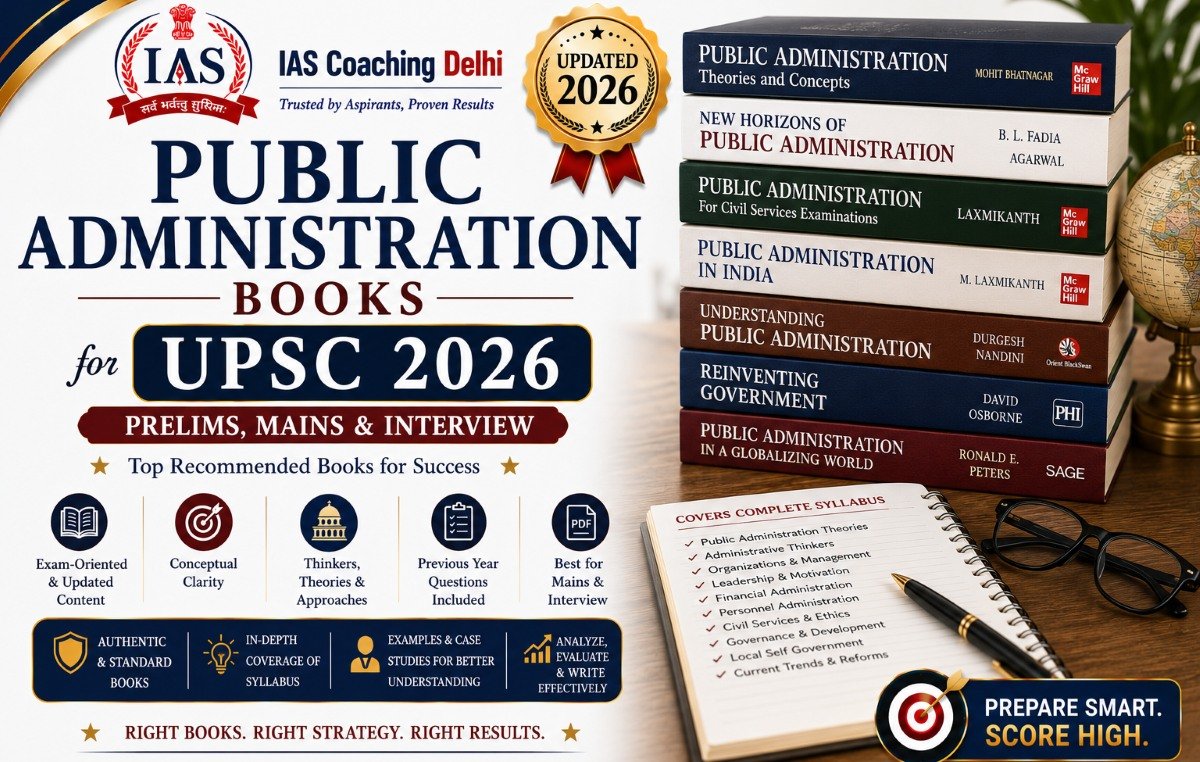
Finding the right Public Administration Books is the most crucial first step for any civil services aspirant. Public Administration remains a top favorite optional subject for UPSC because it directly overlaps with General Studies Paper 2, General Studies Paper 4, and your Mains Essay paper.
When you choose the right study material, you build strong conceptual clarity, save hundreds of preparation hours, and easily target 300+ marks in Mains. In this clear and beginner-friendly guide, we will break down the exact reading list, topper-tested strategy, and phase-wise plan for your UPSC 2026 Preparation.
Why Choosing the Right Public Administration Books Matters
Picking proper UPSC Optional Books can make or break your final rank. The Public Administration Syllabus is dynamic and practical. If you buy random market guides, you will quickly get confused and lose momentum.
A well-planned Public Administration Book List gives you direct clarity. You learn how to connect theoretical administrative concepts with daily governance news. Many students fail simply because they collect ten different books instead of revising two main books five times.
So, sticking to a crisp list of Public Administration Books keeps your prep light, focused, and exam-ready.
Key Benefits of Choosing the Right Books
- Builds Super Clear Concepts: Standard books explain basic terms without confusing jargon.
- Saves Hundreds of Hours: You avoid reading irrelevant topics that UPSC never asks.
- Direct Overlap with GS Papers: Helps you answer GS 2 governance and GS 4 ethics questions easily.
- Makes Note-Making Super Easy: Clean chapter structures allow you to make quick revision sheets.
Best Public Administration Books for UPSC 2026
Let us jump into the top recommended Publi
c Administration Optional Books for your UPSC 2026 Preparation. Each of these books plays a specific role in your study plan.
Public Administration – M. Laxmikanth
- Author: Laxmikanth
- Why it is useful: It breaks complex ideas into very easy, bite-sized points.
- Best for: Beginners who want a simple overall view of the syllabus.
- Pros: Clean structure, simple English, very easy to memorize.
- Cons: Lacks deep analysis required for tricky Paper 1 questions.
- Paper covered: Overview of Paper 1 and Paper 2.
- Level:
- Buying recommendation: Must-buy to kickstart your preparation smoothly.
New Horizons of Public Administration – Mohit Bhattacharya
- Author: Mohit Bhattacharya
- Why it is useful: This is the ultimate core text for administrative concepts and vocabulary.
- Best for: Getting high marks in analytical Paper 1 questions.
- Pros: Deep coverage of modern governance and administrative debates.
- Cons: The language is academic and heavy for absolute beginners.
- Paper covered: Paper 1.
- Level: Intermediate to Advanced.
- Buying recommendation: Essential book if you want a top rank in Mains.
Administrative Thinkers – D. Ravindra Prasad & V.S. Prasad
- Author: Ravindra Prasad, V.S. Prasad, and team.
- Why it is useful: It explains all the major thinkers in a neat chapter-wise format.
- Best for: Understanding Taylor, Weber, Fayol, Simon, and Riggs.
- Pros: Reader-friendly layout, easy to remember key theories and criticisms.
- Cons: You need to revise it 3–4 times to memorize specific quotes and theories.
- Paper covered: Paper 1 (Thinkers section).
- Level: Beginner to Intermediate.
- Buying recommendation: 100% mandatory for every Pub Ad aspirant.
Public Administration and Public Affairs – Nicholas Henry
- Author: Nicholas Henry
- Why it is useful: Gives a global angle on public policy and organizational structures.
- Best for: Extra depth on public policy paradigms.
- Pros: Great global case studies and policy theories.
- Cons: Contains American administrative context that you do not need for UPSC.
- Paper covered: Paper 1.
- Level:
- Buying recommendation: Read only selected chapters; do not read cover-to-cover.
Indian Public Administration – Ramesh K. Arora & Rajni Goyal
- Author: Ramesh K. Arora & Rajni Goyal
- Why it is useful: Explains how the Indian administrative machinery actually functions.
- Best for: District administration, civil services, and state government topics.
- Pros: Engaging narrative tone, very practical for answer writing.
- Cons: The book is slightly thick, which might intimidate new readers.
- Paper covered: Paper 2.
- Level:
- Buying recommendation: Top pick for Paper 2 preparation.
Public Administration – Fadia & Fadia
- Author:L. Fadia & Kuldeep Fadia
- Why it is useful: Works like an encyclopedia covering almost every single syllabus topic.
- Best for: Looking up rare or niche topics missing from other books.
- Pros: Super detailed and comprehensive syllabus coverage.
- Cons: Very bulky; reading the whole book will drain your energy.
- Paper covered: Paper 1 and Paper 2.
- Level:
- Buying recommendation: Keep it purely as a reference text on your desk.
IGNOU BA & MA Notes
- Author: IGNOU Professors
- Why it is useful: Written in clean, simple, and direct language for distance learners.
- Best for: Making quick topic-wise short notes at home.
- Pros: Completely free to download online, balanced and neutral content.
- Cons: Information is spread across many different PDF files.
- Paper covered: Paper 1 and Paper 2.
- Level: Beginner to Intermediate.
- Buying recommendation: Download free PDFs online whenever you get stuck on a topic.
2nd Administrative Reforms Commission (ARC) Reports
- Author: Government of India
- Why it is useful: Contains official government solutions for administrative reforms.
- Best for: Boosting your answer quality with authentic government recommendations.
- Pros: High credibility; examiners love seeing ARC references in answers.
- Cons: Original government PDFs are hundreds of pages long.
- Paper covered: Paper 2 (and Paper 1 accountability topics).
- Level:
- Buying recommendation: Buy concise market summaries of reports 1, 4, 6, 10, 11, and 12.
Best Books for Paper 1
Paper 1 tests your understanding of administrative theories and thinkers. To score well here, you need solid conceptual clarity. These are the main Public Administration Paper 1 Books:
- Administrative Thinkers by Prasad & Prasad: Master every single thinker from this book first.
- New Horizons of Public Administration by Mohit Bhattacharya: Use this to grab proper academic vocabulary and modern governance trends.
- Public Administration: Concepts and Theories by Rumki Basu: Great for understanding public policy and accountability models in simple words.
- Public Administration and Public Affairs by Nicholas Henry: Refer to this only for selected policy chapters.
Pro Tip: Never touch Mohit Bhattacharya on day one! Start with M. Laxmikanth or Prasad & Prasad first. Once your base is ready, then open Mohit Bhattacharya.
Best Books for Paper 2
Paper 2 focuses on Indian Administration—how our government system evolved and works today. You must add real-life examples and current affairs updates here. These are the key Public Administration Paper 2 Books:
- Indian Public Administration by Arora & Goyal: Covers central, state, and district administration inside out.
- Introduction to the Constitution of India by D.D. Basu: Helps you write accurate constitutional articles and legal framework points.
- Indian Administration by S.R. Maheshwari: Good secondary source for historical administrative trends.
- 2nd ARC Summaries: Must-read for administrative reform solutions.
- Yojana & Kurukshetra Magazines: Perfect for picking up current case studies on rural and urban development.
Books Beginners Should Start With
If you are just starting your Public Administration Preparation, jumping straight into heavy books will frustrate you. Follow this smooth step-by-step reading order instead:
- Step 1: Read Class 11 & 12 NCERTs (Political Science) to get basic clarity.
- Step 2: Read M. Laxmikanth (Public Administration) for core definitions.
- Step 3: Read Prasad & Prasad (Administrative Thinkers) for theoretical base.
- Step 4: Read Arora & Goyal (Indian Administration) for Paper 2 context.
First, scan class 11 and 12 Political Science NCERTs to get familiar with basic government terminology. Next, pick up M. Laxmikanth to learn basic Pub Ad terms. After that, move to Prasad & Prasad for thinkers. This simple order keeps your confidence high right from week one!
Public Administration Booklist for Self Study
You do not need expensive coaching classes to crack this exam. If you are doing self-study, use this neat Public Administration Study Material grid to keep your prep structured:
| Area / Topic | Core Recommended Book | Helpful Alternative |
| Basic Concepts | Public Administration – M. Laxmikanth | IGNOU BA Notes |
| Thinkers & Theories | Administrative Thinkers – Prasad & Prasad | Administrative Theories – R.K. Sapru |
| Advanced Theory | New Horizons of Pub Ad – Mohit Bhattacharya | Pub Ad Concepts – Rumki Basu |
| Indian Governance | Indian Public Administration – Arora & Goyal | Indian Administration – S.R. Maheshwari |
| Constitutional Rules | Introduction to Constitution – D.D. Basu | Governance in India – M. Laxmikanth |
| Reforms & Solutions | 2nd ARC Summary Reports | NITI Aayog Reports & PIB |
Along with these books, you can check standard Public Administration Coaching Notes to fill any small gaps in your study plan.
Common Mistakes While Choosing Books
Aspirants often make simple mistakes while buying books. Avoid these traps:
- Buying Too Many Books: Buying five books for one single chapter creates total chaos. Stick strictly to one main book per section.
- Reading Without the Syllabus: Never read any book from cover to cover blindly. Keep your Public Administration Syllabus open beside you and read only what is asked.
- Skipping Revision: Reading ten books once gives you zero results. Reading two standard books five times brings high marks!
- Ignoring Current News: Paper 2 needs real governance examples. If you write only static bookish lines, your marks will stall.
- Skipping PYQs: Always solve Public Administration Previous Year Questions alongside your reading to see what UPSC actually asks.
Book Buying Tips
Keep these simple tips in mind before spending your money on Public Administration Reference Books:
- Always Buy Latest Editions: Grab the newest prints for dynamic books like Arora & Goyal so you get updated facts and data.
- Check the Table of Contents: Match the book index with your syllabus copy before buying.
- Prefer Hard Copies for Main Books: Printed books like Prasad & Prasad let you highlight important lines and scribble notes in margins easily.
- Use Soft Copies for Extras: Download free PDFs for IGNOU material and government reports instead of buying heavy printed bundles.
Preparation Strategy Using These Books
To get an edge in UPSC 2026, follow this clear 3-phase study roadmap:
First Phase: Base Building (Months 1 to 3)
- Complete basic readings (Laxmikanth + Prasad & Prasad).
- Get comfortable with core thinkers and basic administrative terms.
Second Phase: Advanced Study & Notes (Months 4 to 6)
- Read Mohit Bhattacharya & Arora & Goyal.
- Make short, clean revision notes.
- Connect Paper 1 theories with Paper 2 real-life examples.
Third Phase: Writing & Revision (Months 7 to 9)
- Solve the last 10 years of PYQs thoroughly.
- Add 2nd ARC quotes into your answer practice.
- Take mock test series to improve your writing speed.
If you look at any Public Administration Toppers Strategy, you will notice one key trick: they always link Paper 1 theories with Paper 2 issues. For example, if you write about administrative delays in India (Paper 2), mention Max Weber’s bureaucracy concept or Riggs’ model from Paper 1. This simple habit elevates your answers instantly!
Frequently Asked Questions
Q1. Which are the best Public Administration Books for UPSC 2026?
The top essential Public Administration Books are M. Laxmikanth for basics, Prasad & Prasad for Thinkers, Mohit Bhattacharya for Paper 1 theories, and Arora & Goyal for Paper 2 Indian Administration.
Q2. Is reading one book enough for Public Administration?
No single book covers 100% of the syllabus. However, you should stick to just one core textbook for each individual topic instead of mixing multiple sources.
Q3. Which book is best for beginners in Public Administration?
Public Administration by M. Laxmikanth is perfect for beginners because it uses a super clear layout and simple language.
Q4. Are IGNOU notes necessary for UPSC Public Administration?
They are not mandatory, but they serve as amazing Public Administration Resources. They explain tough topics like Public Policy in very friendly, step-by-step language.
Q5. Which book covers Paper 2 completely?
Indian Public Administration by Ramesh K. Arora and Rajni Goyal covers almost all of Paper 2. Just supplement it with constitutional points from D.D. Basu.
Conclusion
Clearing UPSC optional needs clear strategy, steady focus, and limited books. Instead of buying dozens of guides, put your time into core Public Administration Books like Prasad & Prasad, Mohit Bhattacharya, and Arora & Goyal.
Make short revision sheets, link theories with daily news, and write answers every week. Stay consistent with your revision, keep your resources minimal, and you will be fully ready to crush UPSC 2026!