
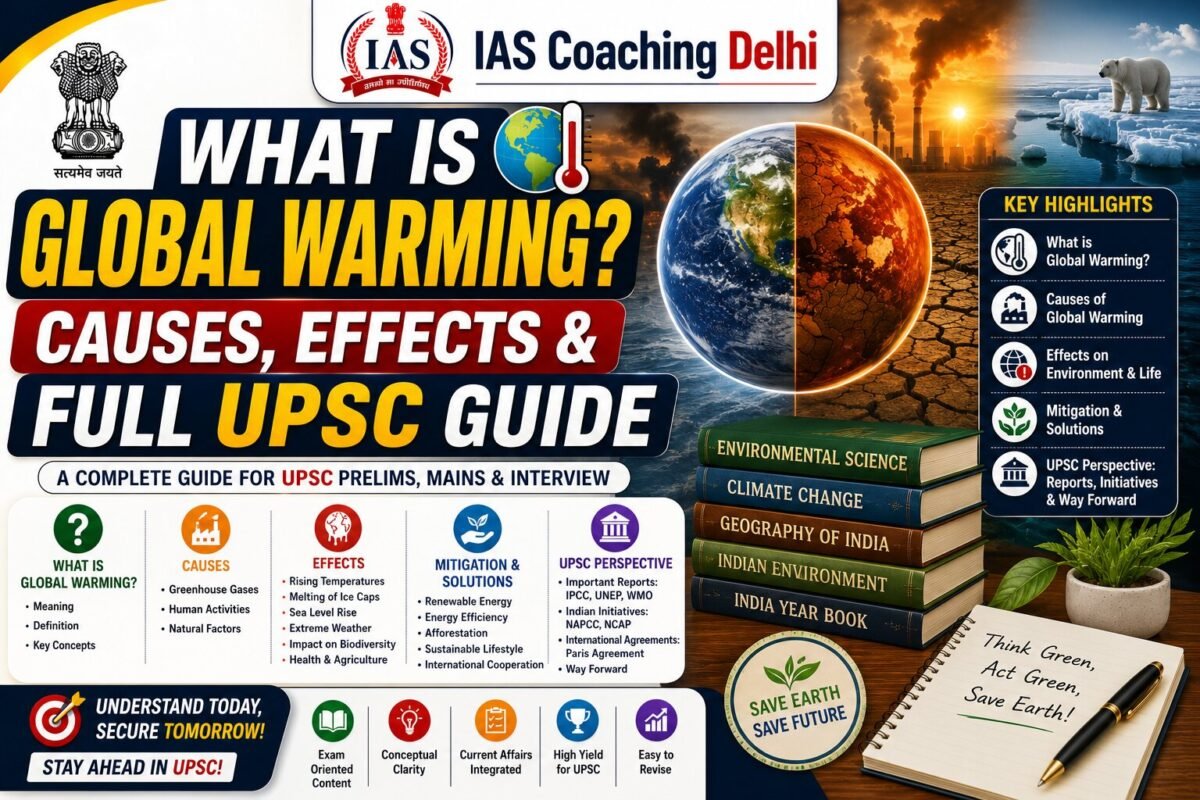
With the issue of climate change gaining prominence among the various topics being discussed all across the world, What is Global Warming becomes a crucial concept for aspirants preparing for UPSC exam. Several questions on global warming, climate change, greenhouse gases, and environmental protection have been asked in previous years of Civil Services Examination, including GS Paper III, Essay, and Interview.
Rather than rote learning definitions, UPSC aspirants must know about the causes of global warming, its effects on humanity and nature, actions taken by the government and other agencies, and its solutions. Here is a detailed approach that will help link the environment-related topics to current affairs, geography, economics, and governance topics.
Why Global Warming is Important for UPSC Preparation
Environmental issues have gained significant importance in recent UPSC examinations. Questions are no longer limited to definitions; they now focus on analysis, policy-making, and practical solutions.
A thorough understanding of global warming helps in:
- General Studies Paper III
- UPSC Essay Writing
- Environment & Ecology
- Geography
- Current Affairs
- Interview Preparation
Candidates who understand the interconnection between environmental challenges and governance often perform better in descriptive answers.
What is Global Warming?
Global warming refers to the gradual increase in the Earth’s average temperature due to the excessive accumulation of greenhouse gases in the atmosphere. These gases trap heat from the sun, creating a warming effect known as the greenhouse effect.
Human activities such as burning fossil fuels, industrial development, deforestation, and rapid urbanization have significantly accelerated this process over the past century.
Unlike natural climate variations, today’s warming trend is primarily driven by human-induced emissions. Rising global temperatures affect ecosystems, weather patterns, agriculture, water resources, biodiversity, and human health.
For UPSC aspirants, understanding What is Global Warming means going beyond definitions and analyzing its social, economic, and environmental implications.
Difference Between Global Warming and Climate Change
Many aspirants use these terms interchangeably, but UPSC often expects conceptual clarity.
| Global Warming | Climate Change |
| Increase in Earth’s average temperature | Long-term changes in weather patterns |
| Mainly caused by greenhouse gases | Includes global warming and its consequences |
| Focuses on temperature rise | Covers rainfall, storms, droughts, and seasonal shifts |
Understanding this distinction strengthens conceptual answers in both Prelims and Mains.
Major Causes of Global Warming
Global warming is driven by multiple human activities that increase greenhouse gas concentrations.
Burning Fossil Fuels
Coal, petroleum, and natural gas remain the primary energy sources worldwide. Burning these fuels releases enormous quantities of carbon dioxide into the atmosphere.
Major sectors include:
- Power generation
- Transportation
- Manufacturing industries
- Construction
Carbon dioxide remains one of the largest contributors to rising global temperatures.
Deforestation
Forests absorb carbon dioxide naturally. However, rapid deforestation reduces this natural carbon sink.
Major reasons include:
- Urban expansion
- Agriculture
- Mining
- Infrastructure projects
Loss of forests accelerates climate imbalance and biodiversity loss.
Industrialization
Rapid industrial growth contributes significantly to greenhouse gas emissions.
Industrial activities release:
- Carbon dioxide
- Methane
- Nitrous oxide
- Fluorinated gases
These gases remain in the atmosphere for years, increasing Earth’s temperature.
Agriculture
Modern agriculture also contributes to climate change.
Major contributors include:
- Livestock farming
- Rice cultivation
- Chemical fertilizers
- Crop residue burning
Methane released from livestock is considered a highly potent greenhouse gas.
Waste Management
Improper waste disposal produces methane through landfill decomposition.
Increasing urban waste without scientific treatment further contributes to greenhouse gas emissions.
Effective waste management remains an important environmental strategy.
Greenhouse Gases Responsible for Global Warming
Several gases contribute to the greenhouse effect.
| Greenhouse Gas | Primary Source |
| Carbon Dioxide (CO₂) | Fossil fuels |
| Methane (CH₄) | Agriculture, livestock |
| Nitrous Oxide (N₂O) | Fertilizers |
| Water Vapour | Natural process |
| Fluorinated Gases | Industrial activities |
Among these, carbon dioxide contributes the largest share due to widespread fossil fuel consumption.
Effects of Global Warming
The consequences of rising temperatures are already visible across the world.
Rising Global Temperatures
Average global temperatures continue to increase, leading to hotter summers and more frequent heatwaves.
Countries across Asia, Europe, and North America have recorded record-breaking temperatures in recent years.
Melting Glaciers
Mountain glaciers and polar ice sheets are melting at an alarming rate.
This contributes directly to rising sea levels and threatens freshwater supplies for millions of people.
The Himalayas, often called the “Water Tower of Asia,” are particularly vulnerable.
Rising Sea Levels
Melting glaciers combined with thermal expansion of seawater cause sea levels to rise.
Potential consequences include:
- Coastal flooding
- Land erosion
- Saltwater intrusion
- Climate migration
Several island nations face serious long-term risks.
Extreme Weather Events
Climate change increases the frequency and intensity of:
- Cyclones
- Floods
- Heatwaves
- Droughts
- Heavy rainfall
UPSC frequently asks analytical questions connecting climate change with disaster management.
Loss of Biodiversity
Changing climatic conditions threaten numerous plant and animal species.
Many ecosystems struggle to adapt to rapidly changing temperatures.
Habitat destruction increases the risk of extinction for several endangered species.
Impact on India
India is among the countries most vulnerable to climate change.
Major concerns include:
- Heatwaves
- Water scarcity
- Irregular monsoons
- Glacier retreat
- Agricultural losses
- Coastal erosion
Since agriculture supports a large population, climate change directly affects food security and rural livelihoods.
Government policies increasingly focus on balancing economic growth with environmental sustainability.
Global Warming and the UPSC Syllabus
Environmental topics are integrated across multiple sections of the UPSC examination.
Candidates should prepare this topic for:
- Environment & Ecology
- Disaster Management
- Geography
- Science & Technology
- International Relations
- Ethics
- Essay Paper
- Current Affairs
Developing an interdisciplinary understanding helps write high-quality Mains answers.
Smart Preparation Strategy for UPSC Aspirants
Preparing environmental topics requires more than reading textbooks.
A balanced strategy includes:
- Understanding NCERT fundamentals
- Following current environmental developments
- Practicing previous year questions
- Linking static concepts with current affairs
- Preparing diagrams and flowcharts
- Revising government initiatives regularly
Consistent answer-writing practice improves analytical thinking and presentation.
International Agreements on Climate Change
Global warming is a worldwide challenge that requires collective action. Over the years, countries have signed several international agreements to reduce greenhouse gas emissions and promote sustainable development. These agreements are frequently covered in the UPSC syllabus and often appear in both the Preliminary and Mains examinations.
United Nations Framework Convention on Climate Change (UNFCCC)
The UNFCCC, adopted in 1992 during the Rio Earth Summit, laid the foundation for international climate cooperation. Its primary objective is to stabilize greenhouse gas concentrations at a level that prevents dangerous human interference with the climate system.
Kyoto Protocol
The Kyoto Protocol, adopted in 1997, introduced legally binding emission reduction targets for developed countries. It was one of the first global efforts to combat climate change through measurable commitments.
Paris Agreement
The Paris Agreement, signed in 2015, remains one of the most significant international climate agreements. It aims to limit global temperature rise to well below 2°C, while making efforts to restrict it to 1.5°C above pre-industrial levels.
For UPSC preparation, aspirants should understand the objectives, significance, and differences between these agreements rather than memorizing dates alone.
Government Initiatives to Address Global Warming
India has introduced several initiatives to balance economic growth with environmental sustainability. Questions related to these schemes are common in UPSC examinations because they connect environment with governance.
Some important initiatives include:
- National Action Plan on Climate Change (NAPCC)
- National Solar Mission
- Green India Mission
- National Mission for Sustainable Agriculture
- FAME Scheme for Electric Vehicles
- International Solar Alliance (ISA)
- National Clean Air Programme (NCAP)
Candidates should also stay updated with recent policy changes and environmental reports through current affairs.
Practical Solutions to Reduce Global Warming
Understanding solutions is just as important as learning about causes and effects. UPSC often expects aspirants to provide balanced and practical recommendations in descriptive answers.
Transition to Renewable Energy
Replacing fossil fuels with renewable energy sources such as solar, wind, and hydroelectric power can significantly reduce carbon emissions.
Afforestation and Forest Conservation
Planting more trees and protecting existing forests increases carbon absorption and helps restore ecological balance.
Sustainable Transportation
Promoting electric vehicles, public transportation, cycling, and cleaner fuels can reduce emissions from the transport sector.
Energy Efficiency
Using energy-efficient appliances, adopting green buildings, and reducing unnecessary electricity consumption contribute to long-term sustainability.
Responsible Consumption
Individuals can also contribute by reducing waste, recycling materials, conserving water, and choosing environmentally friendly products.
Well-rounded answers that combine policy measures with individual responsibility generally score better in UPSC Mains.
How Global Warming Impacts Different Sectors
Global warming influences nearly every sector of the economy and society. Understanding these connections helps aspirants write analytical answers.
Agriculture
Changing rainfall patterns, prolonged droughts, and rising temperatures reduce crop productivity and affect food security.
Water Resources
Shrinking glaciers and irregular rainfall increase water scarcity, affecting drinking water availability and irrigation.
Health
Heatwaves, changing disease patterns, and poor air quality create new public health challenges.
Economy
Natural disasters, infrastructure damage, and reduced agricultural production increase financial burdens on governments and communities.
Biodiversity
Many plant and animal species struggle to adapt to changing climatic conditions, leading to habitat loss and declining biodiversity.
Important UPSC Preparation Tips for Environment Topics
Environment is one of the highest-scoring subjects when prepared systematically. Instead of studying it in isolation, aspirants should integrate it with geography, science, economy, and current affairs.
A smart preparation strategy includes:
- Reading NCERT Environment and Geography books
- Following reliable current affairs sources
- Studying government reports and environmental policies
- Solving previous years’ UPSC questions
- Practicing answer writing regularly
- Preparing short revision notes
- Using diagrams and flowcharts where appropriate
Regular revision is more effective than collecting too many study materials.
Common Mistakes UPSC Aspirants Should Avoid
Many candidates spend considerable time studying environmental topics but still struggle to score well because of avoidable mistakes.
Some common errors include:
- Memorizing facts without understanding concepts
- Ignoring current affairs related to climate change
- Writing generic answers without examples
- Not linking environmental issues with governance and economy
- Skipping previous year question analysis
- Avoiding answer-writing practice
Building conceptual clarity and applying knowledge to contemporary issues significantly improves answer quality.
How the Right Guidance Can Improve Your Preparation
Self-study forms the foundation of UPSC preparation, but structured guidance can help aspirants stay focused and avoid common mistakes. A well-planned learning approach ensures that candidates cover the syllabus systematically while developing analytical and answer-writing skills.
For students looking for expert support, IAS Coaching Delhi provides guidance through updated study resources, experienced mentors, regular test practice, and strategic preparation plans aligned with the latest UPSC pattern. The focus is on helping aspirants build conceptual clarity, improve writing skills, and stay updated with current affairs—essential elements for success in the Civil Services Examination.
Conclusion
It is important to understand What is Global Warming because it is not only useful for the UPSC examination but it will give us an insight into one of the biggest problems faced by the world from the environmental point of view. There are many subjects which are linked to global warming and environment such as greenhouse gas emissions, climate change, international agreements, and government measures.
The aspirants should pay more attention to concept building and answering questions through regular current affairs updates and revision instead of just cramming the subject. A good combination of both can be helpful for candidates in the UPSC Civil Services Examination.
FAQs
Q.1 What is Global Warming in simple words?
Global warming is the gradual increase in Earth’s average temperature caused mainly by greenhouse gases released through human activities such as burning fossil fuels and deforestation.
Q.2 Why is global warming important for UPSC preparation?
Global warming is an important part of the UPSC syllabus because it is linked with Environment, Geography, Disaster Management, Current Affairs, and Essay writing.
Q.3 What are the major causes of global warming?
The major causes include burning fossil fuels, deforestation, industrial emissions, agriculture, transportation, and improper waste management.
Q.4 Which international agreements should UPSC aspirants study?
Candidates should focus on the UNFCCC, Kyoto Protocol, and Paris Agreement, along with India’s climate commitments and environmental policies.
Q.5 How can I prepare environment topics effectively for UPSC?
Build strong fundamentals through NCERTs, follow current affairs, solve previous year papers, practice answer writing, and revise important government initiatives regularly.