
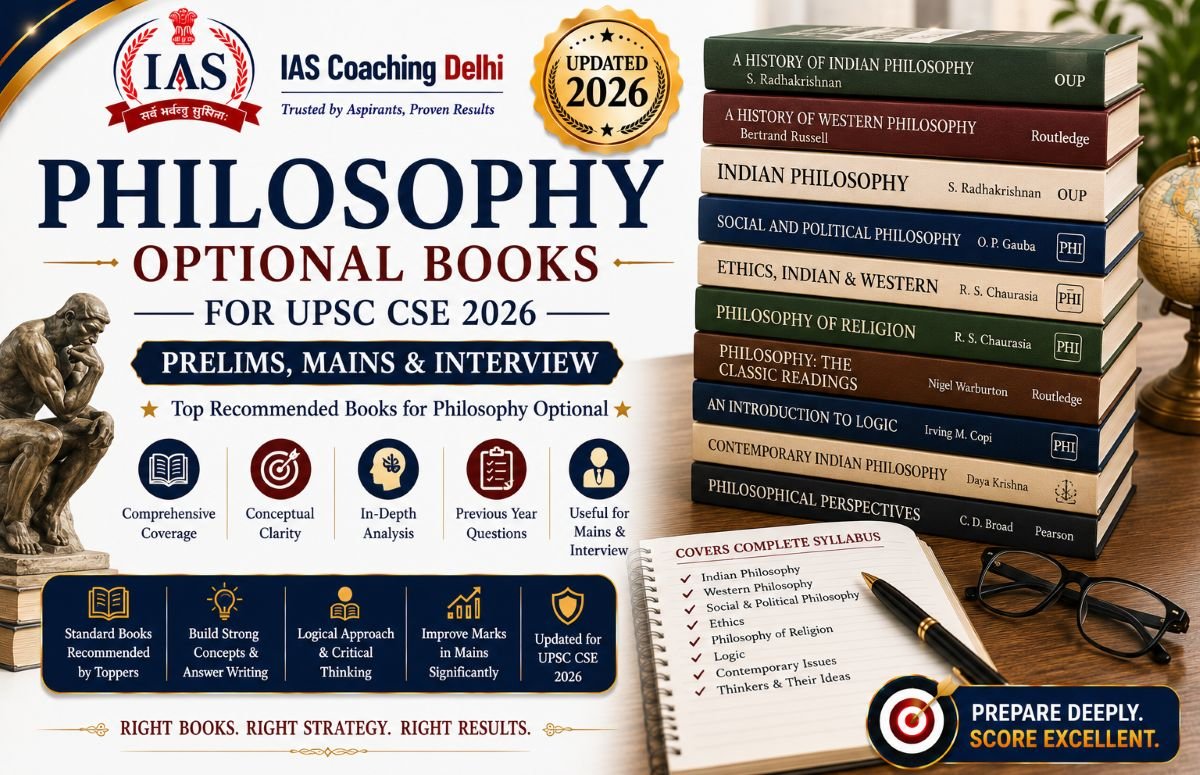
Selection of your optional subject is a defining moment in the UPSC Civil Services Examination. Most students find Philosophy a natural choice due to its rational nature and defined scope along with the concise syllabus. But without a good set of Philosophy Optional Books, studying in the absence of a proper reading list will just be a waste of your time.
The correct choice of books will not only help you save time but also enable you to craft well-written answers that score high marks. This guide covers everything about the complete book list and some valuable preparation tips for the upcoming UPSC CSE 2026.
Why Choose Philosophy Optional for UPSC CSE 2026?
Selecting an optional subject requires careful planning. Here is why Philosophy remains a popular choice among successful aspirants:
- Short and Defined Syllabus: As compared to other subjects such as History or Geography, philosophy has an easy syllabus. You can comfortably complete your first reading in three to four months’ time.
- Direct Overlap: Whatever you study here will assist you directly in General Studies Paper IV (Ethics, Integrity & Aptitude) and the Essay paper too.
- Static Content: The theories formulated by various philosophers remain static. Once you get the theory right, it is always going to be with you while preparing for the exam.
- No Background Required: There is no prerequisite of knowledge regarding philosophy for performing well in this subject. Students of streams such as engineering, science, or commerce regularly score 300+ marks every year.
Complete Philosophy Optional Syllabus Overview
The UPSC Philosophy Optional consists of two papers, each carrying 250 marks, making a total of 500 marks.
Paper 1: History and Problems of Philosophy
- Section A (Western Philosophy): Covers classical thinkers like Plato and Aristotle, rationalists, empiricists, Kant, Hegel, as well as modern movements like Existentialism and Logical Positivism.
- Section B (Indian Philosophy): Focuses on both orthodox schools (Nyaya, Vaisheshika, Samkhya, Yoga, Mimamsa, Vedanta) and heterodox schools (Carvaka, Jainism, Buddhism), along with modern thinkers like Sri Aurobindo.
Paper 2: Socio-Political Philosophy & Philosophy of Religion
- Section A (Socio-Political Philosophy): Focuses on core concepts such as Liberty, Equality, Justice, Sovereignty, Political Ideologies, and contemporary issues like Gender and Caste discrimination.
- Section B (Philosophy of Religion): Covers fundamental topics including concepts of God, proofs for the existence of God, the problem of evil, reason versus faith, and religious pluralism.
Best Philosophy Optional Books for UPSC CSE 2026
To keep your preparation focused, here is a carefully curated list of primary Philosophy Optional Books categorized by paper and topic.
Best Books for Indian Philosophy
- An Introduction to Indian Philosophy
- Author: Satischandra Chatterjee and Dhirendramohan Datta
- Why it is useful: It provides clear and accessible explanations for complex Indian philosophical traditions.
- Who should read it: Ideal for beginners who are starting Indian philosophy for the first time.
- Pros: Simple language, systematic layout, and clear chapter summaries.
- Cons: Slightly brief on a few advanced topics.
- Difficulty level: Easy to Moderate.
- A Critical Survey of Indian Philosophy
- Author: Chandradhar Sharma (C.D. Sharma)
- Why it is useful: It gives a deep, analytical breakdown of both orthodox and heterodox schools of thought.
- Who should read it: Every candidate preparing Section B of Paper 1.
- Pros: Great for building conceptual clarity and learning how to evaluate arguments.
- Cons: Some chapters feature dense prose that requires slow reading.
- Difficulty level: Moderate.
Books for Western Philosophy
- A Critical History of Western Philosophy
- Author: Y. Masih
- Why it is useful: It directly matches the syllabus requirements for major Western thinkers.
- Who should read it: Beginners as well as candidates reviewing Western thinkers.
- Pros: Clean chronological structure covering Greek, Medieval, and Modern periods.
- Cons: Limited coverage of late 20th-century analytical thinkers.
- Difficulty level: Moderate.
- Contemporary Western Philosophy
- Author: B.K. Lal
- Why it is useful: Explains complex modern developments like Existentialism, Phenomenology, and Pragmatism.
- Who should read it: Aspirants covering modern Western philosophical streams.
- Pros: Makes difficult thinkers like Husserl, Heidegger, and Wittgenstein easy to digest.
- Cons: Requires prior understanding of basic Western philosophy.
- Difficulty level: Moderate to Advanced.
Books for Socio-Political Philosophy
- An Introduction to Political Theory
- Author: O.P. Gauba
- Why it is useful: Clear explanations of primary political concepts such as Liberty, Equality, Justice, and Sovereignty.
- Who should read it: Anyone starting Paper 2 Section A.
- Pros: Extremely readable, well-organized, and beginner-friendly.
- Cons: Written from a general political science perspective, so you must extract the philosophical arguments.
- Difficulty level: Easy.
Best Books for Philosophy of Religion
- Introduction to Religious Philosophy
- Author: Y. Masih
- Why it is useful: Directly aligns with UPSC exam questions on religious concepts.
- Who should read it: Essential for Paper 2 Section B preparation.
- Pros: Broad coverage of core themes like God, Soul, Reincarnation, and Evil.
- Cons: The layout feels slightly outdated; taking personal notes is recommended.
- Difficulty level: Easy to Moderate.
- Philosophy of Religion
- Author: John H. Hick
- Why it is useful: Offers crisp, high-level analysis on arguments surrounding God’s existence and pluralism.
- Who should read it: Candidates aiming to write precise, high-scoring answers.
- Pros: Concise writing, strong logical points, and precise terminology.
- Cons: Compact book; you only need to read chapters relevant to the syllabus.
- Difficulty level: Moderate.
NCERT Books You Should Read
Although NCERT does not come out with an exclusive philosophy textbook, here are some introductory books which give the necessary foundation for philosophy:
- Class 11 Political Science (Political Theory): Good starting point for learning concepts such as Freedom, Rights, Equality, and Justice.
- Class 11 & 12 Sociology NCERTs: Provides insights on social topics such as Caste, Gender, and Social Change for Paper 2.
Standard Reference Books
Some of these reference books are useful for quick clarifications and additional background information:
- Oxford Dictionary of Philosophy by Simon Blackburn (Useful for fast reference of technical words).
- A History of Philosophy by Frank Thilly (Provides insights on the historical relationship between western philosophers).
Books Recommended by UPSC Toppers
It is advisable to follow the advice of toppers to avoid collecting too many sources for studying.
Toppers Advice: Try sticking to one book per chapter from your philosophy optional syllabus. Your study should be coupled with class notes for additional topics.
| Book Name | Author | Best For | Beginner Friendly |
| An Introduction to Indian Philosophy | S. Chatterjee & D. Datta | Basic Indian Philosophy | Yes |
| A Critical Survey of Indian Philosophy | C.D. Sharma | Advanced Indian Thought | Yes |
| A Critical History of Western Philosophy | Y. Masih | Classical & Modern Thinkers | Yes |
| Contemporary Western Philosophy | B.K. Lal | 20th-Century Western Philosophy | No |
| An Introduction to Political Theory | O.P. Gauba | Socio-Political Concepts | Yes |
| Introduction to Religious Philosophy | Y. Masih | Religion Core Topics | Yes |
| Philosophy of Religion | John H. Hick | Arguments on God & Faith | Yes |
How to Study Philosophy Optional Effectively
Follow this practical 5-step preparation guide to make the best use of your reading time:
First Step: Decode the Syllabus and Past Papers
Before opening any textbook, examine the official syllabus carefully. Look through previous year questions to see how topics are tested. Notice how questions are structured around key themes.
Second Step: Read Core Standard Books
Pick one primary book for each section. Read through without stressing about memorizing everything on the first pass. Focus strictly on understanding the logical flow of arguments.
Third Step: Make Short, Actionable Notes
Avoid rewriting whole book chapters. Prepare short 1-to-2 page summaries for every syllabus heading. Include main arguments, core terminology, and basic criticisms.
Fourth Step: Practice Daily Answer Writing
Start answering previous year questions once you complete a section. Aim to practice 10-marker and 15-marker questions regularly. Focus on clear introduction, logical flow, exact terminology, and structured conclusion.
Fifth Step: Revise Multiple Times
Philosophy requires repeated revision to retain technical arguments accurately. Review your concise personal notes at least 4 to 5 times before sitting for Mains.
Common Mistakes Students Make
- Collecting Too Many Books: Having several books on a single topic causes information overflow. One book suffices for each topic.
- Skipping Critical Evaluation: It’s never enough to provide an exposition of the philosopher’s standpoint. You have to offer critiques and counterarguments to earn full marks.
- Writing GS-Style Answers: Philosophy questions need certain technical vocabulary. Do not use overly vague language.
- Delaying Answer Writing Practice: The tendency to start writing philosophy questions after finishing the whole syllabus is very frequent. Start writing earlier than that.
Tips from UPSC Toppers
- Focus on Understanding over Rote Learning: Concentrate on the logical links between ideas instead of trying to memorize paragraphs.
- Connect Paper 1 and Paper 2 Concepts: Bring philosophical concepts from Indian and Western thinkers into your Socio-Political answers to increase answer depth.
- Keep the Syllabus Handy: Keep a printed copy of the Philosophy Optional syllabus on your desk to stay aligned with what UPSC expects.
Frequently Asked Questions
Q1. Which book is best for Philosophy Optional?
For Indian Philosophy, A Critical Survey of Indian Philosophy by C.D. Sharma is highly recommended. For Western Philosophy, A Critical History of Western Philosophy by Y. Masih serves as a solid foundational text.
Q2. Can beginners choose Philosophy Optional?
Yes, beginners can easily opt for Philosophy. It does not require prior background knowledge, as long as you enjoy logical reasoning and reading abstract ideas.
Q3. How many books are enough for Philosophy Optional?
Around 5 to 6 core textbooks, paired with crisp classroom notes and previous year papers, are more than enough to cover the whole syllabus completely.
Q4. Is coaching necessary for Philosophy Optional?
No, coaching is not strictly mandatory. Many candidates successfully self-study using standard Philosophy Optional Books, topper notes, and past paper practice.
Q5. Which books cover Indian Philosophy best?
An Introduction to Indian Philosophy by Chatterjee & Datta along with C.D. Sharma’s A Critical Survey of Indian Philosophy provide complete and thorough coverage.
Conclusion
Philosophy for UPSC is a goal that you can reach by following a proper strategy. With the help of good Philosophy Optional Books, maintaining short study notes and solving previous year papers regularly, you can prepare well for high scores.
Start your journey of UPSC CSE 2026 now! Prepare your basic books, study the syllabus, and write your first answer within the week!