
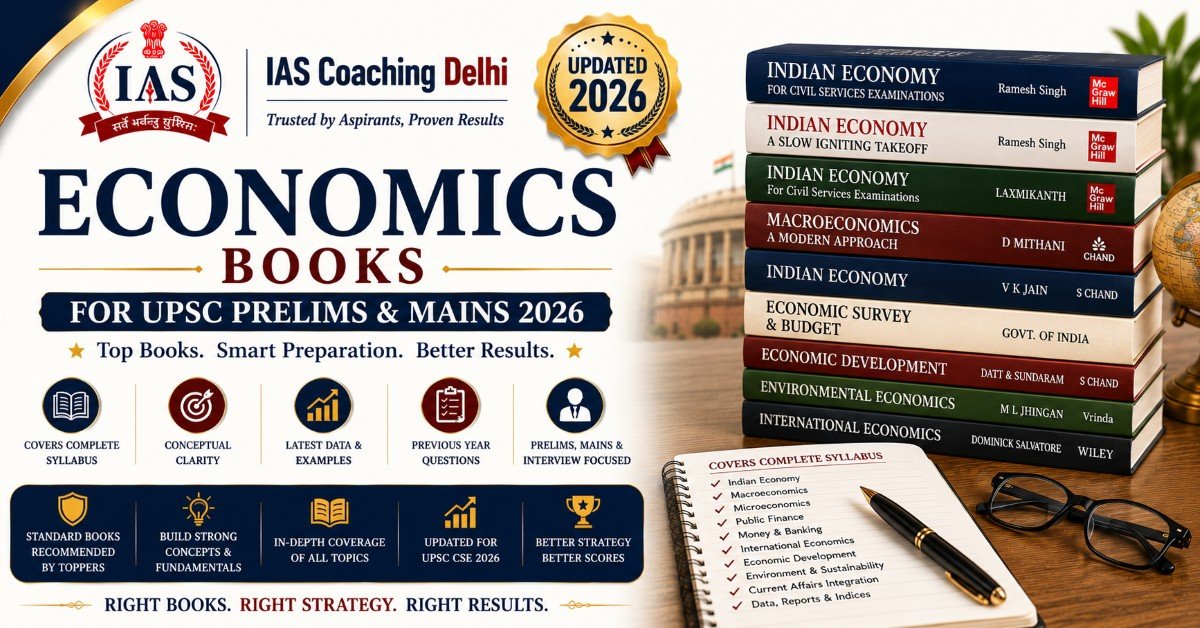
Starting your Civil Services preparation can feel confusing when you look at the huge market of study materials. Every beginner faces the same struggle on day one: what to read and what to leave behind. If you wander through markets without a plan, you will gather heavy textbooks that waste time. However, choosing the right Economics Books simplifies your entire Civil Services preparation instantly.
Economics carries high weightage in both the Preliminary and Mains exams. Because UPSC questions test how well you understand everyday financial news, you need clear resources. Therefore, having a simple booklist saves you hundreds of study hours. In this guide, I will share the exact reference books, school texts, and smart strategy tips you need for the 2026 exam. Let us make your study routine simple, clear, and effective!
Why Choosing the Right Economics Books Matters
Economics frightens many UPSC candidates, especially those without a background in commerce. Terms like inflation, repo rate, and fiscal deficits sound hard at first. However, the exam never asks for complex mathematical formulas. Instead, it tests whether you understand how policies impact everyday life.
Here is why picking the right reading material matters:
- Clears Core Concepts Easily: Simple standard books explain difficult financial terms in plain English.
- Saves Precious Study Time: Candidate-friendly books focus strictly on exam topics instead of useless theoretical details.
- Connects Static Theory to News: Good books help you understand daily financial news without any extra effort.
- Prevents Book Hoarding: Following a fixed list stops you from buying too many confusing books.
- Boosts Mains Marks: Clear understanding helps you write logical, structured answers in GS Paper 3.
- Builds Prelims Accuracy: Strong fundamentals allow you to eliminate wrong options quickly in MCQs.
Consequently, selecting target-focused sources builds a solid foundation for your Indian Economy Preparation.
Best Economics Books for UPSC 2026
To clear both stages of the exam, you need a smart balance of basic school texts and standard reference guides. You do not need a huge library. Instead, you only need a few well-written books that cover your entire syllabus.
Here is a quick overview of the top Economy Books for UPSC:
- Class 9 to 12 NCERTs: Best for building core concepts and learning simple financial definitions.
- Indian Economy by Ramesh Singh: Best for detailed, topic-by-topic syllabus coverage for both stages.
- Indian Economy by Nitin Singhania: Best for visual learners who love charts, diagrams, and tables.
- Key Concepts of Indian Economy by Sankarganesh Karuppiah: Best for non-commerce beginners who need plain English explanations.
- Economic Survey & Union Budget: Essential government documents for policy trends, schemes, and official data.
NCERT Economics Books
Starting with school textbooks is the smartest step every beginner can take. NCERT Economics Books break down heavy topics into simple, reader-friendly lessons.
Here is how you should cover them:
- Class 9 Economics: Read this to learn basic ideas about human resources, poverty, and rural economic activities.
- Class 10 Understanding Economic Development: Read this to understand money, credit, sectors of the economy, and globalization.
- Class 11 Indian Economic Development: Focus deeply on this book because it explains Indian economic history from 1947 to modern reforms.
- Class 12 Introductory Macroeconomics: Study this thoroughly to master core terms like GDP, national income, banking systems, and foreign exchange.
- Class 12 Microeconomics: You can safely skip this book because UPSC rarely asks questions on individual consumer behavior.
First, read Class 11 to understand historical policy changes. Next, move to Class 12 Macroeconomics to build strong technical definitions. As a result, these school books convert complex ideas into simple knowledge.
Indian Economy by Ramesh Singh
After finishing basic school books, you need one detailed reference text. Indian Economy by Ramesh Singh is the most widely recommended book among Civil Services aspirants. Published by McGraw Hill, it covers every topic in the UPSC Economy Syllabus.
Key features of this standard book include:
- Comprehensive Topic Coverage: Covers agriculture, banking, fiscal policy, land reforms, and trade bodies in detail.
- Updated Annual Content: Includes current government initiatives, economic schemes, and recent financial policy updates.
- Prelims and Mains Utility: Explains static definitions for Prelims and policy backgrounds for Mains answers.
- Simple Topic Structure: Divides complex chapters into smaller sections for step-by-step reading.
However, this reference guide is quite thick. Therefore, avoid reading it cover to cover like a novel. Instead, check your syllabus daily and read only those chapters that directly match exam topics.
Economic Survey
The Economic Survey is an official annual report released by the Ministry of Finance just before the budget. It reviews the country’s economic health and performance over the past year.
Why you must include it in your UPSC Study Material:
- Provides Official Facts: Supplies authentic government statistics for Mains answer writing.
- Highlights Key Trends: Explains growth trends in agriculture, manufacturing, services, and international trade.
- Contains Policy Solutions: Suggests future economic strategies that you can directly quote in GS Paper 3.
- Generates Prelims Questions: Exam setters frequently frame direct MCQs from survey chapters.
Because the full report is very long, reading reliable summary booklets from reputed institutes saves study time.
Union Budget
Along with the survey, the Union Budget is a crucial piece of your reading list. It outlines projected government revenues and planned expenditures for the upcoming year.
Important highlights to study from the budget:
- New Welfare Schemes: Focus on new flagship government programs and their target groups.
- Sector Fund Allocations: Note major financial investments in infrastructure, health, education, and defense.
- Taxation Changes: Understand broad updates in direct tax slabs and indirect GST policies.
- Fiscal Deficit Targets: Remember primary financial metrics and debt targets set by the government.
Mastering these budget points improves your score in both Prelims and Mains.
Economics Books for UPSC Prelims
The Preliminary exam tests conceptual clarity through multiple-choice questions. Questions usually test topics like inflation controls, central bank policies, exchange rates, and international agencies. Therefore, your choice of UPSC Prelims Economics Books must focus on simple terms and clear concepts.
Top choices for the Prelims stage:
- Key Concepts of Indian Economy by Sankarganesh Karuppiah: Uses simple analogies and short chapters to explain banking, tax systems, and market terms.
- Indian Economy by Nitin Singhania: Contains clear bullet lists, mind maps, and comparison tables for rapid visual revision.
- The Indian Economy by Sanjiv Verma: Explains government policy goals in short, easy-to-read chapters.
- Past 10 Years PYQ Question Banks: Helps you practice options elimination and understand UPSC question trends.
Solving regular practice questions alongside reading these books ensures high speed and accuracy during the exam.
Economics Books for UPSC Mains
The Mains paper demands analytical depth, structured writing, and issue-based understanding. You must write descriptive answers on inclusive growth, farming issues, land reforms, infrastructure, and jobs. Therefore, short notes alone are not enough.
Top UPSC Mains Economics Books and study sources:
- Indian Economy Since Independence by Uma Kapila: Gives deep historical context on policy shifts, industrial changes, and planned development.
- Indian Economy by Mishra & Puri: Useful as an advanced reference for specific topics like poverty trends, employment data, and industrial policy.
- NITI Aayog Strategy Reports: Provides forward-looking policy solutions that make your Mains answers stand out.
- Monthly Current Affairs Magazines: Keeps you updated with recent socio-economic developments and expert opinions.
In addition, prepare concise Economics Notes for UPSC arranged topic by topic according to the syllabus. Add statistics, survey findings, and official committee suggestions into your handwritten notes for top marks.
How to Study Economics Effectively
Having the Best Books for Indian Economy on your table is only the first step. You also need a simple study plan to absorb all information without feeling overwhelmed.
Follow this practical 4-step preparation plan:
First Step (Master NCERT Fundamentals):
- Read Class 11 Indian Economic Development once.
- Read Class 12 Macroeconomics carefully.
- Learn basic definitions like GDP, repo rate, and balance of payments.
Second Step (Read One Standard Text):
- Choose Ramesh Singh or Nitin Singhania as your core book.
- Highlight key points matching your syllabus.
- Avoid reading topics that are not in the syllabus.
Third Step (Add Daily Current Affairs):
- Read the business page of The Hindu or The Indian Express.
- Link real-world events to textbook chapters.
- Read annual budget and economic survey summaries.
Fourth Step (Revise and Practice PYQs):
- Prepare short bullet-point revision notes.
- Solve last 10 years of Prelims questions.
- Practice writing 2 Mains answers every week.
Following this step-by-step strategy turns a scary subject into an easy, scoring routine.
Common Mistakes Students Make
Many candidates lose marks in Indian Economy due to small mistakes that are easy to avoid. Knowing these traps keeps your study on the right track.
Avoid these major mistakes:
- Collecting Too Many Books: Buying every new market guide creates confusion. Stick strictly to one standard reference book.
- Ignoring Current News: Reading only static IAS Economy Books without daily current affairs leads to low scores.
- Memorizing Data Without Logic: Learning facts without understanding their background causes confusion in Mains.
- Skipping Basic NCERTs: Moving to heavy reference guides without reading school books damages conceptual clarity.
- Delaying Answer Practice: Leaving answer writing practice for after Prelims reduces your chances in Mains.
- Avoiding Periodic Revision: Neglecting weekly revision makes you forget technical definitions quickly.
Frequently Asked Questions (FAQs)
Q1. Which is the best book for UPSC Economics beginners?
Class 11 and Class 12 NCERTs are the absolute best books for beginners. After completing NCERTs, you can read Key Concepts of Indian Economy by Sankarganesh Karuppiah for easy definitions of difficult financial terms.
Q2. Is Ramesh Singh enough for UPSC Economics preparation?
Yes, Indian Economy by Ramesh Singh covers the static syllabus thoroughly for both stages. However, you must combine it with the latest Economic Survey, Union Budget, and daily news updates.
Q3. How many questions come from Economics in UPSC Prelims?
Every year, UPSC asks around 15 to 20 questions from Economics in Prelims. This high weightage makes it one of the most critical subjects for clearing the cutoff score.
Q4. Should I read Class 11 and 12 Microeconomics for UPSC?
No, you do not need to study Microeconomics in detail. UPSC focuses almost entirely on Macroeconomics and Indian economic issues. Therefore, concentrate on Class 12 Macroeconomics and Class 11 Indian Economic Development.
Q5. How do I cover the Economic Survey for UPSC 2026?
Instead of reading the original five-hundred-page report, read summary booklets released by established coaching institutes. Focus on key growth trends, major government schemes, and sector analysis.
Conclusion
Mastering Indian Economy is not as hard as it seems. You do not need to read dozens of heavy textbooks to score high marks. Instead, start with basic NCERTs, pick one good reference book like Ramesh Singh, and stay updated with daily news along with the Economic Survey.
Selecting the right Economics Books gives you the exact clarity and confidence you need for both stages of the exam. Keep your study list short, revise your notes regularly, and practice past papers. With a simple plan and consistent effort, clearing UPSC 2026 is completely within your reach!