
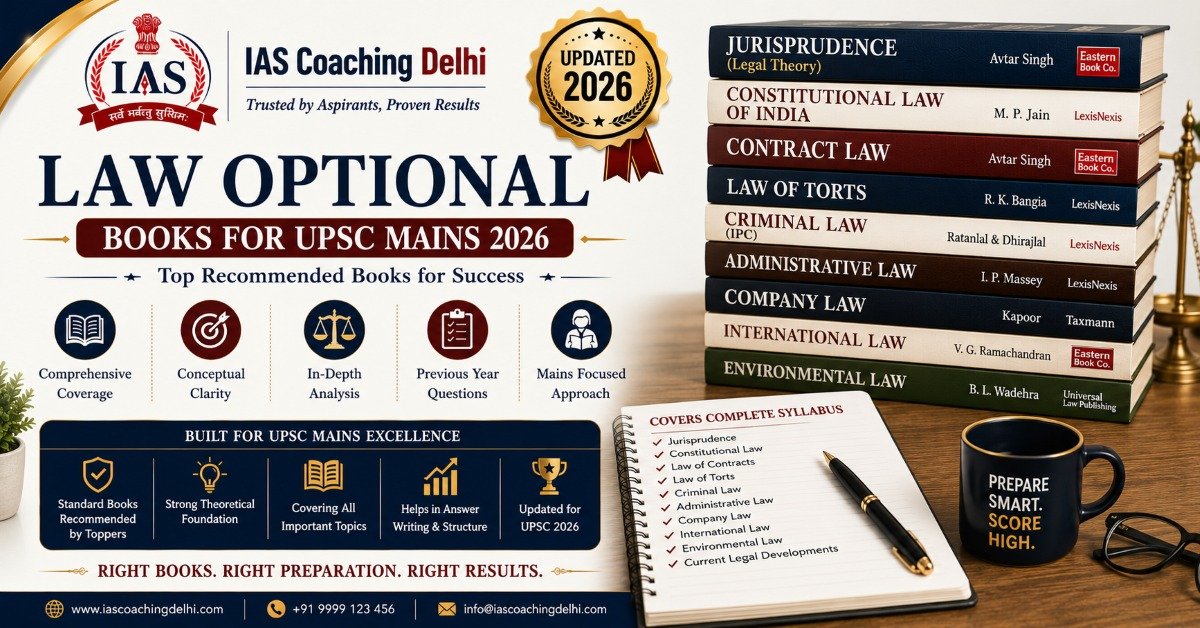
The selection of Law Optional Books should be the primary concern for those who wish to crack UPSC Mains 2026. It’s a systematic subject where you can secure marks easily, but students often struggle because of collecting numerous study materials. However, with the selection of the proper books in Law Optional Books, it becomes much easier for you to build concepts regarding law. Here in this article, you’ll get everything regarding the best booklist, preparation strategy, and tips to score in UPSC Mains.
Why Choose Law Optional in UPSC 2026?
Law is one of the most reliable subjects in the civil services exam. It offers clarity because the syllabus is well-defined.
1. High Overlap with General Studies
First, UPSC Law Optional overlaps significantly with GS Paper 2 (Polity, Governance, and Constitution). Also, it helps in GS Paper 4 (Ethics) when you discuss justice and administrative rules.
2. Predictable Questions and High Scoring Potential
Second, questions in law often repeat legal principles and classic case laws. Therefore, if you practice Previous Year Questions, you can easily predict the exam pattern.
3. Who Should Choose Law Optional?
- Law graduates (LL.B / LL.M students) who want to leverage their degree.
- Non-law graduates who enjoy analytical thinking and reading constitutional affairs.
- Aspirants seeking a static subject with minimal syllabus changes over time.
Best Law Optional Books for UPSC Mains 2026
To simplify your search, here is a quick overview showing the core Law Optional Study Material for UPSC Mains 2026:
- Constitutional Law: Indian Constitutional Law by M.P. Jain. This book offers comprehensive coverage of doctrines and legal provisions.
- Administrative Law: Administrative Law by I.P. Massey. It provides simple explanations of delegated legislation and principles.
- International Law: International Law by Malcolm Shaw or S.K. Kapoor. These books cover global treaties, UN organs, and maritime laws.
- Law of Crimes: Textbook on IPC / Bharatiya Nyaya Sanhita (BNS) by K.D. Gaur. It gives a great analysis of criminal liability and landmark cases.
- Law of Torts: Law of Torts by R.K. Bangia. It is very easy to read with beginner-friendly case illustrations.
- Law of Contracts: Law of Contract & Specific Relief by Avtar Singh. It explains commercial principles and agreements clearly.
Best Books for Law Optional Paper 1
Law Optional Paper 1 focuses on Constitutional Law, Administrative Law, and Public International Law. Let us explore the core Constitutional Law Books and International Law Books.
Constitutional Law
- Indian Constitutional Law by M.P. Jain: This is the gold standard textbook. It provides deep insights into constitutional articles, federal structures, and fundamental rights.
- Introduction to the Constitution of India by D.D. Basu: This book offers an analytical view of constitutional history and structure. It is great for comparative topics.
Administrative Law
- Administrative Law by I.P. Massey: This book covers topic-wise concepts like Principles of Natural Justice, Delegated Legislation, and Lokpal. Because the language is clear, beginners can finish it quickly.
International Law
- International Law by Malcolm Shaw: This globally famous textbook explains international legal theories and the UN system thoroughly.
- International Law by S.K. Kapoor: If you want concise notes for exam preparation, Kapoor’s book is handy for quick revision.
Best Books for Law Optional Paper 2
Law Optional Paper 2 covers substantive laws, including Crimes, Torts, Contracts, Mercantile Law, and Contemporary Legal Developments.
1. Law of Crimes
- Textbook on IPC / Bharatiya Nyaya Sanhita (BNS) by K.D. Gaur: This book breaks down criminal intent (mens rea), general exceptions, and offenses against the human body. Make sure you read updated statutory changes alongside this text.
2. Law of Torts
- Law of Torts by R.K. Bangia: Bangia makes tort law simple. You will easily learn concepts like strict liability, negligence, and vicarious liability.
3. Law of Contracts and Mercantile Law
- Law of Contract & Specific Relief by Avtar Singh: This book explains offer, acceptance, indemnity, agency, and breach of contract.
4. Contemporary Legal Developments
For dynamic topics like Intellectual Property Rights (IPR), Competition Law, Right to Information (RTI), and Cyber Law, rely on current updates from official legal websites.
Bare Acts You Must Read
You cannot score well in UPSC Mains Law Optional without citing actual sections and articles. Reading Bare Acts builds statutory accuracy in your answers.
Important Bare Acts for UPSC Law Optional
- The Constitution of India (P.M. Bakshi edition)
- Bharatiya Nyaya Sanhita (BNS) / The Indian Penal Code
- The Indian Contract Act, 1872
- The Consumer Protection Act
- The Right to Information Act, 2005
- The Information Technology Act, 2000
- The Arbitration and Conciliation Act, 1996
Keep a pocket Bare Act with you while reading textbook chapters. Always highlight important article numbers and definitions.
Previous Year Papers
Solving Previous Year Questions (PYQs) is essential for a winning Law Optional Strategy. UPSC tends to repeat core themes in law papers.
Why PYQs Are Vital
- Identify High-Yield Topics: PYQs reveal which sections of the Law Optional Syllabus carry maximum weightage.
- Improve Answer Structure: Practice writing structured answers with an introduction, legal provisions, landmark case laws, and a solid conclusion.
- Boost Speed and Precision: Timed PYQ practice helps you manage exam pressure on the final day.
Practical 3-Month Study Plan Using These Law Optional Books
Here is a practical study schedule to cover your Best Law Optional Books efficiently:
Month 1: Focus on Paper 1 (Constitutional & Administrative Law)
Start your preparation with Constitutional Law using M.P. Jain alongside the Bare Act. Once you cover the main constitutional provisions, finish Administrative Law using I.P. Massey. Focus on making short Law Optional Notes on fundamental rights, judicial review, and administrative tribunals.
Month 2: Master Paper 2 (Crimes, Torts, Contracts)
Begin the second month with Law of Crimes using K.D. Gaur. Next, move to Torts with R.K. Bangia and Contracts with Avtar Singh. Solve topic-wise previous year questions as you finish each chapter to check your understanding.
Month 3: International Law, Contemporary Topics, and Revision
Use the final month for International Law using Malcolm Shaw or S.K. Kapoor. Update contemporary legal topics using online legal news portals. Revise your notes multiple times and write full-length mock test papers under timed conditions.
Common Mistakes to Avoid
- Reading Too Many Books: Stick to one primary textbook per subject instead of collecting multiple resources.
- Ignoring Case Laws: Answers without Landmark Judgments lack depth. Always mention relevant Supreme Court cases.
- Skipping Bare Acts: Reading commentary without checking exact statutory language leads to vague answers.
- Neglecting Answer Writing: Knowing law concepts is not enough; you must present them clearly within word limits.
- Forgetting Current Legal Developments: Failing to link static topics with recent legal events will cost you marks.
Expert Tips for Scoring High
- Integrate Landmark Judgments: Use classical cases like Kesavananda Bharati, Maneka Gandhi, or R. Bommai to strengthen constitutional law answers.
- Quote Section/Article Numbers: Always quote exact Article numbers (e.g., Article 21, Article 300A) to show authority.
- Keep Notes Concise: Make simple notes for case laws with three details: Case Name, Legal Principle, and Key Ratio.
- Follow News Portals: Read legal updates on platforms like [External Link 1] and [External Link 2] to cite current affairs in Paper 2.
- Refer to Syllabus Regularly: Keep your Law Optional Syllabus handy to avoid reading irrelevant topics. Check our comprehensive [Internal Link] guide for extra Mains preparation strategies.
Frequently Asked Questions (FAQs)
Q1. Which standard Law Optional Books are best for beginners?
M.P. Jain for Constitutional Law, R.K. Bangia for Torts, and I.P. Massey for Administrative Law are extremely beginner-friendly textbooks.
Q2. Can non-law background students clear UPSC Mains Law Optional?
Yes, non-law graduates clear UPSC with Law optional every year. The syllabus is structured, and conceptual clarity comes with consistent reading.
Q3. How many Law Optional Books should I buy per subject?
You should buy only one standard textbook per subject area. Rely on Bare Acts and concise self-made notes for revision.
Q4. Are Bare Acts mandatory for UPSC Law preparation?
Yes, Bare Acts provide exact definitions and statutory language. Citing correct articles and sections adds credibility to your answer sheets.
Q5. How important are Landmark Judgments in Mains writing?
Landmark Judgments are very important. Quoting Supreme Court decisions proves that you understand legal applications beyond theoretical concepts.
Conclusion
Choosing the appropriate books for UPSC Law Optional is what makes up the essence of your preparation. The best books include conventional textbooks such as M.P. Jain, R.K. Bangia, and K.D. Gaur that give you strong conceptual clarity. On the other hand, Bare Acts, case laws, and previous year’s questions guarantee exam-related accuracy. Keep your list of books small, work on revisions and practice answer writing. Begin preparing by reading the recommended Law Optional Books.