
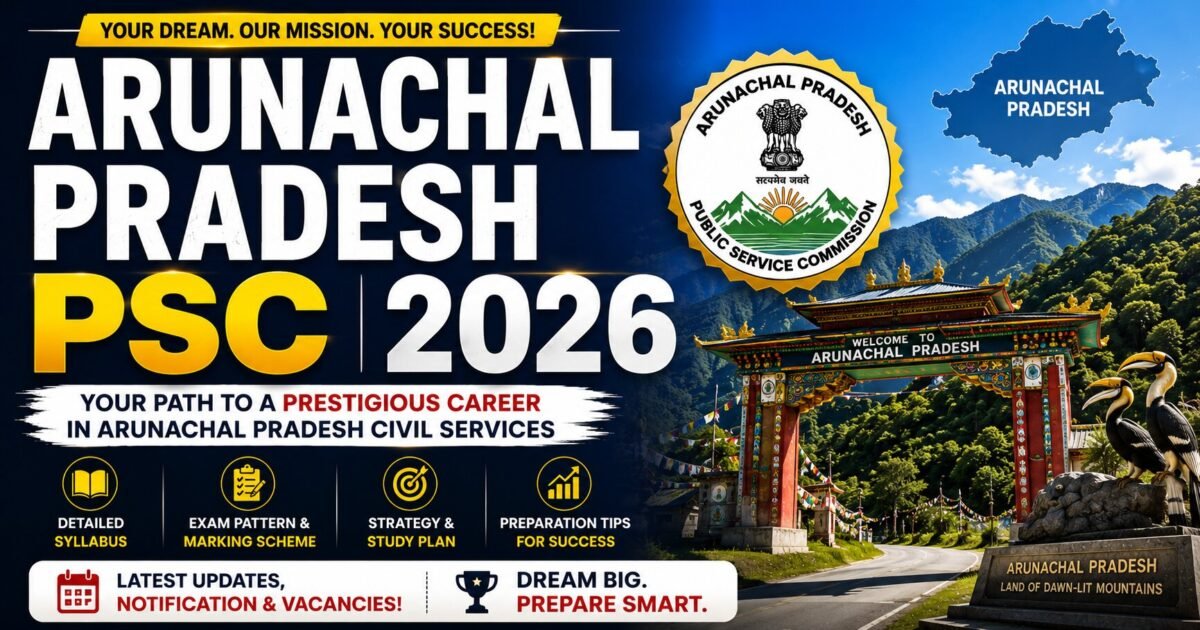
A state civil service examination demands accurate information, an effective approach, and regular preparation from an aspirant’s end. The first step for an aspirant who wants to get into a respected administrative job in Arunachal Pradesh is a clear insight into the process of the Arunachal Pradesh PSC examination. Organized by the Arunachal Pradesh Public Service Commission, the competitive exam provides ample scope for working in different administrative services and departments of the state government.
The number of applications each year for state civil services recruitment has increased, and the challenge level has gone up accordingly. A proper knowledge of the notifications, eligibility conditions, exam pattern, and syllabus can help candidates ace the competition easily.
What is Arunachal Pradesh PSC?
The Arunachal Pradesh Public Service Commission (APPSC) is the constitutional body responsible for recruiting qualified candidates for various government services and administrative positions within the state.
The commission conducts examinations, interviews, and recruitment procedures for several state-level posts. Through its transparent selection process, APPSC ensures that deserving candidates are appointed to important administrative and public service roles.
The examination serves as a gateway for candidates aspiring to work in:
- State Civil Services
- Administrative Departments
- Revenue Services
- Development Administration
- Government Ministries
- Various State-Level Officer Positions
For many aspirants, clearing this examination represents an opportunity to contribute directly to the governance and development of Arunachal Pradesh.
Arunachal Pradesh PSC 2026 Notification
The official notification is expected to provide complete details regarding vacancies, application dates, eligibility conditions, examination schedules, and selection procedures.
Candidates should regularly monitor official announcements to avoid missing important updates.
The notification generally contains information about:
Important Details Included in Notification
- Number of vacancies
- Application start date
- Last date to apply
- Examination dates
- Eligibility criteria
- Reservation policies
- Examination centers
- Application fees
- Selection process
Aspirants are advised to read the official notification carefully before submitting their applications.
Missing eligibility requirements or submitting incorrect information can lead to disqualification during later stages of recruitment.
Arunachal Pradesh PSC Eligibility Criteria
Before applying, candidates must ensure they meet all eligibility conditions specified by the commission.
Educational Qualification
Applicants must possess a bachelor’s degree from a recognized university or educational institution.
The degree can be from various disciplines, including:
- Arts
- Science
- Commerce
- Engineering
- Management
- Other recognized fields
Final-year students may also be eligible depending on the conditions mentioned in the official notification.
Nationality
Candidates must fulfill the nationality requirements specified by the commission and government recruitment guidelines.
Physical and Medical Standards
Certain posts may require candidates to meet specific medical and physical fitness standards.
These requirements vary according to the nature of the position.
Arunachal Pradesh PSC Age Limit
Age eligibility is one of the most important factors in the application process.
Generally, candidates must fall within the prescribed age bracket specified in the recruitment notification.
Typical Age Requirements
| Category | Age Limit |
| General Category | Usually 21 to 32 Years |
| OBC Category | Age Relaxation Applicable |
| SC/ST Category | Age Relaxation Applicable |
| PwBD Candidates | As Per Government Rules |
Age relaxation benefits are provided according to state and central government regulations.
Candidates should verify exact age requirements from the official notification because eligibility rules may change for different recruitment cycles.
Selection Process
The recruitment process is designed to evaluate candidates across multiple dimensions, including academic knowledge, analytical ability, decision-making skills, and personality traits.
The selection process typically consists of:
Preliminary Examination
This is the first stage of screening.
The objective-type examination tests candidates on general studies and current affairs.
Main Examination
Candidates who qualify for the preliminary stage proceed to the mains examination.
This stage evaluates in-depth understanding of various subjects through descriptive answers.
Personality Test or Interview
Successful mains candidates appear for a personal interview conducted by the commission.
This stage assesses:
- Communication skills
- Leadership qualities
- Administrative aptitude
- Decision-making ability
- General awareness
The final merit list is prepared based on performance in the relevant stages of selection.
Arunachal Pradesh PSC Exam Pattern
Understanding the examination structure helps candidates prepare more effectively.
Preliminary Examination Pattern
The preliminary examination generally serves as a qualifying stage.
Subjects commonly include:
- General Studies
- Current Affairs
- Indian Polity
- Geography
- History
- Economy
- Environment
- Science and Technology
The objective nature of the examination requires speed and accuracy.
Main Examination Pattern
The mains examination is descriptive in nature.
Candidates are evaluated on:
- Essay Writing
- General Studies Papers
- Optional Subjects
- Analytical Skills
- Administrative Understanding
The mains stage carries significant weight in the overall selection process.
Arunachal Pradesh PSC Syllabus
A clear understanding of the syllabus is crucial for focused preparation.
General Studies
This section covers a broad range of subjects.
Important topics include:
Indian History
Candidates should focus on:
- Ancient India
- Medieval India
- Modern India
- Freedom Movement
Geography
Key areas include:
- Physical Geography
- Indian Geography
- World Geography
- Environmental Issues
Indian Polity
Important topics:
- Constitution
- Fundamental Rights
- Parliament
- Judiciary
- Governance
Economy
Areas to cover:
- Economic Development
- Budget
- Fiscal Policy
- Banking System
- Government Schemes
Science and Technology
Candidates should stay updated with recent scientific developments and technological advancements.
Current Affairs
Regular newspaper reading remains essential for success.
Focus on:
- National Events
- International Developments
- Government Policies
- Economic News
- Environmental Issues
Best Preparation Strategy
Success in state civil services examinations requires a systematic approach rather than random studying.
Understand the Syllabus First
Many candidates waste valuable time studying irrelevant topics.
Begin by understanding the complete syllabus and examination pattern.
This helps create a focused preparation plan.
Build Strong Fundamentals
Start with standard books and NCERT resources.
A strong conceptual foundation makes advanced preparation easier.
Create a Study Schedule
A disciplined timetable improves consistency.
Allocate time for:
- Static subjects
- Current affairs
- Revision
- Mock tests
- Answer writing practice
Consistency is more important than studying long hours occasionally.
Importance of Current Affairs
Current affairs play a significant role in both preliminary and mains examinations.
Candidates should develop a daily habit of reading newspapers and following reliable news sources.
Focus on:
- Government initiatives
- Economic developments
- International relations
- Environmental issues
- State-specific developments
Maintaining concise notes can make revision easier before the examination.
Role of Mock Tests in Preparation
Mock tests help candidates evaluate their readiness.
Benefits include:
- Better time management
- Improved accuracy
- Understanding weak areas
- Increased confidence
- Examination temperament development
Regular practice under exam-like conditions helps reduce stress during the actual examination.
Common Mistakes Candidates Should Avoid
Many aspirants fail not because of a lack of capability but because of avoidable mistakes.
Ignoring the Syllabus
Studying without a syllabus often leads to wasted effort.
Lack of Revision
Reading multiple books without revision reduces retention.
Poor Time Management
Candidates must balance learning new topics with revising old material.
Excessive Resource Collection
Too many books create confusion.
Focus on quality resources instead of quantity.
Neglecting Answer Writing
Descriptive examinations require regular writing practice.
Candidates should develop structured answer-writing skills early in their preparation journey.
Subject-Wise Preparation Tips
History
Focus on conceptual understanding and timelines.
Pay special attention to the freedom struggle and important historical events.
Geography
Use maps extensively.
Visual learning improves retention and understanding.
Polity
Study constitutional provisions thoroughly.
Current governance-related developments should also be covered.
Economy
Understand concepts rather than memorizing facts.
Economic surveys and budget highlights can provide valuable insights.
Environment
This area has gained increasing importance in recent years.
Focus on biodiversity, climate change, and conservation efforts.
Career Opportunities After Selection
Successful candidates can secure prestigious positions within the state administration.
Career benefits include:
- Job stability
- Competitive salary
- Social prestige
- Leadership opportunities
- Administrative authority
- Career progression
Civil service positions offer a platform to contribute directly to public welfare and state development.
For many aspirants, this combination of responsibility and impact makes the examination highly attractive.
Why Professional Guidance Can Help
Preparing independently is possible, but expert guidance often accelerates progress.
Professional coaching helps candidates:
- Understand examination trends
- Access structured study plans
- Receive mentorship
- Practice answer writing
- Participate in mock interviews
Platforms such as IAS Coaching Delhi provide guidance, mentorship, study resources, and strategic preparation support for civil services aspirants preparing for state and national competitive examinations.
A structured approach can significantly improve efficiency and confidence during preparation.
Time Management Strategy for Working Aspirants
Many candidates prepare while pursuing jobs or higher education.
For such aspirants:
- Study consistently every day.
- Prioritize important subjects.
- Use weekends effectively.
- Follow concise current affairs sources.
- Focus on revision regularly.
Even a few productive hours daily can yield excellent results when maintained consistently over time.
Conclusion
The Arunachal Pradesh PSC 2026 examination offers a prestigious opportunity for candidates aspiring to serve in administrative and government roles within the state. Success requires a clear understanding of eligibility criteria, examination structure, syllabus, and preparation strategies.
A focused study plan, regular revision, current affairs preparation, and consistent practice can significantly improve performance. Candidates who begin their preparation early and follow a disciplined approach stand a better chance of securing a place in the final merit list. With determination, smart preparation, and the right guidance, achieving success in the Arunachal Pradesh civil services examination becomes an attainable goal.
FAQs
Q.1 What is Arunachal Pradesh PSC?
The Arunachal Pradesh Public Service Commission conducts recruitment examinations for various administrative and government posts in the state.
Q.2 What is the minimum educational qualification required?
Candidates must generally possess a bachelor’s degree from a recognized university.
Q.3 What is the age limit for Arunachal Pradesh PSC?
The age limit usually starts from 21 years, with upper-age relaxation available for reserved categories as per government norms.
Q.4 How many stages are there in the selection process?
The recruitment process generally includes a Preliminary Examination, Main Examination, and Personal Interview.
Q.5 Is current affairs important for the examination?
Yes, current affairs play a crucial role in both preliminary and mains examinations.
Q.6 Can final-year students apply?
Eligibility for final-year students depends on the specific conditions mentioned in the official notification.
Q.7 How should beginners start preparation?
Beginners should first understand the syllabus, build strong fundamentals, and follow a structured study plan.
Q.8 How can IAS Coaching Delhi help aspirants?
IAS Coaching Delhi provides mentorship, study guidance, mock tests, preparation strategies, and expert support for civil services aspirants preparing for competitive examinations.