
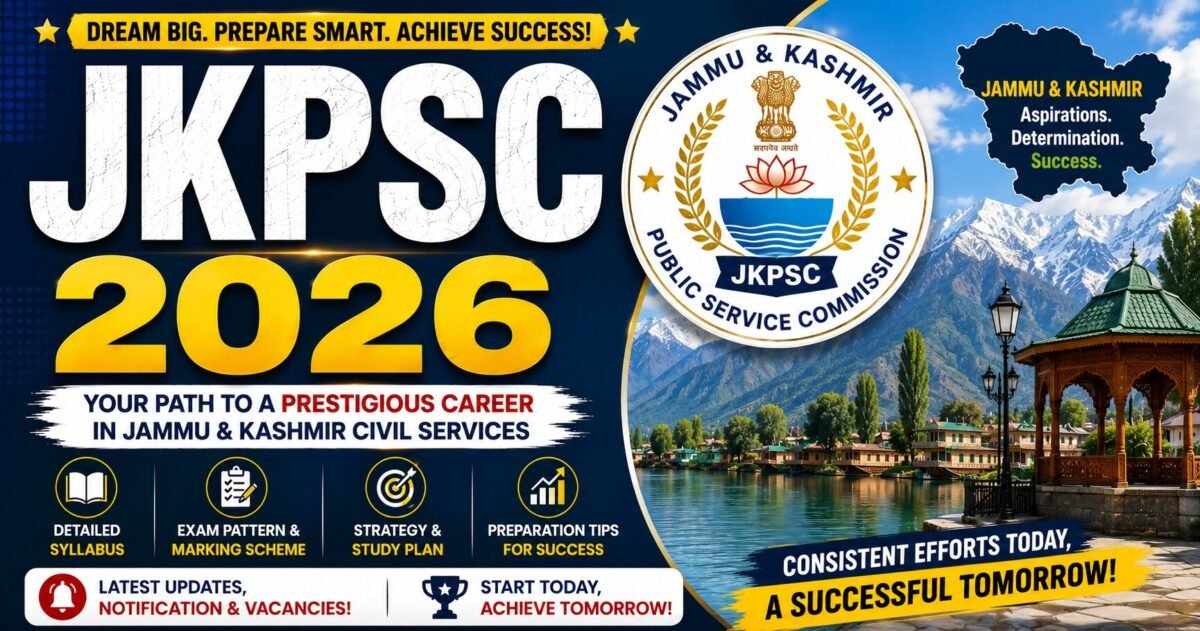
For all those aspiring to become a member of any coveted post in the government sector, the JKPSC exam provides a golden opportunity for all the residents of J&K state. The JKPSC is an autonomous commission in the Union Territory of Jammu and Kashmir, which conducts the recruitment process for various posts in the administrative and civil services category.
It becomes essential for each applicant to know about the eligibility criteria, age limits, exam pattern, syllabus, and other related important factors, prior to making his/her appearance in the recruitment process.
This article presents the detailed information regarding the JKPSC examination 2026, for the prospective candidates aspiring to make their future career in administrative and civil sectors.
What is JKPSC?
The Jammu and Kashmir Public Service Commission is the constitutional body responsible for recruiting candidates for various gazetted services and administrative positions in Jammu & Kashmir.
The commission conducts several competitive examinations throughout the year to select qualified candidates for government departments.
Some popular examinations conducted by the commission include:
- Combined Competitive Examination (CCE)
- Administrative Services Examination
- Police Services Examination
- Accounts Services Examination
- Medical Officer Recruitment
- Lecturer Recruitment
- Assistant Engineer Recruitment
These positions offer stability, career growth, attractive salaries, and the opportunity to serve society.
JKPSC 2026 Notification
The official notification is expected to provide complete information regarding:
- Number of vacancies
- Application dates
- Eligibility requirements
- Examination schedule
- Selection process
- Reservation policy
- Syllabus updates
Candidates should regularly monitor the official commission website for the latest announcements.
The notification serves as the most important document because it contains all recruitment-related details and instructions.
Important Dates for JKPSC 2026
Although official dates may vary, aspirants can expect the recruitment cycle to follow a structured timeline.
| Event | Expected Timeline |
| Notification Release | Early 2026 |
| Online Application Start | Along with Notification |
| Last Date to Apply | Within 30 Days |
| Preliminary Examination | Mid 2026 |
| Preliminary Result | Few Weeks After Exam |
| Main Examination | Later in 2026 |
| Interview Round | After Mains Result |
| Final Result | End of Recruitment Cycle |
Candidates should verify all dates from the official notification once released.
JKPSC Eligibility Criteria 2026
Before applying, candidates must carefully review the eligibility requirements.
Educational Qualification
Applicants must possess a bachelor’s degree from a recognized university.
The degree can be in any discipline unless a particular post requires specialized qualifications.
Final-year students may also be eligible depending on notification guidelines.
Nationality
The applicant must be an Indian citizen and fulfill domicile requirements prescribed by the commission.
Number of Attempts
The number of attempts generally depends on category-wise rules mentioned in the official notification.
Candidates should check the latest guidelines before applying.
JKPSC Age Limit 2026
Age eligibility is one of the most important aspects of the recruitment process.
Typically, the age criteria vary according to category.
General Category
Usually between 21 and 32 years.
Reserved Categories
Relaxation is generally provided to:
- OBC candidates
- SC candidates
- ST candidates
- EWS candidates
- Ex-servicemen
- Persons with Disabilities
Applicants should refer to the latest notification for exact age calculations and relaxation rules.
Selection Process
The recruitment process generally consists of three stages.
Preliminary Examination
This is the first screening stage.
The marks obtained here are usually considered for qualifying purposes only.
Main Examination
Candidates who clear the preliminary stage appear for the mains examination.
This stage evaluates analytical ability, subject knowledge, and writing skills.
Personality Test
The final stage is the interview.
Candidates are assessed on:
- Communication skills
- Decision-making ability
- Leadership qualities
- Administrative aptitude
- Personality traits
Final merit is prepared based on mains and interview performance.
Exam Pattern Overview
Understanding the examination pattern is essential for effective preparation.
Preliminary Examination
The preliminary stage generally consists of objective-type papers.
| Paper | Subject |
| Paper I | General Studies |
| Paper II | Aptitude Test |
The objective format helps assess candidates’ foundational knowledge and analytical abilities.
Main Examination
The mains stage typically includes:
- Essay
- General Studies Papers
- Optional Subject Papers
- Language Papers
This stage requires in-depth preparation and answer-writing practice.
JKPSC Syllabus 2026
A clear understanding of the syllabus helps candidates prepare strategically.
General Studies Topics
Important subjects include:
- Indian Polity
- Governance
- Economy
- Geography
- History
- Environment
- Science and Technology
- International Relations
- Current Affairs
CSAT Topics
Common aptitude areas include:
- Logical Reasoning
- Analytical Ability
- Data Interpretation
- Reading Comprehension
- Decision Making
Main Examination Subjects
The mains syllabus generally focuses on:
- Ethics
- Governance
- Social Issues
- Internal Security
- Economic Development
- Essay Writing
Candidates should always refer to the latest syllabus released by the commission.
How to Start Preparation
Success in competitive examinations requires a structured study plan.
Build Strong Fundamentals
Begin with basic concepts from NCERT books and standard reference materials.
Strong fundamentals improve understanding of advanced topics.
Follow a Daily Schedule
Consistency matters more than studying long hours occasionally.
Allocate dedicated time for:
- Current affairs
- Static subjects
- Revision
- Mock tests
Focus on Current Affairs
Current events play a major role in both prelims and mains.
Read newspapers daily and maintain concise notes.
Practice Mock Tests
Regular testing helps:
- Improve accuracy
- Increase speed
- Identify weak areas
- Build exam confidence
Mock tests should be an essential part of preparation.
Best Books for JKPSC Preparation
Selecting quality study material can significantly improve preparation.
History
- Spectrum Modern History
- NCERT History Books
Polity
- Indian Polity by M. Laxmikanth
Geography
- NCERT Geography Books
- GC Leong
Economy
- Indian Economy by Ramesh Singh
Environment
- Shankar IAS Environment
Current Affairs
- Newspapers
- Monthly magazines
- Government reports
Quality resources are more valuable than collecting too many books.
Common Mistakes to Avoid
Many aspirants make avoidable mistakes during preparation.
Ignoring the Syllabus
Preparation without understanding the syllabus often leads to wasted effort.
Lack of Revision
Studying new topics without revising previous ones reduces retention.
Overdependence on Coaching Notes
Standard books and self-study remain essential.
Neglecting Answer Writing
Mains success depends heavily on answer-writing practice.
Avoiding Mock Tests
Mock exams reveal strengths and weaknesses before the actual exam.
Avoiding these mistakes can significantly improve performance.
Career Opportunities After Selection
Government services recruited through the commission offer rewarding careers.
Benefits include:
- Job security
- Respect in society
- Career progression
- Attractive salary packages
- Pension benefits
- Administrative authority
Successful candidates contribute directly to governance and public administration.
These positions provide opportunities to make meaningful contributions to society while enjoying professional growth.
Why Early Preparation Matters
Competition levels continue to increase every year.
Starting preparation early offers several advantages:
- Better conceptual understanding
- More revision time
- Improved answer-writing skills
- Enhanced confidence
- Reduced exam stress
Candidates who begin preparation well in advance often perform better than those who rely on last-minute study.
A long-term strategy allows aspirants to cover the syllabus comprehensively and improve overall performance.
Smart Preparation Strategy for 2026 Aspirants
A practical preparation strategy should include:
Phase 1: Foundation Building
Focus on:
- NCERT books
- Basic concepts
- Current affairs
Phase 2: Advanced Preparation
Move toward:
- Standard reference books
- Optional subjects
- Test series
Phase 3: Revision and Testing
Prioritize:
- Mock examinations
- Previous year papers
- Rapid revision
This systematic approach helps maintain consistency and improves exam readiness.
Conclusion
The JKPSC 2026 exam offers a great chance for those who wish to be part of the highly regarded government services in Jammu & Kashmir. As long as you have a sound strategy for preparing for the exam along with an appropriate syllabus, success can come within your reach.
To succeed in competitive exams, it is important to know that success cannot be attained at once. It needs a lot of hard work and dedication. With an appropriate knowledge of the notice, eligibility, exam format, and preparation methods, one can prepare effectively for the exam.
Early starters will always stand a greater chance of success in their preparation process.
FAQs
Q.1 What is JKPSC?
JKPSC stands for Jammu and Kashmir Public Service Commission, which conducts recruitment examinations for various government services in Jammu & Kashmir.
Q.2 What is the minimum qualification for JKPSC 2026?
Candidates generally need a bachelor’s degree from a recognized university to apply.
Q.3 What is the age limit for JKPSC?
The age limit usually starts from 21 years, with upper-age relaxation available for reserved categories as per government rules.
Q.4 How many stages are there in the selection process?
The recruitment process generally includes Preliminary Examination, Main Examination, and Personality Test.
Q.5 Is current affairs important for JKPSC preparation?
Yes, current affairs play an important role in both preliminary and main examinations.
Q.6 Which books are best for preparation?
Standard books such as Laxmikanth for Polity, Spectrum for History, NCERTs, and current affairs resources are widely recommended.
Q.7 How much time is required for preparation?
Most successful candidates prepare consistently for several months to build a strong foundation and revise effectively.
Q.8 Can beginners crack JKPSC in their first attempt?
Yes. With proper planning, consistent study, and regular practice, many candidates successfully clear the examination in their first attempt.