
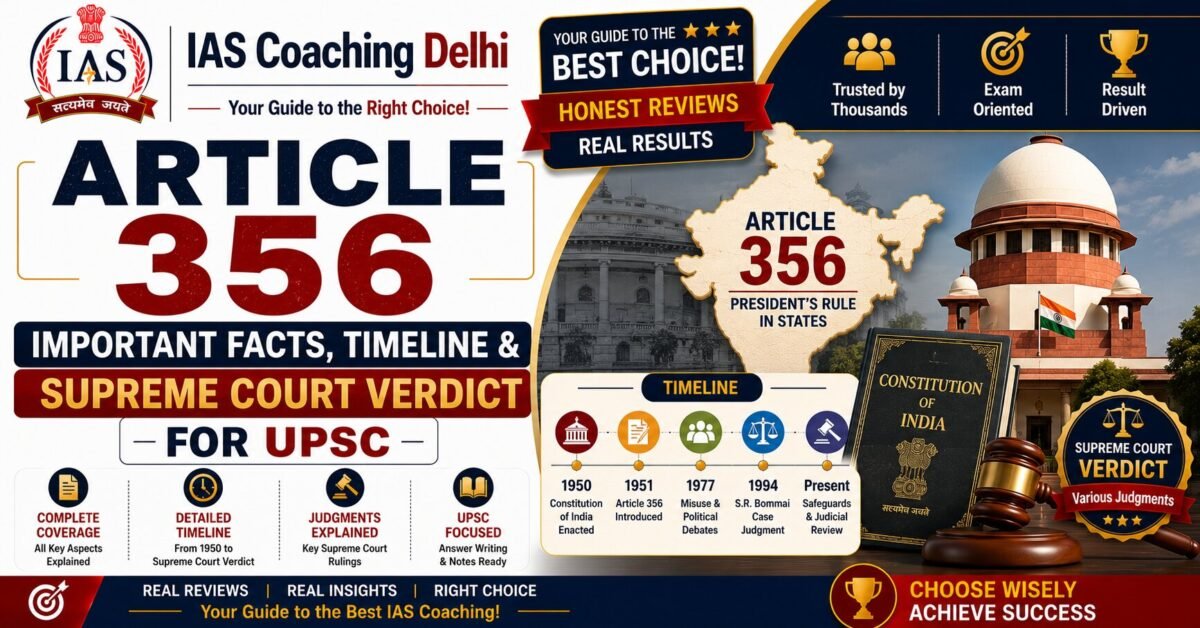
The Indian Constitution maintains a careful balance between the Union Government and the individual states. However, situations can arise when a state government fails to run according to constitutional rules. In such critical moments, the President of India can use Article 356 to restore constitutional governance in that state.
For students preparing for the UPSC examination, Article 356 is a central topic in Indian Polity and Governance. Therefore, you must understand its constitutional background, historical evolution, and key judicial safeguards.
In this complete guide, we will break down Article 356 in simple, clear language without using complex legal jargon.
What is Article 356?
Article 356 allows the President of India to impose President’s Rule in a state. Consequently, people also call this provision a Constitutional Emergency or a State Emergency.
When the President applies this provision, three major administrative changes happen immediately:
- First, the Central Government suspends or dismisses the elected state government.
- Second, the Governor exercises executive authority in the state on behalf of the President.
- Third, the Parliament assumes the legislative powers of the state assembly.
Why Did the Framers Add Article 356?
The framers of the Constitution wanted a legal safeguard to protect national unity and constitutional order. Therefore, they incorporated Article 356 as an extraordinary remedy for rare political crises.
Dr. B. R. Ambedkar explicitly hoped that this provision would remain a “dead letter.” In other words, he believed the Centre would use this extreme power only as a last resort. However, political leaders have used it over 100 times since 1950, making it a major subject of debate in Indian federalism.
How Article 356 Connects with Articles 355 and 365
You cannot study Article 356 in isolation. Instead, you should understand how it works together with Article 355 and Article 365:
- Article 355: This article makes it the duty of the Union to protect every state against external aggression and internal disturbance.
- Article 356: This article gives the President power to step in when state governance fails.
- Article 365: This article states that if a state fails to follow directions from the Union, the President can treat it as a failure of constitutional machinery.
As a result, these three provisions form a linked system that strengthens the federal structure during crises.
When Can the Centre Apply Article 356?
The President can invoke Article 356 based on a report from the State Governor or through independent satisfaction. Specifically, common situations include:
- Hung Assembly: No party wins a clear majority after the election. No coalition can form a stable government.
- Loss of Majority: The ruling party no longer has a majority. No other party can prove it has support on the assembly floor.
- Ignoring Union Directions: A state repeatedly ignores lawful constitutional instructions from the Central Government.
- Complete Governance Breakdown: The state government fails to prevent widespread lawlessness that threatens constitutional administration.
However, simple administrative difficulties or political differences do not justify President’s Rule.
Parliamentary Approval and Time Limits
President’s Rule cannot continue without strict parliamentary oversight. Therefore, the Constitution specifies clear time limits and rules for its approval:
- Initial Approval: Both Houses of Parliament (Lok Sabha and Rajya Sabha) must approve the proclamation within two months.
- Type of Majority: Parliament approves the resolution through a Simple Majority (more than 50% of members present and voting).
- Duration: Once approved, President’s Rule stays active for six months.
- Maximum Period: Parliament can extend President’s Rule every six months up to a maximum limit of three years.
Special Rule for Extension Beyond One Year
The 44th Amendment Act of 1978 added two strict conditions to extend President’s Rule beyond one year:
- First, a National Emergency (under Article 352) must be active in the country or in that state.
- Second, the Election Commission must certify that holding state assembly elections is difficult.
What Happens During President’s Rule?
When Article 356 comes into effect, it brings several direct administrative consequences:
- Executive Action: The Chief Minister and the Council of Ministers cease to function. Meanwhile, the Governor manages state administration with appointed advisors.
- Legislative Action: Parliament passes state bills and approves the annual state budget.
- Judicial Safeguard: High Courts retain all their powers. Specifically, the Central Government cannot touch or alter the status of the State High Court.
The S. R. Bommai Case (1994): Key Guidelines
Before 1994, central governments often used Article 356 to dismiss state governments run by rival parties. However, the landmark Supreme Court judgment in S. R. Bommai v. Union of India (1994) changed Indian politics forever.
In this historic ruling, the Supreme Court established strict safeguards:
- Judicial Review: The President’s proclamation is subject to review by the judiciary. Thus, courts can examine the evidence behind the decision.
- Mandatory Floor Test: The Governor must test a government’s majority on the floor of the assembly, not inside a private office.
- Restoration of Government: If a court finds the proclamation unconstitutional, it can restore the dismissed government and assembly.
- Secularism is Essential: The court declared secularism a basic feature of the Constitution. Therefore, violating secular principles can justify action under Article 356.
Article 356 vs. Article 352 (National Emergency)
| Feature | Article 356 (President’s Rule) | Article 352 (National Emergency) |
| Applicable Area | Applies to a single state. | Applies to the entire country or a large region. |
| Main Ground | Failure of constitutional machinery in a state. | War, external aggression, or armed rebellion. |
| State Government | Dismissed or suspended. | Continues to function, but Centre gets override powers. |
| Parliamentary Approval | Within 2 months by Simple Majority. | Within 1 month by Special Majority. |
| Maximum Limit | Maximum 3 years. | Indefinite time (with regular approvals). |
Best Preparation Tips for Candidates
Indian Polity requires clear conceptual understanding rather than simple memorization. Therefore, candidates should follow a structured approach:
- Read constitutional provisions alongside standard reference books.
- Make short revision notes on major Supreme Court rulings.
- Practice writing balanced Mains answers from a constitutional perspective.
- Solve previous years’ exam questions regularly.
For structured guidance, comprehensive Polity study material, and regular mock tests, explore learning programs at IAS Coaching Delhi.
Frequently Asked Questions (FAQs)
Q1. What is Article 356 in simple words?
Article 356 lets the President of India place a state under Central rule. This happens when the state government cannot follow constitutional principles.
Q2. Who recommends President’s Rule in a state?
Usually, the State Governor sends a report to the President recommending President’s Rule. However, the President can also act independently if satisfied that state governance has failed.
Q3. Can courts challenge the imposition of Article 356?
Yes. Following the landmark S. R. Bommai judgment in 1994, the Supreme Court can review the President’s decision and strike it down if it lacks proper justification.
Q4. What is the maximum duration for President’s Rule?
President’s Rule can last up to three years. Parliament must approve its extension every six months.
Q5. What is the difference between Article 355 and Article 356?
Article 355 establishes the Union’s duty to protect states from external aggression and internal disturbance. Meanwhile, Article 356 provides the actual legal mechanism to impose Central rule when state administration breaks down.
Conclusion
Article 356 plays a crucial role in maintaining constitutional accountability and federal harmony in India. While the framers made it a rare safeguard, rulings like the S. R. Bommai case keep its use fair.
For Civil Services aspirants, mastering Article 356 requires a clear understanding of its constitutional provisions, historical precedents, and judicial safeguards. By linking these ideas to current events and practicing answer writing, you can tackle Indian Polity questions with confidence.