
To be ready for the UPSC Civil Services Examination, aspirants need to have more than knowledge of current affairs. Preparation involves the study of constitutional background, legal issues, historical perspective, and the issues of governance related to various topics. One such topic is Article 370 that keeps appearing in UPSC Prelims, Mains, interview, and even State Public Service Commission examinations. Conceptual understanding of this topic will enable candidates to answer both fact-based and analytical questions confidently.
If you are looking for proper and structured UPSC preparation, you should definitely focus on preparing constitutional topics from authentic sources. Apart from studying from NCERTs, standard books, and government reports, classroom teaching by experts along with practice of answering questions will be beneficial. Websites like IAS Coaching Delhi help candidates in building up their concepts.
Why Article 370 Remains an Important UPSC Topic
Among all the provisions of the Indian Constitution, Article 370 continues to be one of the most significant topics from the Polity syllabus. It connects constitutional law, federalism, Parliament, presidential powers, the reorganization of states, and Supreme Court judgments—making it relevant across multiple sections of the UPSC syllabus.
From an examination perspective, candidates should not memorize isolated facts. Instead, they should understand the evolution of the provision, why it was introduced, how it functioned for decades, and the constitutional developments that followed. Questions in UPSC often combine historical events with constitutional provisions and recent judicial interpretations.
This topic is particularly important for:
- UPSC Civil Services Examination
- State PCS examinations
- Judiciary entrance examinations
- University political science courses
- Competitive exams covering Indian Polity
Building a strong foundation on such constitutional topics improves both Prelims accuracy and Mains answer quality.
What Was Article 370?
Article 370 was a constitutional provision that granted special status to the former State of Jammu and Kashmir. It defined the constitutional relationship between the Union of India and the state after its accession to India in 1947.
Unlike most Indian states, Jammu and Kashmir had a unique constitutional arrangement during the early years after Independence. Certain provisions of the Indian Constitution applied automatically, while others required approval through constitutional procedures existing at that time.
The provision addressed areas such as:
- Legislative powers
- Constitutional applicability
- Administrative relationship
- Presidential Orders
- State autonomy
Understanding these constitutional mechanisms is more important than simply remembering dates because UPSC increasingly tests conceptual understanding.
Historical Background of Article 370
To understand this constitutional provision properly, aspirants must first examine the historical events that led to its inclusion in the Constitution.
After Independence in 1947, princely states were given the option to join either India or Pakistan. Jammu and Kashmir initially remained undecided. However, following the tribal invasion supported from across the border, Maharaja Hari Singh signed the Instrument of Accession in October 1947, allowing the state to become part of India.
Following accession, discussions took place regarding the constitutional relationship between India and Jammu and Kashmir. These discussions eventually resulted in the inclusion of Article 370 in the Constitution of India.
The provision was intended as a temporary constitutional arrangement during a period of political transition. Over the following decades, several Presidential Orders gradually extended numerous provisions of the Indian Constitution to the state.
For UPSC aspirants, this evolution demonstrates how constitutional provisions can change through legal and political processes rather than remaining static.
Key Features Every UPSC Aspirant Should Remember
Instead of memorizing lengthy constitutional text, focus on the major features that are frequently tested in examinations.
Some important characteristics included:
- It appeared under Part XXI of the Constitution.
- Part XXI deals with Temporary, Transitional and Special Provisions.
- The President could issue Constitutional Orders under specified procedures.
- Parliament’s legislative powers evolved through constitutional mechanisms over time.
- Several provisions of the Constitution became applicable through Presidential Orders issued over different years.
Rather than remembering isolated provisions, candidates should understand how constitutional flexibility operated under this framework.
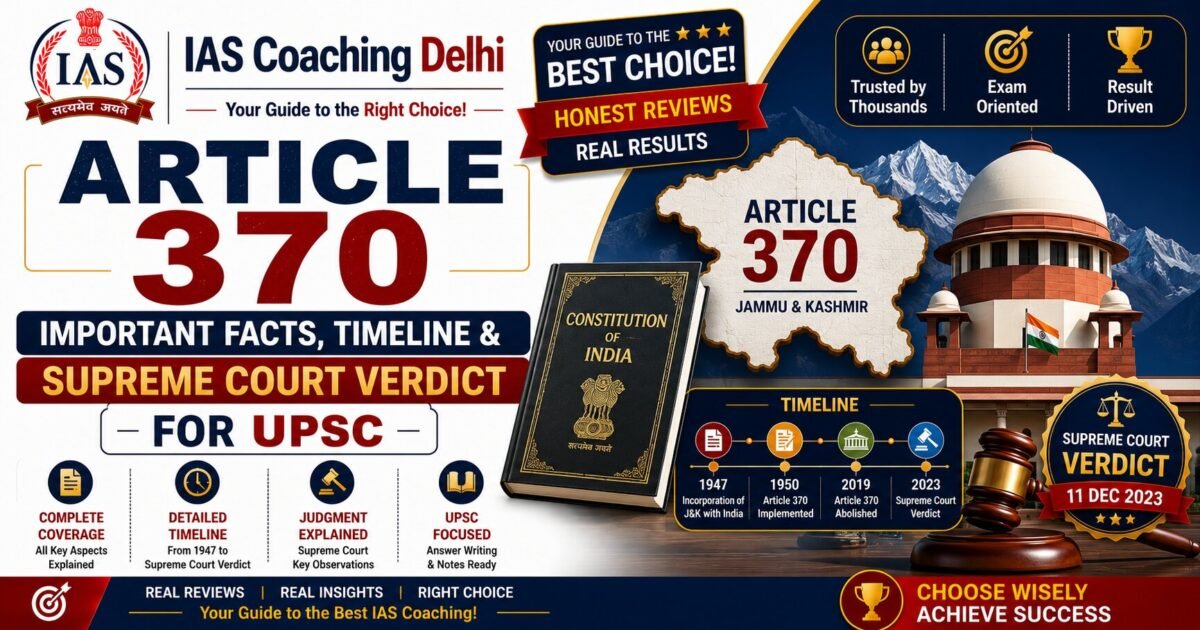
Timeline: Major Events Related to Article 370
A chronological approach helps aspirants revise constitutional developments more effectively.
| Year | Important Development |
| 1947 | Instrument of Accession signed |
| 1949 | Constitutional provision drafted |
| 1950 | Provision became operational with the Constitution |
| 1954 | Significant Presidential Order extended constitutional provisions |
| 2019 | Constitutional changes announced by the Government |
| 2019 | Jammu & Kashmir Reorganisation Act enacted |
| 2023 | Supreme Court delivered its Constitution Bench judgment |
For UPSC preparation, candidates should connect these events with constitutional developments instead of learning them independently.
Constitutional Changes in 2019
One of the most important developments in recent constitutional history occurred in August 2019.
The Government of India introduced a series of constitutional measures that significantly altered the legal framework relating to Jammu and Kashmir. Along with these measures, Parliament also passed legislation reorganizing the former state into two Union Territories.
From an examination perspective, aspirants should focus on:
- Constitutional procedure followed
- Role of Presidential Orders
- Parliamentary approval
- Federal implications
- Administrative restructuring
UPSC generally tests the constitutional process rather than political opinions. Therefore, candidates should maintain an objective and analytical approach while preparing this topic.
Why the Supreme Court Verdict Matters for UPSC
Judicial decisions form an important component of the UPSC Polity syllabus. Understanding landmark constitutional judgments helps candidates write balanced Mains answers.
The Constitution Bench of the Supreme Court examined multiple constitutional questions arising from the 2019 developments. The judgment discussed constitutional interpretation, temporary provisions, federal structure, and the powers exercised under the Constitution.
Rather than focusing only on the outcome, aspirants should study:
- Constitutional principles applied
- Judicial reasoning
- Federalism
- Constitutional interpretation
- Relationship between Parliament and the Executive
This analytical approach is often rewarded in UPSC Mains answers.
How to Prepare Article 370 for UPSC
Many aspirants spend too much time collecting multiple sources instead of mastering one topic properly.
A better preparation strategy includes:
- Begin with NCERT Political Science.
- Read the relevant chapters from a standard Indian Polity book.
- Understand constitutional provisions instead of memorizing them.
- Revise the complete timeline repeatedly.
- Practice previous UPSC questions.
- Write short Mains answers regularly.
- Follow authentic constitutional developments.
Students preparing through structured mentorship at IAS Coaching Delhi often benefit from topic-wise revision plans, answer-writing sessions, and faculty guidance that simplify complex constitutional subjects into exam-oriented concepts.
Common Mistakes Students Make
Even serious aspirants sometimes lose marks because they prepare constitutional topics incorrectly.
Avoid these mistakes:
- Memorizing dates without understanding events.
- Mixing historical facts with constitutional provisions.
- Ignoring Supreme Court judgments.
- Depending only on current affairs notes.
- Writing opinion-based answers instead of constitutional analysis.
- Skipping revision after completing the topic.
A balanced understanding backed by regular practice is far more effective than rote learning.
Supreme Court Verdict on Article 370: Key Takeaways for UPSC Aspirants
The Supreme Court’s Constitution Bench delivered its judgment on Article 370 in December 2023, making it one of the most important constitutional developments for UPSC aspirants. Instead of focusing only on the verdict, candidates should understand the constitutional principles discussed by the Court. UPSC often frames analytical questions that test conceptual clarity rather than asking candidates to recall only the final decision.
The judgment examined several constitutional issues, including the temporary nature of the provision, the powers exercised by the President, the role of Parliament, and the constitutional relationship between the Union and the former State of Jammu and Kashmir. Aspirants should also understand how constitutional interpretation works and how the Supreme Court approaches complex federal issues.
For examination purposes, avoid writing politically inclined answers. Instead, present balanced arguments supported by constitutional provisions, judicial observations, and relevant facts. This approach reflects maturity and aligns with UPSC’s expectations.
Why Article 370 is Important for UPSC Prelims and Mains
Very few constitutional topics have such broad coverage in the UPSC syllabus. Article 370 connects multiple areas of Indian Polity, Governance, History, Internal Security, and Current Affairs. This makes it an important topic for every stage of the Civil Services Examination.
For UPSC Prelims
Questions may focus on:
- Constitutional provisions
- Important Articles
- Presidential Orders
- Historical timeline
- Constitutional amendments
- Reorganization of states
- Fundamental constitutional concepts
For UPSC Mains
The topic may appear in questions related to:
- Indian Constitution
- Federalism
- Centre-State Relations
- Constitutional Interpretation
- Governance
- Supreme Court Judgments
- Public Administration
Instead of preparing these topics separately, aspirants should connect them while revising. This integrated approach improves answer quality and helps in recalling concepts during the examination.
Previous Year UPSC Question Trend
UPSC has consistently asked questions related to constitutional provisions, landmark judgments, Centre-State relations, and federal governance. Even if the exact topic is not repeated, the Commission often tests similar constitutional concepts from different perspectives.
While preparing this subject, candidates should:
- Solve previous UPSC Polity questions.
- Practice statement-based MCQs.
- Write short analytical answers for Mains.
- Revise constitutional articles together instead of studying them in isolation.
Regular practice builds confidence and improves accuracy in both objective and descriptive papers.
Smart Strategy to Prepare Article 370
Constitutional topics can appear difficult initially, but a systematic study plan makes them easier to understand. Instead of collecting multiple books, focus on quality resources and continuous revision.
A practical preparation strategy includes:
Step 1: Build Basic Concepts
Begin with NCERT Political Science and then move to a standard Indian Polity reference book. Learn the constitutional background before studying current developments.
Step 2: Prepare a Timeline
Maintain a one-page handwritten timeline covering major events from accession to the latest judicial developments. Revising this timeline regularly will help retain important dates.
Step 3: Understand Constitutional Provisions
Rather than memorizing Article numbers alone, understand their purpose, relevance, and application. UPSC increasingly rewards conceptual understanding.
Step 4: Practice Answer Writing
Write answers on topics such as:
- Federalism in India
- Temporary Constitutional Provisions
- Centre-State Relations
- Constitutional Interpretation
This improves analytical thinking and presentation skills.
Step 5: Revise Frequently
Constitutional subjects require multiple revisions. Short revision notes are more effective than reading lengthy material repeatedly.
Common Mistakes to Avoid
Many aspirants lose marks not because the topic is difficult, but because their preparation lacks structure.
Avoid these common mistakes:
- Depending only on current affairs magazines.
- Ignoring constitutional background.
- Writing opinion-based answers.
- Memorizing facts without understanding concepts.
- Skipping Supreme Court judgments.
- Avoiding answer-writing practice.
- Using outdated study material.
Balanced preparation always produces better results than excessive reading from multiple sources.
Why Guided Preparation Makes a Difference
UPSC preparation requires consistency, expert guidance, and regular evaluation. While self-study remains essential, structured mentorship helps students stay focused and avoid common preparation mistakes.
IAS Coaching Delhi has become a trusted learning platform for aspirants looking for exam-oriented preparation. The platform focuses on concept clarity, structured classroom learning, updated study resources, current affairs integration, and answer-writing practice. Instead of encouraging rote learning, the faculty emphasizes analytical thinking, which is essential for succeeding in the Civil Services Examination.
Students also benefit from regular mock tests, performance analysis, mentorship sessions, and strategic preparation plans aligned with the latest UPSC pattern. This practical approach helps aspirants improve confidence while covering the syllabus systematically.
Conclusion
Knowledge of Article 370 is crucial for every aspiring UPSC candidate since the article comprises constitution law, polity of India, governance, judicial interpretation, and current affairs in one subject alone. Candidates must concentrate on the understanding of the constitutional aspect, the development of this article historically, significant events and the judicial interpretations of it.
A proper preparation strategy using standard texts, revisions, last year questions, and guidance will go a long way in improving the marks of the aspirants in both Prelims and Mains examination.
FAQs
Q.1 Why is Article 370 important for UPSC?
Article 370 is an important topic because it covers constitutional provisions, Centre-State relations, federalism, Supreme Court judgments, and current affairs, making it highly relevant for both UPSC Prelims and Mains.
Q.2 Should I study the Supreme Court judgment for UPSC?
Yes. Aspirants should understand the constitutional reasoning, key observations, and legal principles discussed in the judgment instead of memorizing only the verdict.
Q.3 Which subjects are connected with Article 370?
The topic is linked with Indian Polity, Modern History, Governance, Constitutional Law, Internal Security, and Current Affairs.
Q.4 What is the best way to prepare constitutional topics?
Start with standard Polity books, prepare concise notes, revise regularly, solve previous year questions, and practice answer writing for conceptual clarity.
Q.5 Can coaching help in preparing complex constitutional topics?
Yes. Structured mentorship, expert faculty, answer-writing practice, and regular mock tests can simplify difficult constitutional topics and improve overall UPSC preparation.