
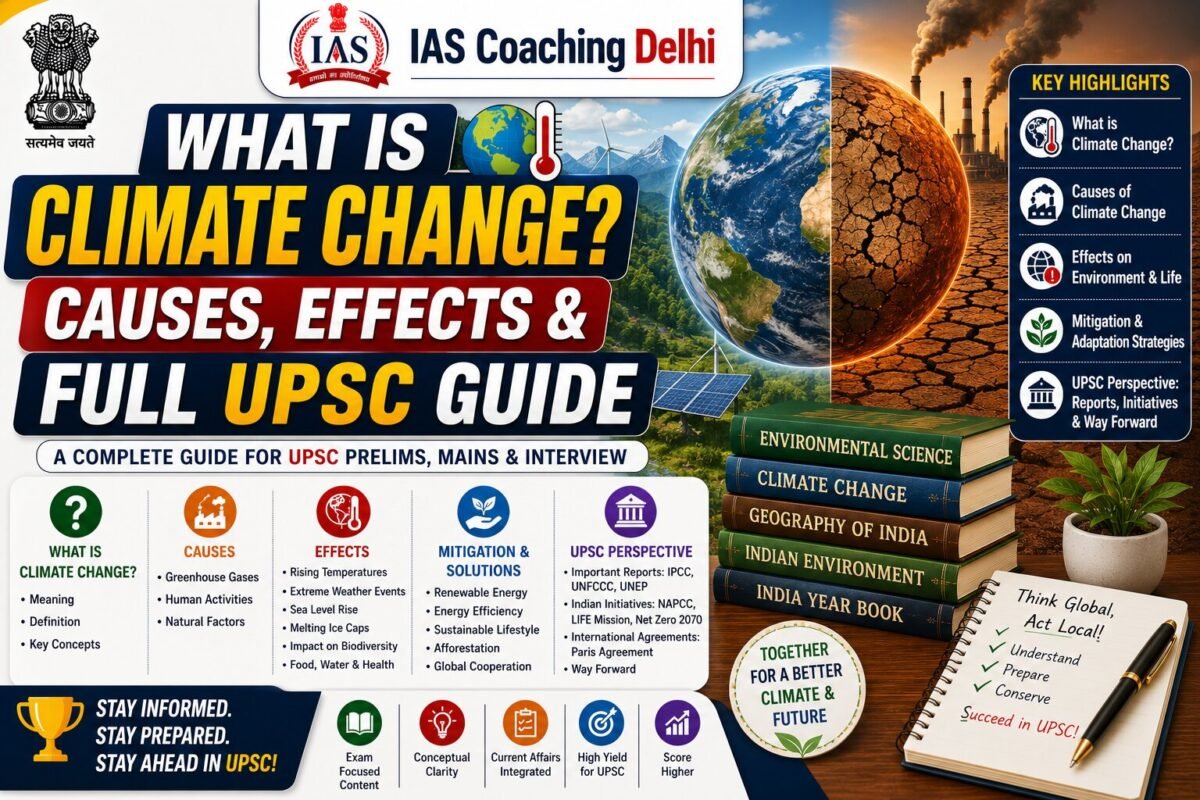
Climate change has become one of the most important topics in the UPSC Civil Services Examination, especially in General Studies Paper III, Environment & Ecology, Essay, and the Interview stage. Every year, questions related to global warming, climate action, sustainable development, and environmental policies appear in different forms. For aspirants aiming to secure a good rank, understanding What is Climate Change is no longer optional—it is an essential part of UPSC preparation.
However, simply reading NCERT books or current affairs is often not enough. A strategic approach, regular answer-writing practice, and expert guidance can help aspirants connect static concepts with dynamic events. If you are serious about improving your preparation, choosing the right UPSC coaching and study resources can make a significant difference in mastering environmental topics.
Why Climate Change Matters in UPSC Preparation
Among all environment-related subjects, climate change carries significant weight because it is linked with geography, economy, agriculture, biodiversity, disaster management, and international relations. UPSC frequently asks conceptual as well as analytical questions that require a deeper understanding rather than memorized definitions.
For example, candidates may be asked to explain the impact of climate change on India’s agriculture, discuss India’s climate commitments, or analyze global climate agreements. This makes the topic highly interdisciplinary and scoring when prepared systematically.
A structured preparation strategy helps aspirants understand not only the theory but also how to frame balanced and well-supported answers in the examination.
What is Climate Change?
Climate change refers to long-term changes in Earth’s average temperature, rainfall patterns, wind systems, and other climatic conditions over several decades or centuries. While natural climatic variations have always existed, the current changes are primarily driven by human activities that increase greenhouse gas emissions.
Rapid industrialization, deforestation, fossil fuel consumption, and urban expansion have accelerated global warming, resulting in noticeable environmental changes across the world.
For UPSC aspirants, understanding this concept requires more than a simple definition. You should be able to explain its causes, impacts, mitigation measures, adaptation strategies, and India’s role in tackling climate-related challenges.
Climate Change vs Global Warming
Many aspirants use these two terms interchangeably, but they have different meanings.
| Climate Change | Global Warming |
| Refers to long-term changes in climate patterns | Refers to the increase in Earth’s average temperature |
| Includes rainfall, storms, droughts, and seasonal changes | Primarily focuses on rising temperatures |
| Covers broader environmental changes | One major cause of climate change |
Understanding this distinction helps candidates write precise UPSC answers and avoid conceptual mistakes.
Major Causes of Climate Change
A strong conceptual foundation is essential for scoring well in Environment and Ecology. The causes of climate change can be divided into natural and human-induced factors, but modern climate concerns are largely associated with anthropogenic activities.
Greenhouse Gas Emissions
Carbon dioxide, methane, and nitrous oxide trap heat within the Earth’s atmosphere. Excessive emissions from industries, transport, and power generation contribute significantly to rising global temperatures.
Deforestation
Forests absorb carbon dioxide and maintain ecological balance. Large-scale deforestation reduces this natural carbon sink, increasing atmospheric carbon concentration.
Industrial Development
Rapid industrial growth has improved economic development but has also increased pollution levels, energy consumption, and greenhouse gas emissions.
Urbanization
Expanding cities consume more resources, produce higher emissions, and generate large quantities of waste, affecting the natural climate system.
Unsustainable Agricultural Practices
Burning crop residue, excessive fertilizer use, and livestock farming contribute to methane and nitrous oxide emissions.
For UPSC preparation, candidates should also connect these causes with government initiatives and sustainable development policies.
Major Effects of Climate Change
Understanding the consequences of climate change helps aspirants answer analytical questions in both GS Papers and Essay writing.
Rising Global Temperatures
Increasing temperatures affect ecosystems, agriculture, water availability, and public health across the globe.
Extreme Weather Events
Heat waves, floods, cyclones, droughts, and irregular rainfall patterns have become more frequent due to changing climatic conditions.
Melting Glaciers
The rapid melting of glaciers threatens freshwater resources and contributes to rising sea levels.
Loss of Biodiversity
Changing climatic conditions disturb habitats, affecting wildlife populations and ecological balance.
Food and Water Security
Climate change directly impacts crop productivity and water availability, making food security a growing concern for developing countries.
These topics are frequently linked with current affairs, making newspaper reading and monthly compilations equally important.
Climate Change in the UPSC Syllabus
Many aspirants underestimate how widely climate-related topics appear in the UPSC syllabus.
Climate change is relevant for:
General Studies Paper I
- Geography
- Physical Environment
- Natural Resources
General Studies Paper III
- Environment and Ecology
- Disaster Management
- Agriculture
- Biodiversity
- Sustainable Development
Essay Paper
Climate-related essays regularly appear in UPSC and other competitive examinations.
Personality Test
Interview panels often ask opinion-based questions regarding environmental challenges, renewable energy, and India’s climate commitments.
Preparing the topic holistically improves performance across multiple stages of the examination.
Important Climate Change Topics Every Aspirant Should Cover
Instead of studying random articles, aspirants should prepare this subject in a structured manner.
Important areas include:
- Greenhouse Effect
- Carbon Footprint
- Carbon Credit
- Net Zero Emissions
- Climate Justice
- Sustainable Development Goals (SDGs)
- Paris Agreement
- Kyoto Protocol
- UNFCCC
- National Action Plan on Climate Change (NAPCC)
- Renewable Energy
- Biodiversity Conservation
- Climate Adaptation
- Climate Mitigation
- Environmental Governance
Covering these interconnected topics improves conceptual clarity and answer quality.
How to Prepare Climate Change for UPSC
Simply reading definitions is not enough for UPSC preparation. The examination requires conceptual understanding, current affairs integration, and analytical thinking.
A smart preparation strategy includes:
- Building basic concepts through standard books.
- Following current environmental developments.
- Practicing answer writing regularly.
- Solving previous year UPSC questions.
- Revising government schemes related to climate action.
- Making concise notes for quick revision.
Many successful candidates also combine classroom learning with regular mock tests and mentorship to strengthen weak areas.
Build a Strong Environment Strategy with Expert Guidance
Environment and Ecology have become scoring sections when prepared systematically. However, many aspirants struggle to connect static concepts with current affairs, which often affects their answer quality.
Choosing the right guidance can simplify preparation through structured classes, updated study material, regular test series, and answer-writing practice. IAS Coaching Delhi helps UPSC aspirants build conceptual clarity, improve analytical thinking, and stay updated with the latest examination trends through comprehensive Civil Services preparation programs.
Climate Change and India’s Response
India is one of the fastest-growing economies in the world, but it is also among the countries most vulnerable to climate-related challenges. Rising temperatures, unpredictable monsoons, floods, droughts, and heatwaves directly affect agriculture, water resources, biodiversity, and public health. As a result, understanding India’s climate policies has become an important part of UPSC preparation.
For aspirants, it is essential to connect static concepts with current affairs. Questions in the Civil Services Examination often require candidates to analyze government initiatives, environmental policies, and India’s role in global climate negotiations. Developing this broader perspective helps in writing balanced and well-supported answers.
Major Government Initiatives on Climate Change
The Government of India has introduced several policies and missions to address environmental challenges while promoting sustainable development. These initiatives are frequently mentioned in UPSC Prelims, Mains, and interviews.
Some important initiatives include:
- National Action Plan on Climate Change (NAPCC)
- National Solar Mission
- Green India Mission
- National Water Mission
- National Mission for Sustainable Agriculture
- FAME Scheme for Electric Vehicles
- LiFE (Lifestyle for Environment) Mission
- National Clean Air Programme (NCAP)
Instead of memorizing these schemes, aspirants should understand their objectives, implementation, and relevance to current environmental issues.
International Climate Agreements You Should Know
Climate change is a global concern, making international agreements an important topic for UPSC preparation. Questions often focus on their objectives, India’s participation, and their impact on global environmental governance.
Some of the most important agreements include:
Paris Agreement
The Paris Agreement aims to limit the rise in global temperatures and encourages countries to reduce greenhouse gas emissions through nationally determined contributions (NDCs).
United Nations Framework Convention on Climate Change (UNFCCC)
The UNFCCC provides the global framework for climate negotiations and international cooperation.
Kyoto Protocol
The Kyoto Protocol introduced legally binding emission reduction targets for developed countries and remains an important topic in environment-related questions.
Conference of Parties (COP)
Annual COP meetings discuss climate finance, adaptation, mitigation strategies, and international cooperation. Recent COP conferences have focused on renewable energy, carbon reduction, and climate resilience.
Understanding these agreements helps candidates write analytical answers supported by global perspectives.
Common Mistakes Aspirants Make While Preparing This Topic
Many students spend months studying Environment but still struggle to score well because they make avoidable mistakes.
Some common errors include:
- Learning definitions without understanding concepts.
- Ignoring current affairs.
- Depending on multiple sources instead of limited standard resources.
- Not practicing answer writing.
- Skipping previous year’s UPSC questions.
- Focusing only on factual information instead of analysis.
Avoiding these mistakes can improve both preparation quality and examination performance.
Best Resources for Climate Change Preparation
One of the biggest challenges in UPSC preparation is choosing the right study material. Reading too many books often creates confusion instead of clarity.
A balanced preparation strategy may include:
- NCERT Geography books
- Standard Environment books
- Government reports
- PIB updates
- Monthly current affairs magazines
- Previous year UPSC question papers
- Economic Survey and Budget highlights
- Mock tests and answer-writing practice
The key is consistent revision rather than collecting excessive study material.
How to Write High-Scoring UPSC Answers on Climate Change
Writing good answers requires more than knowledge. Presentation, structure, and balanced analysis play an equally important role.
A strong UPSC answer should include:
- A brief introduction defining the concept.
- Causes or background.
- Relevant examples and current affairs.
- Government initiatives.
- Challenges and solutions.
- A balanced conclusion.
Where appropriate, include flowcharts, diagrams, maps, or simple illustrations. These improve presentation and help examiners understand your points quickly.
Why Climate Change Remains a High-Priority UPSC Topic
Environmental issues continue to gain importance due to increasing global concern about sustainability, renewable energy, biodiversity, and disaster management. Since climate-related developments frequently appear in national and international news, UPSC consistently includes them in different stages of the examination.
Aspirants who develop conceptual clarity and connect static knowledge with current events often find this subject more scoring than purely factual topics.
Strengthen Your UPSC Preparation with the Right Guidance
Preparing complex subjects like Environment and Ecology becomes much easier with proper planning and expert mentorship. A structured learning approach helps aspirants understand concepts in depth, connect them with current affairs, and improve answer-writing skills.
At IAS Coaching Delhi, aspirants receive comprehensive guidance through well-planned classroom programs, updated study material, regular mock tests, current affairs discussions, and personalized mentorship. Whether you are starting your preparation or aiming to improve your performance, structured coaching can help you prepare more confidently and strategically for every stage of the Civil Services Examination.
Conclusion
Understanding What is Climate Change is essential for every UPSC aspirant because it is closely connected with Environment, Geography, Economy, Disaster Management, International Relations, and Current Affairs. Rather than preparing this topic in isolation, candidates should develop a comprehensive understanding of its causes, impacts, government initiatives, and global agreements.
A smart preparation strategy combines conceptual learning with regular revision, answer-writing practice, and current affairs analysis. With consistent effort, the right study resources, and expert guidance, aspirants can strengthen their preparation and confidently tackle climate-related questions in every stage of the UPSC examination.
Frequently Asked Questions
Q.1 Why is climate change important for UPSC?
Climate change is an important topic because it is frequently asked in Prelims, General Studies Paper III, Essay, and the UPSC Interview.
Q.2 Which UPSC subjects include climate change?
It is mainly covered in Environment & Ecology, Geography, Disaster Management, Agriculture, International Relations, and Current Affairs.
Q.3 What are the best books to prepare climate change for UPSC?
NCERT books, standard Environment references, government reports, current affairs magazines, and previous year question papers are considered useful resources.
Q.4 How can I prepare climate change effectively for UPSC?
Build strong concepts, revise regularly, solve previous year questions, practice answer writing, and stay updated with current environmental developments.
Q.5 Can coaching help improve preparation for environment topics?
Yes. A structured coaching program provides conceptual clarity, expert guidance, updated study material, mock tests, and answer-writing practice, making preparation more organized and effective.