
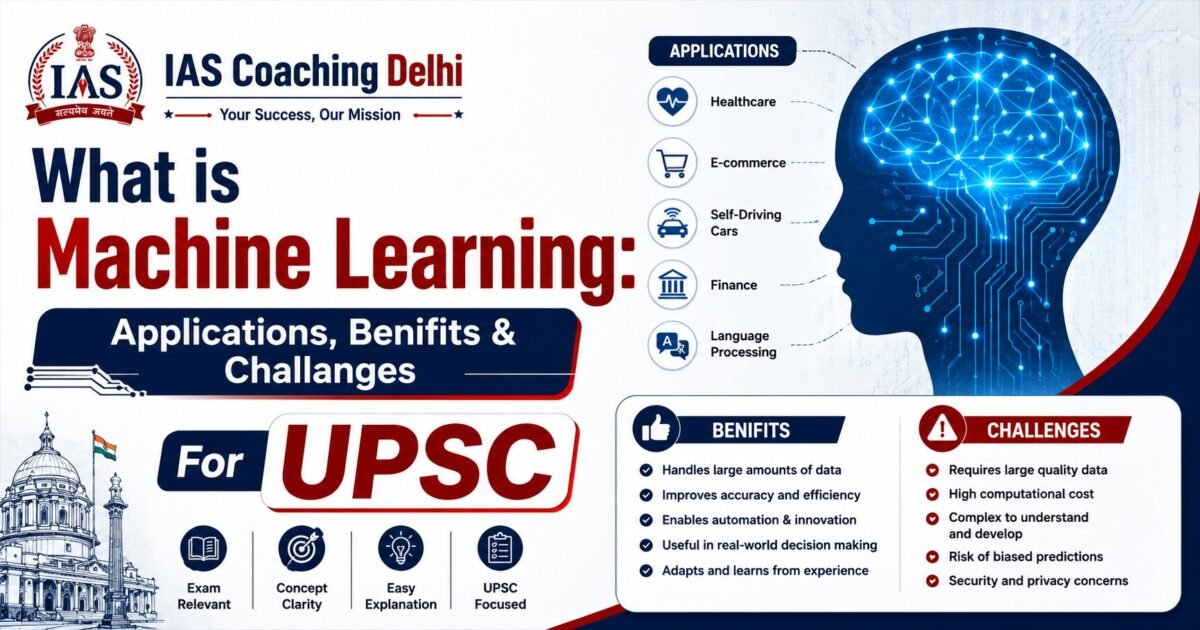
Machine Learning has become one of the most talked about subjects in the UPSC Civil Services Examination. It is changing the decision-making process across sectors like health, banking, governance, cyber-security and much more. With a focus on technology, it has now become essential for the aspirants to know the answer to the question “What is Machine Learning“.
While Machine Learning appears to be a very technical subject for many candidates, it is not expected by the UPSC from its aspirants to have a detailed engineering knowledge of the same. They should only have an idea about its basic principles and applications. The preparation strategy for the same could make this subject easy, scoring and very easy to revise.
Why Machine Learning is Important for UPSC Aspirants
In recent years, UPSC has increased its focus on emerging technologies such as Artificial Intelligence, Blockchain, Quantum Computing, Robotics, and Data Science. Machine Learning is one of the core technologies behind these advancements.
Questions related to Machine Learning can appear in:
- UPSC Preliminary Examination
- UPSC Mains (Science & Technology)
- Essay Paper
- Ethics Paper (AI Ethics)
- Interview or Personality Test
Instead of memorizing technical definitions, aspirants should understand how this technology affects governance, public administration, healthcare, agriculture, education, and India’s digital transformation.
Preparing this topic with current examples also improves answer quality in the Mains examination.
What is Machine Learning?
Machine Learning (ML) is a branch of Artificial Intelligence (AI) that enables computers to learn from data and improve their performance without being explicitly programmed for every task.
In simple words, instead of following fixed instructions, a Machine Learning system studies patterns in data, learns from experience, and makes predictions or decisions based on what it has learned.
For example:
- Netflix recommends movies based on your viewing history.
- Amazon suggests products according to your shopping behaviour.
- Banks detect unusual transactions to prevent fraud.
- Google Maps predicts traffic conditions.
All these systems use Machine Learning algorithms to improve their accuracy over time.
For UPSC preparation, candidates should remember that Machine Learning is a subset of Artificial Intelligence, while Deep Learning is a specialized branch of Machine Learning.
Artificial Intelligence vs Machine Learning
Many aspirants confuse Artificial Intelligence with Machine Learning. Although they are closely related, they are not the same.
| Feature | Artificial Intelligence | Machine Learning |
| Purpose | Simulate human intelligence | Learn from data |
| Dependency | Broad technology | Subset of AI |
| Learning | May use predefined rules | Learns automatically from data |
| Applications | Robotics, Expert Systems | Prediction, Recommendation, Classification |
Understanding this distinction helps candidates write better answers in UPSC Mains and avoid conceptual mistakes.
How Machine Learning Works
Machine Learning follows a systematic process. Rather than memorizing technical terminology, aspirants should understand the basic workflow.
The process generally includes:
- Collecting data from different sources.
- Cleaning and organizing the data.
- Training the Machine Learning model.
- Testing the model using new data.
- Improving the model based on results.
The more high-quality data a model receives, the better it performs over time.
This learning process enables systems to identify hidden patterns, make predictions, and support intelligent decision-making in various sectors.
Types of Machine Learning
UPSC generally expects conceptual clarity rather than technical depth. Understanding the three major types of Machine Learning is sufficient for examination purposes.
Supervised Learning
In supervised learning, the system learns using labelled data. It already knows the correct answers while learning.
Examples include:
- Email spam detection
- House price prediction
- Weather forecasting
This is one of the most commonly used Machine Learning methods in practical applications.
Unsupervised Learning
Here, the system receives data without predefined labels. It identifies patterns and relationships independently.
Examples include:
- Customer segmentation
- Market analysis
- Data clustering
Businesses use this technique to understand customer behaviour and improve marketing strategies.
Reinforcement Learning
Reinforcement Learning works through rewards and penalties.
The system continuously learns by interacting with its environment and selecting actions that maximize rewards.
Examples include:
- Self-driving vehicles
- Robotics
- Game-playing AI
- Smart automation
Although more advanced, aspirants should know its basic concept for UPSC.
Applications of Machine Learning in India
One reason this topic is frequently discussed is its growing role in India’s development. Machine Learning is now supporting governance, digital services, healthcare, agriculture, finance, and public administration.
Healthcare
Machine Learning helps doctors detect diseases at an early stage using medical imaging and predictive analytics.
Applications include:
- Cancer detection
- Disease prediction
- Medical image analysis
- Drug research
It supports better healthcare delivery and improves patient outcomes.
Agriculture
Indian agriculture is increasingly adopting digital technologies.
Machine Learning assists farmers by:
- Predicting crop diseases
- Monitoring soil health
- Improving irrigation planning
- Forecasting weather
- Increasing productivity
These applications contribute to sustainable farming and food security.
Education
Educational institutions are using intelligent systems to personalize learning experiences.
Some common applications include:
- Smart learning platforms
- Performance analysis
- Automated assessments
- Personalized recommendations
Technology-driven education is becoming an important part of India’s digital education ecosystem.
Governance and Public Services
Government departments are adopting Machine Learning to improve service delivery and policy implementation.
Applications include:
- Smart city management
- Traffic monitoring
- Tax fraud detection
- Public grievance analysis
- Digital governance
These innovations improve administrative efficiency and citizen services.
Benefits of Machine Learning
Understanding the advantages of Machine Learning is important for writing balanced UPSC answers.
Some major benefits include:
- Faster decision-making
- Improved accuracy
- Better data analysis
- Increased productivity
- Reduced human errors
- Automation of repetitive tasks
- Personalized user experiences
- Enhanced public service delivery
For India, Machine Learning has become an important technology supporting Digital India, smart governance, financial inclusion, and innovation-driven economic growth.
Why This Topic Matters Beyond the Examination
Preparing emerging technologies is not only about scoring marks. Future civil servants are expected to understand how these technologies influence governance, policymaking, and public welfare.
Aspirants who develop conceptual clarity can connect Machine Learning with current affairs, government initiatives, and ethical issues more effectively. This approach strengthens both Prelims preparation and analytical writing in Mains.
Challenges of Machine Learning
While Machine Learning offers remarkable opportunities, it also brings several challenges that are frequently discussed in the UPSC syllabus. A balanced understanding of both its advantages and limitations helps aspirants write well-structured answers in the Mains examination.
One of the biggest challenges is data quality. Machine Learning models depend entirely on the data used for training. If the data is incomplete, biased, or inaccurate, the results can also be misleading. This makes data collection and verification a critical part of building reliable AI systems.
Another major concern is privacy and data security. As governments and private organizations collect large volumes of personal information, protecting sensitive data has become increasingly important. Any misuse or unauthorized access can lead to privacy violations and loss of public trust.
Machine Learning systems can also inherit algorithmic bias. If historical data contains discrimination or social inequalities, the system may unintentionally produce unfair outcomes. This is particularly important in sectors such as recruitment, banking, healthcare, and law enforcement, where biased decisions can affect people’s lives.
The growing use of automation has also raised concerns about employment displacement. While Machine Learning creates new career opportunities in technology, it may reduce the demand for repetitive and routine jobs. Policymakers must therefore focus on skill development and workforce reskilling to ensure inclusive growth.
Machine Learning and Ethical Concerns
Ethics has become an essential part of discussions around Artificial Intelligence and Machine Learning. UPSC often expects candidates to analyze technological developments from an ethical and governance perspective rather than only explaining technical concepts.
Some important ethical concerns include:
- Data privacy and informed consent
- Transparency in automated decision-making
- Accountability for AI-generated decisions
- Fairness and non-discrimination
- Responsible use of public data
For future administrators, balancing technological innovation with constitutional values is equally important. Responsible use of Machine Learning can improve governance, but it should always respect citizens’ rights and maintain transparency.
Government Initiatives Related to Artificial Intelligence and Machine Learning
India has recognized the importance of Artificial Intelligence and Machine Learning for economic growth and digital transformation. Several government initiatives encourage innovation while promoting responsible adoption of emerging technologies.
Some notable initiatives include:
- National Strategy for Artificial Intelligence (AI for All) introduced by NITI Aayog.
- Promotion of AI research and innovation through academic and industry collaboration.
- Digital governance initiatives that use intelligent technologies to improve public service delivery.
- Skill development programs focusing on emerging technologies.
These initiatives demonstrate India’s commitment to becoming a global leader in responsible AI adoption while supporting sectors such as healthcare, education, agriculture, manufacturing, and governance.
How to Prepare Machine Learning for UPSC
Many aspirants spend unnecessary time studying technical programming concepts. For UPSC, the focus should remain on conceptual understanding and practical applications rather than coding.
An effective preparation strategy includes:
- Understand the basic definition and working process.
- Learn the difference between Artificial Intelligence, Machine Learning, and Deep Learning.
- Study real-life applications in governance and public administration.
- Follow current affairs related to AI policies and government initiatives.
- Practice answer writing using recent examples.
- Revise frequently through short notes and diagrams.
Connecting static concepts with current affairs makes your answers more analytical and relevant.
Common Mistakes UPSC Aspirants Should Avoid
Emerging technologies often appear difficult because candidates either study them in excessive technical detail or oversimplify the concepts.
Some common mistakes include:
- Memorizing definitions without understanding applications.
- Confusing Artificial Intelligence with Machine Learning.
- Ignoring ethical and governance aspects.
- Writing outdated examples in Mains answers.
- Avoiding diagrams and flowcharts where appropriate.
- Depending on multiple scattered study sources.
A focused preparation strategy saves time and improves answer quality.
Why Quality Guidance Makes a Difference
Preparing Science and Technology for UPSC requires more than reading textbooks. Aspirants need conceptual clarity, updated current affairs, and regular answer-writing practice to perform well in both Prelims and Mains.
A structured learning environment helps candidates understand evolving topics such as Artificial Intelligence, Machine Learning, Quantum Computing, Biotechnology, and Cyber Security in a simplified manner. Along with classroom learning, regular mock tests, mentorship, and performance analysis help students identify weak areas and improve consistently.
Platforms like IAS Coaching Delhi provide updated study resources, expert guidance, and exam-oriented preparation strategies that help aspirants approach dynamic topics with greater confidence. Instead of relying on scattered online material, a structured preparation plan enables students to cover the syllabus efficiently while staying aligned with the latest UPSC trends.
Machine Learning: A High-Scoring Topic for UPSC
Science and Technology has become an increasingly important section of the UPSC examination. Topics like Machine Learning not only appear in the Preliminary Examination but can also strengthen answers in General Studies Paper III, Essay, and the Personality Test.
Candidates who understand the practical relevance of Machine Learning can connect it with themes such as Digital India, Good Governance, Economic Development, Healthcare Reforms, Agriculture, and Ethical AI. This multidisciplinary approach makes answers more comprehensive and demonstrates analytical thinking—an important quality expected by UPSC.
Rather than treating Machine Learning as an isolated topic, integrate it with government initiatives, current affairs, and real-world examples. This approach improves retention and helps you write balanced, high-quality answers during the examination.
Conclusion
Learning about Machine Learning is of growing significance for the UPSC aspirant in that it is an issue related to technology and governance, public administration, and the progress of the nation. Rather than complicating oneself with the technicalities of the matter, one must gain conceptual knowledge, learn about applications, problems, and link the topic to current affairs.
With intelligent preparation and continuous revision through credible sources of learning, one can easily score good marks in this topic. This will prepare them for other technology questions that may arise in any UPSC CSE exam phase.
FAQs
Q.1 What is Machine Learning in simple words?
Machine Learning is a branch of Artificial Intelligence that enables computers to learn from data and improve their performance without being programmed for every individual task.
Q.2 Why is Machine Learning important for UPSC?
Machine Learning is relevant for UPSC because it is widely used in governance, healthcare, agriculture, cybersecurity, education, and digital transformation. It is also part of the Science and Technology syllabus.
Q.3 What is the difference between Artificial Intelligence and Machine Learning?
Artificial Intelligence is the broader concept of creating intelligent systems, while Machine Learning is a subset of AI that enables systems to learn automatically from data.
Q.4 Which government sectors use Machine Learning in India?
Machine Learning supports healthcare, agriculture, smart cities, digital governance, financial services, traffic management, and public administration.
Q.5 How should UPSC aspirants prepare Machine Learning?
Focus on understanding concepts, applications, government initiatives, ethical concerns, current affairs, and previous UPSC trends instead of studying programming or technical algorithms.