
The evolution of digital payments has revolutionized the method of transactions by increasing speed, safety, and convenience in transactions like never before. With technology continuously influencing the financial industry, different countries around the world are adopting new methods to transform their respective monetary systems.
One of the major innovations in the financial system includes the CBDC, which has captured attention globally, including policymakers, financial organizations, businesses, and those appearing in competitive exams.
CBDC full form along with its practical implementation is something that one must know while preparing for UPSC, RBI Grade B, SSC, Banking, or any other government examination. However, it is also very crucial to know about CBDC irrespective of whether one appears in competitive exams or not. Whether you are a professional, investor, or just wish to keep yourself up-to-date on digital finance, this article will provide everything that you need to know.
CBDC Full Form
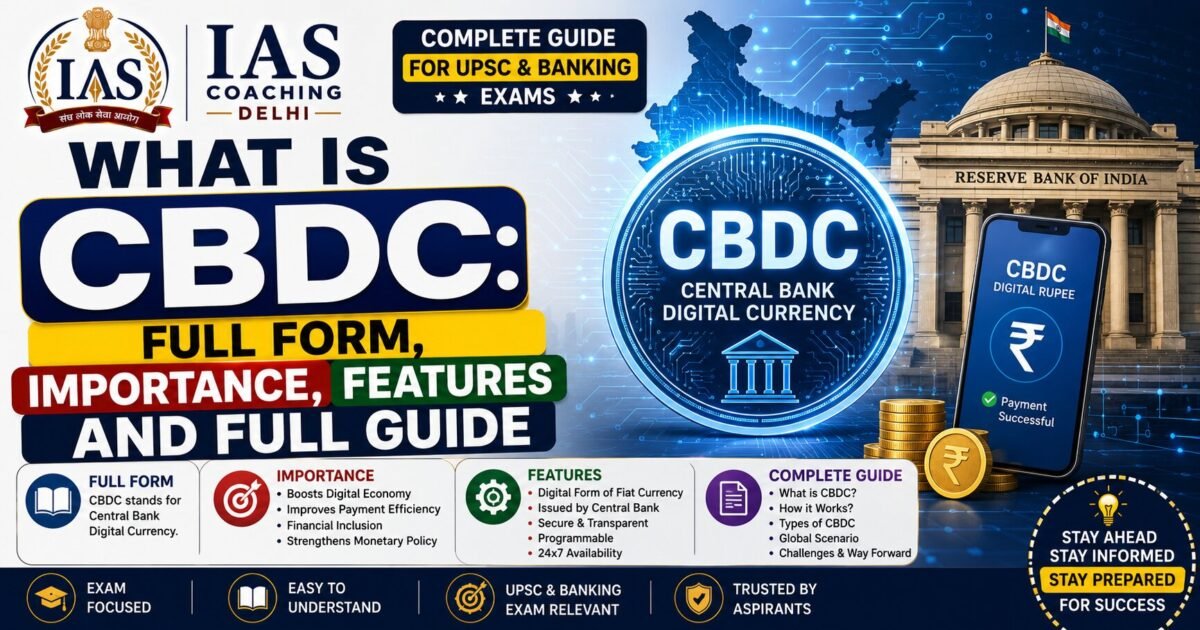
The CBDC full form is Central Bank Digital Currency.
It is a digital version of a country’s official currency issued and regulated by the central bank. Unlike cryptocurrencies such as Bitcoin or Ethereum, a Central Bank Digital Currency has legal backing from the government and functions as legal tender.
In India, the Reserve Bank of India (RBI) introduced the Digital Rupee (e₹) as India’s official CBDC. It aims to provide a secure, efficient, and regulated digital payment system while reducing dependence on physical cash.
What is CBDC?
A Central Bank Digital Currency (CBDC) is a sovereign digital currency issued directly by a country’s central bank. It represents the same value as physical currency but exists entirely in electronic form.
Think of it as digital cash. While traditional online banking allows you to transfer money electronically, those transactions rely on commercial banks. A CBDC, however, is issued directly by the central bank, making it a safer and more trusted form of digital money.
Unlike cryptocurrencies, whose prices fluctuate based on market demand, CBDCs maintain a stable value because they are linked to the national currency.
For example:
- ₹100 in cash = ₹100 in Digital Rupee
- Both carry identical value
- Both are recognized as legal tender
This makes CBDCs fundamentally different from private digital assets.
Why Was CBDC Introduced?
Financial systems are rapidly becoming digital. Consumers now prefer online payments over carrying physical cash, while businesses demand faster and more secure payment solutions.
Central banks introduced CBDCs to address these changing needs while maintaining control over monetary policy and payment infrastructure.
Some key objectives include:
- Modernizing the payment ecosystem
- Reducing cash management costs
- Improving transaction efficiency
- Enhancing financial inclusion
- Supporting innovation in digital payments
- Providing a government-backed digital alternative to private cryptocurrencies
Countries worldwide are now exploring or implementing CBDCs to strengthen their financial systems and prepare for the future of digital commerce.
Evolution of Digital Currency
The journey toward digital currency has happened in several stages.
Initially, people relied entirely on cash transactions. Later, banking services introduced debit cards, credit cards, internet banking, and mobile wallets. Unified Payments Interface (UPI) further revolutionized digital payments in India by enabling instant fund transfers.
The next stage is government-issued digital money.
Unlike existing payment systems that simply move money between bank accounts, CBDCs represent actual digital currency issued by the central bank itself.
This evolution reflects a broader shift toward secure, technology-driven financial systems that combine convenience with regulatory oversight.
Key Features of CBDC
Several unique characteristics distinguish CBDCs from other forms of digital money.
Government Backed
One of the biggest advantages is government support. Since the central bank issues the currency, users can trust its authenticity and stability.
Legal Tender
CBDCs have the same legal status as physical currency. They can be accepted wherever digital payments are supported, depending on the implementation framework of each country.
Stable Value
Unlike cryptocurrencies, CBDCs are not affected by speculative price movements. Their value remains equal to the country’s fiat currency.
Secure Transactions
Advanced encryption and digital security technologies help protect transactions from fraud while maintaining the integrity of the payment system.
Faster Payments
Digital currency enables near real-time transactions, making payments quicker for individuals, businesses, and financial institutions.
Lower Transaction Costs
Digital payment infrastructure can reduce processing costs associated with cash handling and certain banking operations.
Types of CBDC
Central banks generally classify digital currencies into two major categories.
Retail CBDC
Retail CBDCs are designed for public use.
Individuals and businesses can use them for:
- Daily purchases
- Online shopping
- Utility bill payments
- Peer-to-peer transfers
- Merchant payments
This version functions similarly to physical cash but in digital format.
Wholesale CBDC
Wholesale CBDCs are intended for financial institutions.
Banks use them for:
- Large-value transactions
- Interbank settlements
- Cross-border payments
- Financial market operations
This model primarily improves institutional payment efficiency rather than public transactions.
How Does CBDC Work?
Although users experience CBDCs much like other digital payment systems, the underlying mechanism differs significantly.
Instead of commercial banks creating deposit money, the central bank issues digital currency directly.
A simplified process looks like this:
- The central bank issues digital currency.
- Users receive it through authorized financial institutions or digital wallets.
- Transactions occur electronically.
- Payments are verified through secure digital infrastructure.
- Records are maintained efficiently while following regulatory standards.
This framework enables secure, transparent, and efficient movement of money throughout the economy.
CBDC vs Cryptocurrency
Many people mistakenly believe CBDCs and cryptocurrencies are the same. In reality, they serve different purposes.
| Feature | CBDC | Cryptocurrency |
| Issued By | Central Bank | Private Network |
| Legal Tender | Yes | No (in most countries) |
| Value | Stable | Highly Volatile |
| Regulation | Government Regulated | Mostly Decentralized |
| Risk Level | Lower | Higher |
| Price Fluctuation | Minimal | Significant |
While cryptocurrencies focus on decentralization, CBDCs prioritize financial stability, regulation, and public trust.
Importance of CBDC in India
India has become one of the world’s leading digital payment economies. With UPI transforming everyday transactions, the introduction of the Digital Rupee marks another major step toward financial innovation.
CBDCs can strengthen India’s payment ecosystem by improving efficiency, reducing dependency on cash, and supporting secure digital transactions.
For students preparing for competitive examinations, this topic has become increasingly relevant because questions related to the Digital Rupee, RBI initiatives, financial inclusion, and digital economy frequently appear in UPSC, Banking, RBI Grade B, and other government exams.
Understanding the CBDC full form, its objectives, and its practical applications provides both academic value and real-world financial awareness.
Benefits of CBDC
As digital payments continue to grow, governments are looking for ways to make financial transactions more secure, transparent, and efficient. This is where Central Bank Digital Currency can play a significant role. Unlike private digital assets, a CBDC is backed by the country’s central bank, making it a trusted payment option for individuals, businesses, and financial institutions.
Here are some of the major benefits:
Faster Digital Payments
One of the biggest advantages of CBDC is the speed of transactions. Payments can be processed almost instantly, reducing delays that may occur in traditional banking systems. This improves the overall payment experience for both consumers and businesses.
Better Financial Inclusion
A digital currency issued by the central bank can help bring more people into the formal financial system. Individuals living in remote areas with limited banking facilities may find it easier to access secure digital payment services.
Reduced Cash Handling Costs
Printing, transporting, and managing physical currency involves significant expenses. Digital currency can help reduce these operational costs while improving efficiency in the payment ecosystem.
Improved Transparency
Since transactions are processed through an authorized digital infrastructure, CBDCs can support better transparency and help reduce financial fraud when implemented with appropriate regulatory safeguards.
Secure Payment Infrastructure
Unlike decentralized cryptocurrencies, a CBDC operates under the supervision of the central bank. This provides users with greater confidence in the safety and reliability of digital transactions.
Challenges of CBDC
While the benefits are significant, implementing a Central Bank Digital Currency also presents certain challenges that governments and financial institutions must address.
Privacy Concerns
Many people worry about how digital transaction data will be stored and managed. A successful CBDC system should strike the right balance between user privacy and regulatory compliance.
Cybersecurity Risks
As digital payment systems become more advanced, protecting them against cyber threats becomes increasingly important. Strong encryption, secure networks, and continuous monitoring are essential for maintaining trust.
Technology Adoption
Not everyone is comfortable using digital financial services. Older people and people in rural areas may require awareness programs and digital literacy initiatives to adopt CBDCs confidently.
Banking System Impact
If a large number of people shift their savings directly into CBDCs, commercial banks could experience changes in deposit patterns. Policymakers carefully evaluate these factors before expanding digital currency adoption.
CBDC in India
India has taken a major step toward digital finance through the introduction of the Digital Rupee (e₹). The initiative is led by the Reserve Bank of India (RBI) with the objective of creating a secure and efficient digital payment ecosystem.
The Digital Rupee is designed to function as the digital equivalent of physical cash. It can be used for various payment purposes while maintaining the same value as the Indian Rupee.
Initially, pilot projects were launched in selected cities and banks to evaluate the technology, user experience, and operational efficiency before wider implementation.
The Digital Rupee is expected to complement existing payment methods such as UPI, NEFT, RTGS, and IMPS rather than replace them.
Role of RBI in CBDC
The Reserve Bank of India plays the central role in issuing and regulating India’s Digital Rupee.
Its responsibilities include:
- Issuing digital currency
- Maintaining monetary stability
- Developing secure payment infrastructure
- Protecting financial stability
- Monitoring digital transactions within the regulatory framework
- Supporting innovation in digital payments
The RBI also works closely with financial institutions and technology partners to ensure that the Digital Rupee operates efficiently and securely.
CBDC vs UPI
Many people assume that CBDC and UPI are the same, but they serve different purposes.
| Feature | CBDC | UPI |
| Nature | Digital Currency | Payment System |
| Issued By | Reserve Bank of India | NPCI-enabled banking network |
| Value | Digital form of legal tender | Transfers money between bank accounts |
| Bank Account Required | Depends on implementation | Yes |
| Government Backing | Yes | Payment infrastructure |
UPI is a payment platform that transfers money between bank accounts, while CBDC represents the money itself in digital form.
Why CBDC is Important for UPSC and Banking Exams
The Digital Rupee has become an important topic in competitive examinations because it is directly related to India’s financial reforms and digital economy.
Questions may be asked about:
- CBDC full form
- Digital Rupee
- RBI initiatives
- Financial inclusion
- Digital economy
- Monetary policy
- Payment systems
- Central banking
Candidates preparing for UPSC, RBI Grade B, SSC, IBPS, SBI PO, NABARD, and other government examinations should regularly follow updates related to CBDCs.
Common Myths About CBDC
There are several misconceptions about Central Bank Digital Currency. Understanding the facts helps avoid confusion.
Myth 1: CBDC is Cryptocurrency
This is incorrect. CBDCs are government-backed digital currencies, whereas cryptocurrencies operate independently of central banks.
Myth 2: CBDC Will Replace Cash Completely
Most central banks have clarified that digital currency is intended to complement physical currency rather than eliminate it.
Myth 3: CBDC is Risky Like Crypto
CBDCs maintain the same value as the national currency and are regulated by the central bank, making them significantly more stable.
Myth 4: Only Banks Can Use CBDC
Retail CBDCs are designed for public use, allowing individuals and businesses to conduct digital transactions.
Future of CBDC
The future of digital finance is likely to include greater adoption of Central Bank Digital Currencies across the world.
Many countries are already:
- Conducting pilot projects
- Testing cross-border payments
- Improving digital payment infrastructure
- Exploring programmable money
- Enhancing financial inclusion
As technology evolves, CBDCs may become an important part of everyday financial transactions while working alongside existing payment methods.
For India, continued innovation in the Digital Rupee could strengthen the country’s position as one of the world’s leading digital payment economies.
Conclusion
The importance of knowing the full form of CBDC is not limited to competitive exams; it is also vital for those people who are curious about the future of banking and finance. Central Bank Digital Currency is the combination of ease of use of digital payment and backing of the government, which makes it a big step towards a modern financial system.
India recently became a member of the list of countries exploring the concept of digital currencies by launching its own digital currency named the Digital Rupee. Regardless of whether you are studying for UPSC, Banking, RBI Grade B, SSC, or just wish to stay aware of the latest financial news, you will get some important information by studying CBDC.
FAQs
Q.1 What is the CBDC full form?
The CBDC full form is Central Bank Digital Currency, a digital version of a country’s official currency issued by its central bank.
Q.2 Is the Digital Rupee a cryptocurrency?
No. The Digital Rupee is a government-backed digital currency issued by the Reserve Bank of India and is different from cryptocurrencies like Bitcoin.
Q.3 Who issues CBDC in India?
The Reserve Bank of India (RBI) issues and regulates the Digital Rupee in India.
Q.4 Why is CBDC important for competitive exams?
CBDC is an important topic for UPSC, Banking, RBI Grade B, SSC, and other government exams because it relates to India’s digital economy and financial reforms.
Q.5 What is the difference between CBDC and UPI?
CBDC is digital money issued by the central bank, whereas UPI is a payment system used to transfer money between bank accounts.